 Maradok

Kereskedési feltételek
Products
Eszkozok


The Federal Reserve currently possesses the world's most valuable resource—time. This was stated by one of the Fed governors, Beth Hammack. According to her, the US economy is in good shape, and the Fed is well positioned to wait for further developments. Hammack believes that it takes time to understand whether the labor market is recovering and to what extent, thanks to the three rounds of monetary policy easing last year. If the recovery proves successful, the Fed's attention will shift entirely to inflation.
A similar viewpoint was expressed by another Fed governor, Lori Logan. She stated that US inflation remains at an unacceptable level and requires further action. According to her, the US labor market has begun to recover, as confirmed by the Non-Farm Payrolls and unemployment reports. Therefore, we can conclude that the Fed's focus is now fully on inflation.
Naturally, Stephen Miran does not agree with this position (who would you expect?). Just last week, he stated that interest rates need to be lowered as soon as possible, as a "restrictive" monetary policy is no longer necessary for the American economy. He noted that inflationary pressure is easing, and the Fed might miss the "right moment" to lower rates. Remember, inflation typically lags the Fed's rate decisions by a few months. Therefore, if they wait too long, they might see the Consumer Price Index fall below the target level.
A drop in inflation below 2% is not only meaningless from the Fed's perspective but also dangerous. Why keep the interest rate high if that decision leads to unnecessary consequences? At the same time, Fed officials want to ensure that the slowdown in inflation (which, by the way, has not yet been confirmed, only expected) will be sustainable and stable. Recall that the January report will be released on Friday, and it may indicate a slowdown to 2.4%-2.5%. Should such a slowdown in inflation be interpreted as a step towards 2%? In my opinion, no.
Looking at the inflation chart over the past year and a half, one can see that since June 2024, inflation has consistently been between 2.3% and 3.0%. Therefore, a potential drop in inflation to 2.5% does not guarantee that 2% will be reached soon and, most importantly, will stay around that level. Understanding this fact may continue to hold the FOMC committee back from another round of easing.
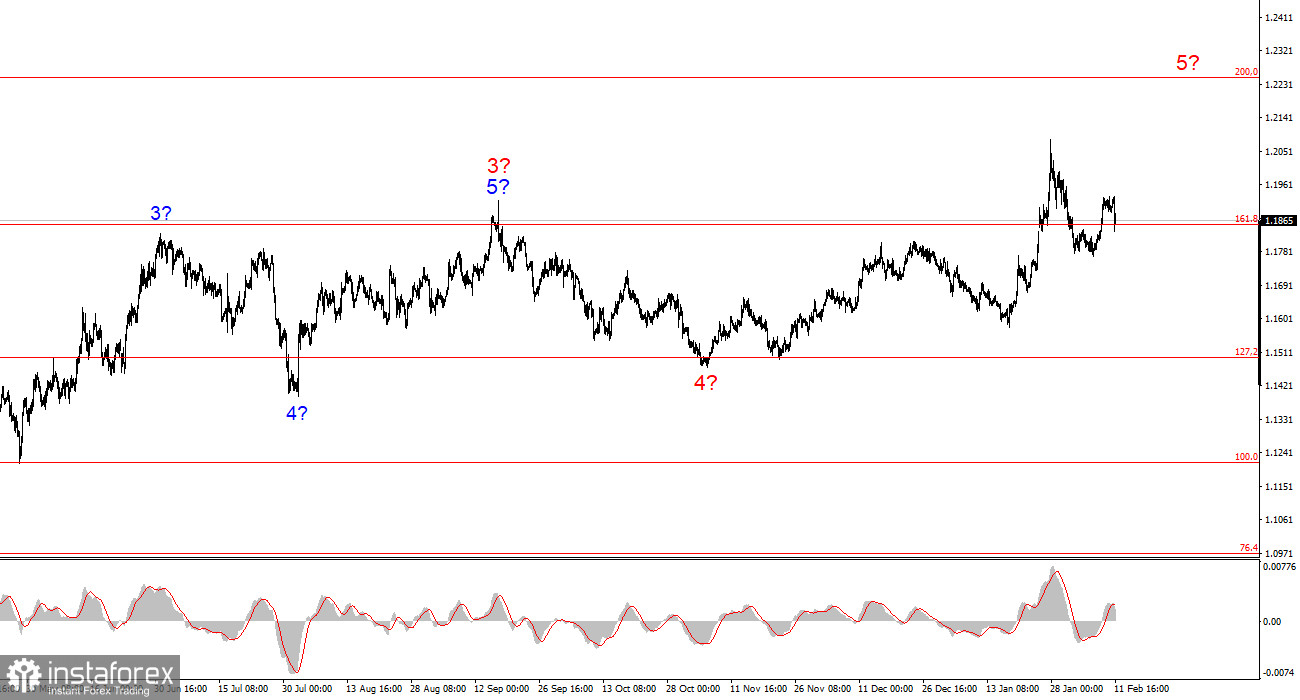
Based on the analysis of EUR/USD, the instrument continues to build an upward trend segment. The policies of Donald Trump and the monetary policy of the Fed remain significant factors in the long-term decline of the American currency. The targets for the current trend segment could reach up to the 25-figure mark. At present, I believe that the instrument remains within the framework of global wave 5, so I expect price increases in the first half of 2026. However, in the near term, I anticipate a downward wave (or series of waves), as the structure a-b-c-d-e also appears complete. In the near future, my readers can look for areas and levels for new longs with targets located around 1.2195 and 1.2367, corresponding to 161.8% and 200.0% Fibonacci.
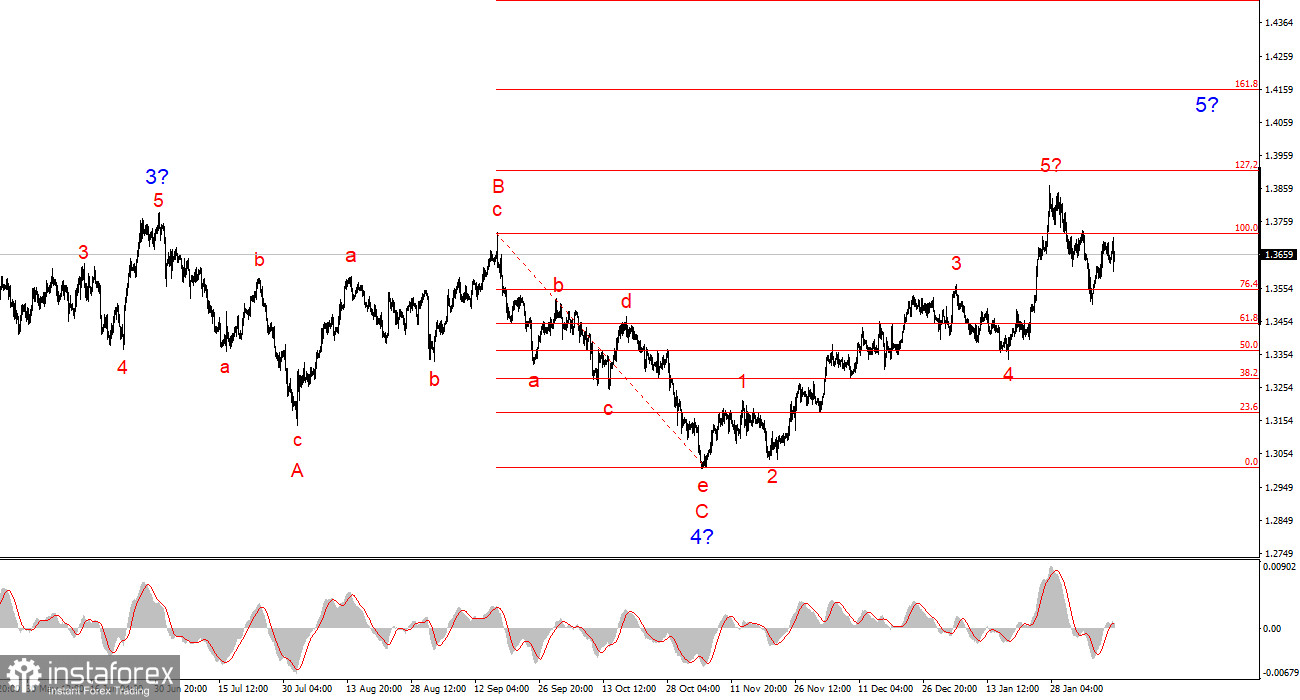
The wave pattern for the GBP/USD instrument appears quite clear. The five-wave upward structure has completed its formation, but the global wave 5 may take on a much more extended appearance. I believe that in the near future, we may observe the construction of a corrective wave set, after which the upward trend will resume. Consequently, in the coming weeks, I recommend looking for opportunities for new longs. In my opinion, under Donald Trump, the British pound has every chance of reaching 1.45-1.50$. Trump himself welcomes the decline of the dollar. All his actions have a dual effect: the decline of the dollar and the resolution of internal, external, trade, and geopolitical issues.
InstaForex analytical reviews will make you fully aware of market trends! Being an InstaForex client, you are provided with a large number of free services for efficient trading.


