 Maradok

Kereskedési feltételek
Products
Eszkozok


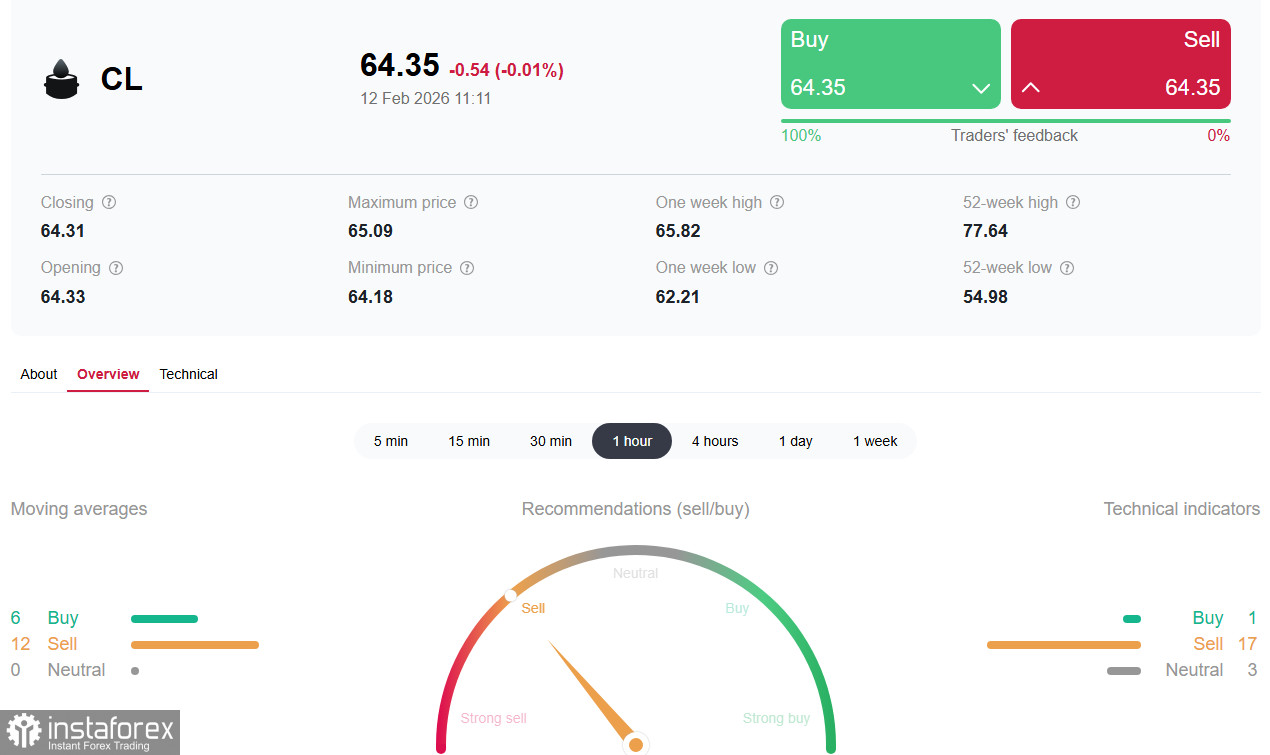
The oil market has entered a phase of confrontation between two opposing forces. On the one hand, prices are pressured by the strongest rise in US inventories in months. On the other hand, escalating tensions between the US and Iran have prevented a crash by providing a geopolitical cushion. As a result, WTI is trading around $64.00–66.00 while investors debate which factor will win out.
WTI was trading near $64.40 in the European morning session on Thursday, pulling back from Wednesday's intraday February high around $64.14. The market now faces a tug?of?war: a massive inventory build in the US versus a geopolitical risk premium that supports prices.
Supply pressure
US Energy Information Administration data are hard to ignore: for the week ended February 6, commercial crude inventories jumped by 8.53 million barrels to 428.8 million barrels. That was not merely a rise but a shock to market expectations, which had forecast a 0.2 million?barrel decline. API earlier reported an even more staggering figure (+13.4 million barrels after a ?11.1 million print the prior week), feeding a convincing bearish signal.
The Iran factor as the lone restraint
If not geopolitical risks, WTI would already be testing levels well below $60.00. Instead, events are unfolding like a high?grade form of blackmail. After meeting with Israeli Prime Minister Netanyahu, President Trump said no "firm decisions" had been taken, but discussions would continue. At the same time, the White House is considering sending a second aircraft carrier to the Middle East — a classic pre?war signal.
OPEC+ keeps a wait?and?see stance
OPEC's February report took a cautious stance. Demand?growth forecasts were kept at 1.38 mb/d for 2026 and 1.34 mb/d for 2027. But those figures mask a worrying signal: OPEC+ now expects global oil demand to fall by 400 kb/d in Q2 relative to Q1 — enough to create a modest but meaningful supply surplus.
Key decisions are postponed until the March 1 online meeting of the monitoring committee, when the group will decide whether to extend production constraints.
The US labor market supports demand
Interestingly, the US labor market is showing unexpected resilience: January Nonfarm Payrolls came in at +130k (after +48k previously), well above the +70k consensus, and unemployment fell to 4.3% (from 4.4%). That is an indirect supporting factor for oil demand and prices and limits the downside even amid rising inventories.
Near?term releases
Market participants will also watch Baker Hughes' weekly rig count report tomorrow at 18:00 GMT. The previous Baker Hughes release showed active rigs rising to 412 (versus 411, 410, 409, etc.). A growing US drilling fleet is bearish for oil prices, but its effect tends to be short-lived. A larger near-term driver will likely be the US CPI print at 13:30 GMT, which can move both the dollar and commodity markets, including oil.
Technical picture
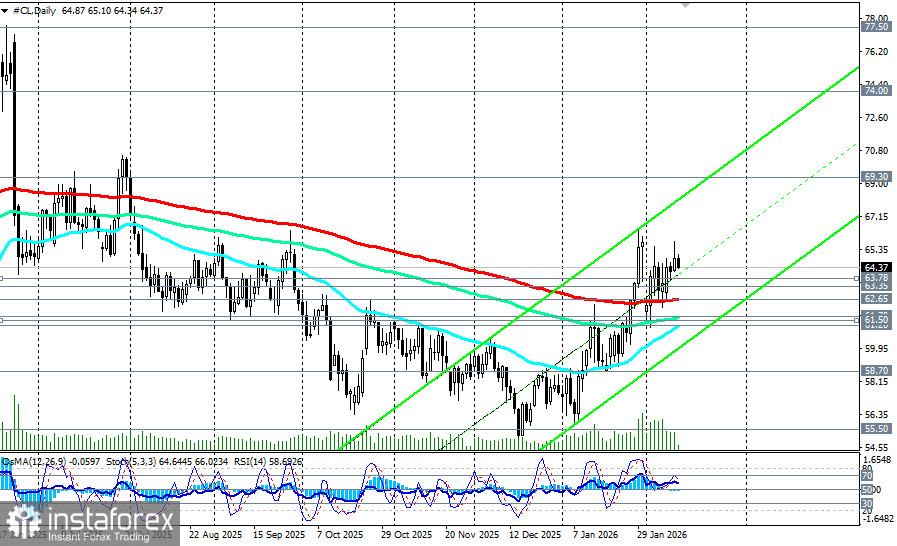
Technically, WTI futures (CL on trading platforms) remain inside an upward channel formed on the daily chart since the start of the year, and the medium?term trend remains moderately bullish.
Only the two fundamental forces mentioned create a dilemma: a sustained breakout above $65.00–66.00 would likely require further escalation in the Iran situation and a sharp drawdown in US crude inventories. Any de?escalation combined with persistently high or rising inventories would trigger immediate profit?taking and a pullback toward $60.00 (the monthly 200-EMA area)–$61.00 (daily 50-EMA area).
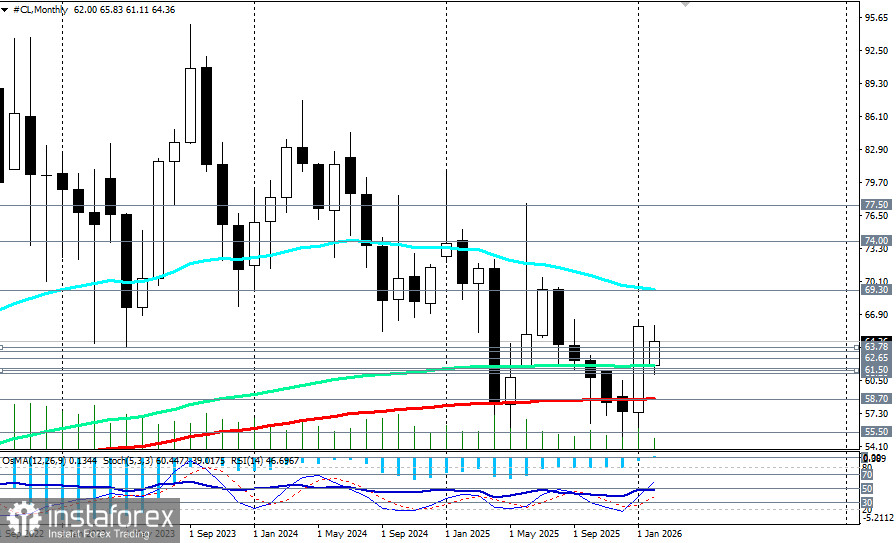
Most likely scenario for February–March — status quo: WTI holds between $62.00 and $66.00.
The geopolitical premium will offset inventory growth, while OPEC+ retains flexibility while the Iran issue is clarified.
Conclusion
WTI is "between a hammer and an anvil." Fundamentals (inventories, OPEC+ forecasts) point to surplus and downward pressure; geopolitics (Iran, carrier deployments, Trump ultimatums) creates an artificial deficit of fear that pushes prices up.
Key takeaway: the market is trading the probability of war rather than the physical oil market right now. While the Iran factor remains on the table, a drop below $60.00 is unlikely even with large inventory builds. Any lull in rhetoric from Washington or Tehran will immediately expose weak real demand and the surplus.
Investors should prepare for a period of heightened volatility in which decisions are driven as much by White House situation rooms as by OPEC meetings. The next catalysts are news on the talks and any announcement of further consultations. Until then, WTI will "work" the psychological levels 64.00, 65.00 and 66.00, reacting to every Trump tweet and every carrier movement in the Gulf.
InstaForex analytical reviews will make you fully aware of market trends! Being an InstaForex client, you are provided with a large number of free services for efficient trading.


