 Maradok
Kereskedési feltételek
Products
Eszkozok



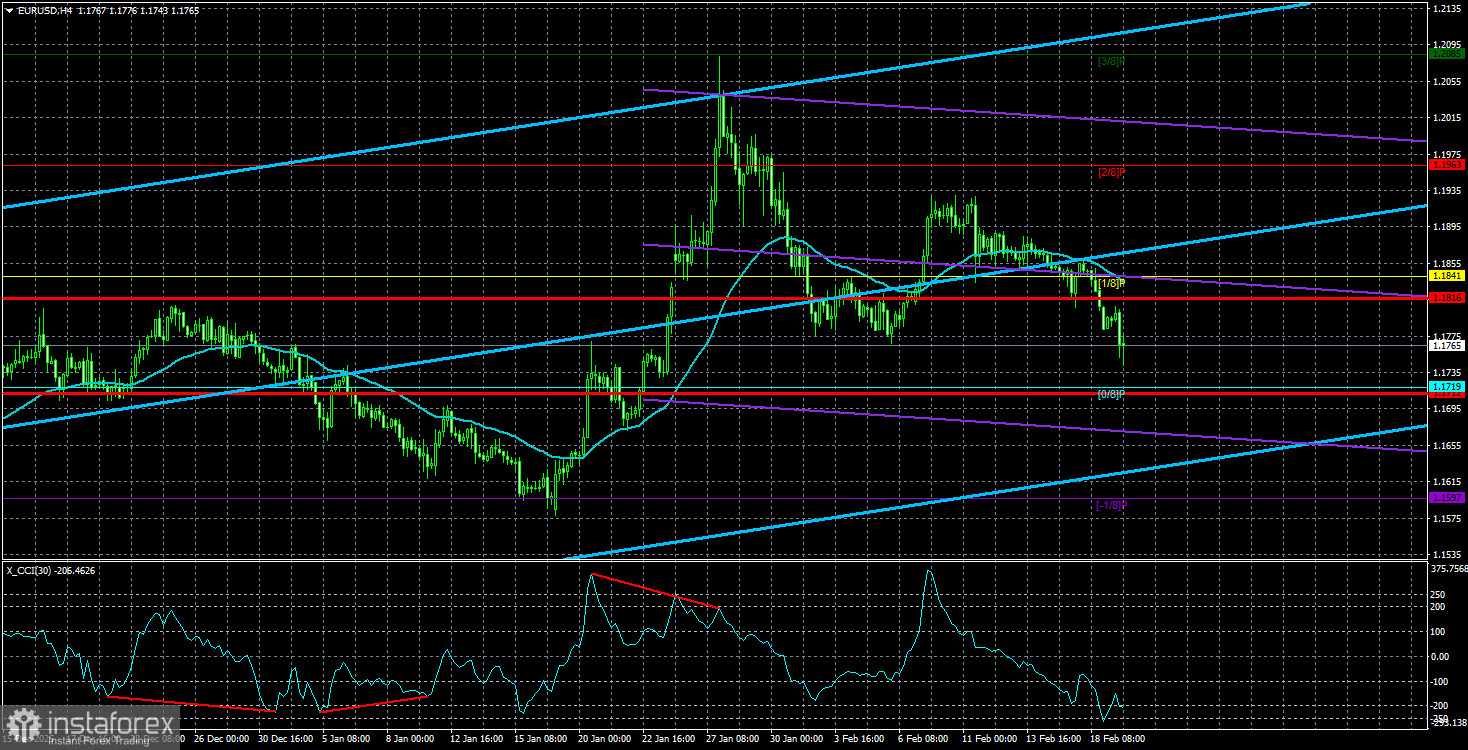
The EUR/USD currency pair continued its decline on Thursday. It's worth noting that the US dollar has been rising nearly every day for almost two weeks. Occasionally, positive macroeconomic data emerges from the US, and sometimes weak reports come from the EU, but overall, the current situation in the world and on the currency market clearly does not suggest a strengthening of the American currency.
Unfortunately, the market does not always respond logically and systematically to fundamentals and macroeconomics. We believe that this is precisely the case now. While on Monday, Tuesday, and Wednesday, it was possible to find at least theoretical grounds for the dollar's rise, what grounds were there on Thursday? Of course, one can always attribute it to "increased anti-risk sentiment." Donald Trump may order an attack on Iran as early as this weekend, which is a plausible explanation for the dollar's growth. However, we try to avoid concocting explanations. Objectively, there were no reasons for the decline of the EUR/USD pair on Thursday. We are starting to believe that the British or American data from this week and last week were not the reasons for the euro's decline and the dollar's rise.
The current movement appears too one-sided. The market is once again interpreting many factors in favor of the US dollar that do not objectively support it. Recall that last week it became known that the total number of NonFarm Payrolls for 2025 had been revised down by 400,000, but the market seemed to focus not on this shortfall but on the January value of NonFarm Payrolls. As if the monthly report is more important than the annual one! Next, inflation was published, which significantly increases the likelihood of the Fed easing monetary policy in the near term. It doesn't matter that the market doesn't believe in this outcome; inflation still allows for it.
One could certainly speculate that traders are currently guided by statements from the Federal Reserve and the European Central Bank. Several Fed officials indicated they are taking a cautious approach to further rate cuts and prefer to wait for more substantial evidence of the key rate moving toward the target level. Valid argument? Sure. But why does the market completely ignore the ECB's position, which also does not plan to ease policy again despite inflation at 1.7%?
It turns out the market reacts only to events and news it wants to respond to, while ignoring all others. We cannot call the current strengthening of the US dollar logical and warranted. However, let's not forget that the market is ruled by market makers, who are under no obligation to open billion-dollar trades based on fundamental or macroeconomic events. There are also central banks, which have sufficient means to influence exchange rates. We believe we should call things by their names. If the movement is illogical, then it is illogical. In this case, it is advisable to rely on technical analysis when making trading decisions.
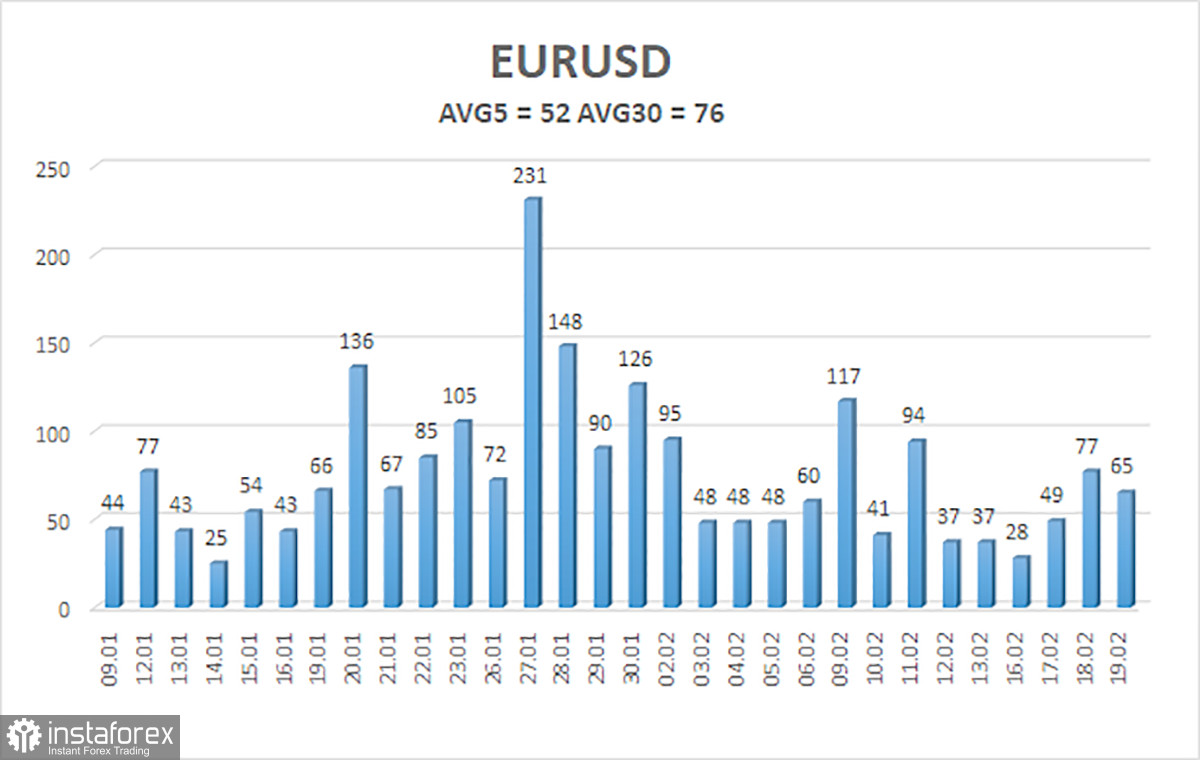
The average volatility of the EUR/USD currency pair over the last 5 trading days as of February 20 is 52 pips, which is considered "average." We expect the pair to trade between 1.1712 and 1.1816 on Friday. The upper channel of the linear regression points upwards, indicating further growth for the euro. The CCI indicator has entered oversold territory, signaling a resumption of the upward trend.
S1 – 1.1719
S2 – 1.1597
S3 – 1.1475
R1 – 1.1841
R2 – 1.1963
R3 – 1.2085
The EUR/USD pair continues its correction within an upward trend. The global fundamental backdrop remains extremely negative for the dollar. The pair spent seven months in a sideways channel, and it is likely that now is the time to resume the global trend from 2025. For long-term growth, the dollar lacks a fundamental basis. Therefore, all the dollar can rely on is range trading or corrections. When the price is below the moving average, small short positions can be considered with targets of 1.1719 and 1.1712 on purely technical grounds. Above the moving average line, long positions remain relevant with targets of 1.1963 and 1.2085.
Regression channels help determine the current trend. If both are oriented in the same direction, it indicates a strong trend;
The moving average line (settings 20,0, smoothed) defines the short-term trend and the direction in which trading should currently be conducted;
Murray levels are target levels for movements and corrections;
Volatility levels (red lines) indicate the probable price channel in which the pair will operate in the next 24 hours, based on current volatility indicators;
The CCI indicator—its entry into the oversold area (below -250) or the overbought area (above +250) indicates that a trend reversal in the opposite direction is approaching.
InstaForex analytical reviews will make you fully aware of market trends! Being an InstaForex client, you are provided with a large number of free services for efficient trading.


