 Maradok
Kereskedési feltételek
Products
Eszkozok



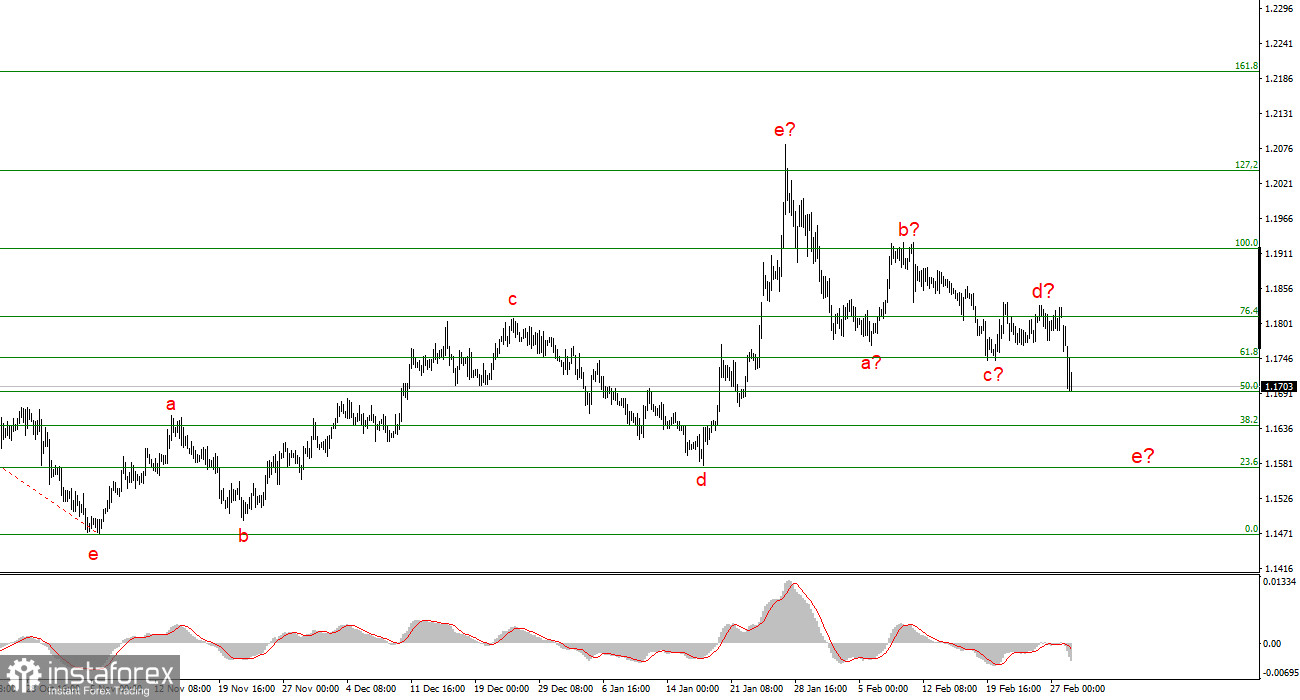
The wave pattern on the 4-hour chart for EUR/USD has taken on a less desirable form, but it still raises no major questions. There is still no talk of canceling the upward trend segment that began in January of last year; only the internal wave structure is periodically adjusted. In my view, the pair has completed the formation of global wave 4 (lower chart). If this assumption is correct, wave 5 is currently unfolding, and it could become quite extended, with targets reaching up to the 1.2500 level.
The internal structure of the presumed wave 5 is not entirely clear (upper chart). The upward wave sequence cannot be considered impulsive due to fairly strong corrective waves. Therefore, at the moment it is interpreted as an a-b-c-d-e structure. However, if wave 5 becomes extended, its internal structure will also likely become complex. If so, the wave count may undergo further adjustments. In any case, I expect the EUR/USD pair to resume its upward movement, as the corrective a-b-c-d-e structure already appears close to completion.
On Monday, EUR/USD declined by 115 basis points and could lose more before the day ends. I believe none of my readers are wondering why demand for the U.S. dollar increased today, but for clarity, I will note the outbreak of war in the Middle East, which Donald Trump had been discussing actively in recent weeks. No progress was achieved in the Geneva negotiations, so the U.S. president did not delay and issued the relevant order. We will discuss this conflict and its consequences—primarily for the United States and the American president—in more detail later. For now, let us briefly review the impact of the first trading day on financial markets.
In response to a massive missile strike on Saturday that killed many high-ranking officials, including Ayatollah Ali Khamenei, Iran began launching missiles at all U.S. allies and American bases in the region. Even a U.S. base in Cyprus was reportedly targeted. Tehran officially stated that it does not intend to comply with Donald Trump's ultimatums and will respond strike for strike. Therefore, hopes for a quick resolution to the conflict are unrealistic. Monday saw a sharp rise in oil and gas prices worldwide after Iran blocked passage through the Strait of Hormuz, through which roughly a quarter of the world's oil supply is transported. In addition, Tehran struck oil and gas companies in the region, leading to production and transportation disruptions. Amid the sharp escalation in the Middle East, the U.S. dollar has once again acted as a safe-haven asset, and the wave structure has consequently evolved into a five-wave corrective formation.
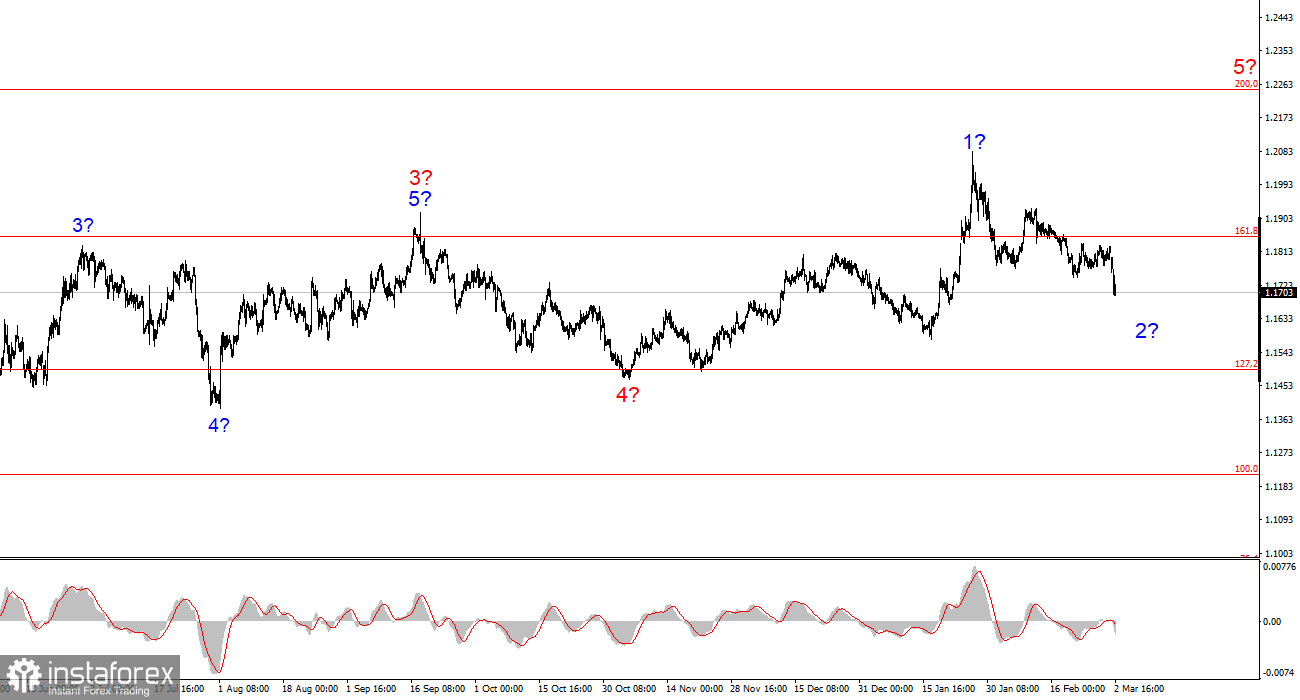
Based on the EUR/USD analysis, I conclude that the pair continues to form an upward trend segment. Donald Trump's policies and the Federal Reserve's monetary policy remain significant long-term factors weighing on the U.S. dollar. The targets for the current trend segment may extend up to the 1.2500 level. At present, I believe the pair remains within global wave 5 and therefore expect higher quotes in the first half of 2026. The corrective a-b-c-d-e structure may conclude at any moment, as it already looks well developed. I believe it is reasonable to search for areas and levels for new long positions with targets around 1.2195 and 1.2367, corresponding to 161.8% and 200.0% Fibonacci levels. However, the war in Iran must now be taken into account.
On a smaller time frame, the entire upward trend segment is visible. The wave structure is not entirely standard, as corrective waves differ in size. For example, the larger wave 2 is smaller than the internal wave 2 within wave 3. Such situations do occur. It is important to identify clear structures on charts rather than rigidly adhering to labeling every wave. At present, the upward wave structure does not raise doubts.
InstaForex analytical reviews will make you fully aware of market trends! Being an InstaForex client, you are provided with a large number of free services for efficient trading.


