 Maradok
Kereskedési feltételek
Products
Eszkozok



EUR/USD, by the end of yesterday, failed to overcome the resistance level at 1.1800, which corresponds to the upper boundary of the Kumo cloud on the D1 timeframe. Buyers renewed a six-week price high, marking 1.1812, but did not hold within the 18th figure, finishing the day at 1.1795. The pair is drifting close to the borders of the 18th figure, waiting for further geopolitical developments that are expected any day now.
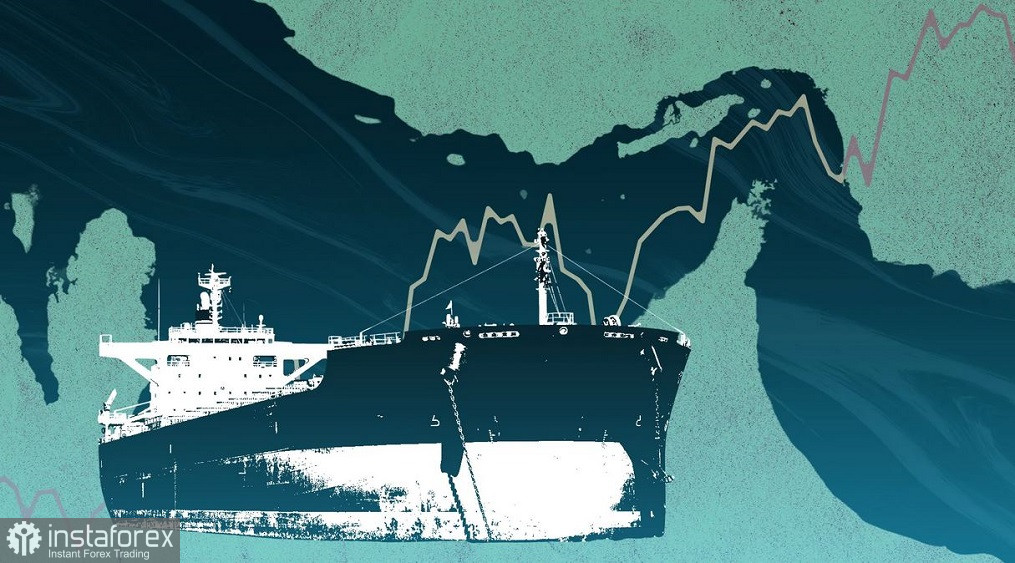
Trader caution is fully justified, given the contradictory situation. On the one hand, United States actions are escalatory. Yesterday was the first full day of the blockade of Iranian ports, involving 12 US warships and dozens of aircraft. According to CENTCOM, over the past 24 hours no vessel has been able to break through the blockade from Iranian ports. It is claimed that the US military has already intercepted six vessels that were sailing out of Iranian ports, though Iran insists that its oil supertanker nevertheless managed to bypass the American blockade.
Against this background, Treasury Secretary Bessent threatened China that it will no longer be able to buy Iranian oil. It should be noted here that roughly 90 percent of Iran's crude oil exports went to China. For China itself, Iranian oil accounts for approximately 13 to 15 percent of total imports.
That is one side of the coin. On the other side are certain signs of possible de-escalation. First and foremost, Iran's restraint must be noted, as it is refraining, for now, from strikes on US forces and other targets in the Persian Gulf. Although, just several days ago, Tehran representatives warned that any attempt to blockade the country's ports would "lead to retaliatory actions, including possible attacks on US Navy ships." As we see, so far that has not happened, even though the blockade began yesterday.
De-escalatory signals are also voiced by US leaders. For example, yesterday, Vice President J. D. Vance said that all objectives of the military operation against Iran have been achieved, and now it is possible to move to conclude this conflict. He also noted that the talks in Islamabad produced big progress but that the ball is now in Tehran's court. Vance hinted at a resumption of the negotiation process in the near term.
Intriguing, but at the same time contradictory, statements were made by Donald Trump. Responding to a Fox News question about whether the war with Iran is over, he said that he considered it very close to conclusion. At the same time, the head of the White House noted that he had not considered extending the ceasefire with Iran because, most likely, there would be no need. In this context, Trump said that the next two days will be significant and remarkable, hinting at an impending resumption of talks with Iran. A little later Vance clarified that the president is offering Iran a normalization of economic relations within the framework of a big agreement.
According to CNN sources, Trump tasked J. D. Vance, who leads the negotiating delegation, with finding a diplomatic way out of the war, despite the failure of the Islamabad talks.
Thus, EUR/USD traders are forced to make trading decisions against a contradictory geopolitical backdrop. On the one hand, the United States has indeed blockaded Iranian seaports, thereby threatening the negotiation process. On the other hand, senior US officials are signaling a resumption of talks and a near end to the conflict.
Inflation reports are also providing a contradictory picture. For example, the headline producer price index in March accelerated substantially, whereas core PPI remained at the previous month's year-on-year level and, in monthly terms, even slowed to 0.1%. Meanwhile, the headline consumer price index in March accelerated to 3.3% after two months at 2.4%. Core CPI showed a more modest rise, increasing to 2.6% from the prior 2.5%.
In other words, headline inflation is pulling the index up solely because of volatile components, primarily energy, whereas real, sustained price growth in the rest of the economy remains subdued. This situation brings us back to the United States-Iran talks because, if the war continues, energy inflation will eventually seep into core inflation through logistics and production costs.
Therefore, the world has frozen awaiting the outcome of the geopolitical plot. The financial world is no exception. The currency market is not immune. The upward impulse in EUR/USD has faded, yet sellers are reluctant to open large positions in favor of the greenback. Given the high degree of uncertainty, it is sensible to maintain a wait-and-see stance on the pair. After all, if the United States and Iran return to the negotiating table, EUR/USD buyers will again try to secure the pair within the 18th figure. But if events develop along an escalation scenario, the safe-haven dollar will once more attract stronger demand, putting pressure on EUR/USD. The intrigue remains, and therefore buying and selling the pair are equally risky.
InstaForex analytical reviews will make you fully aware of market trends! Being an InstaForex client, you are provided with a large number of free services for efficient trading.


