 Maradok

Kereskedési feltételek
Products
Eszkozok


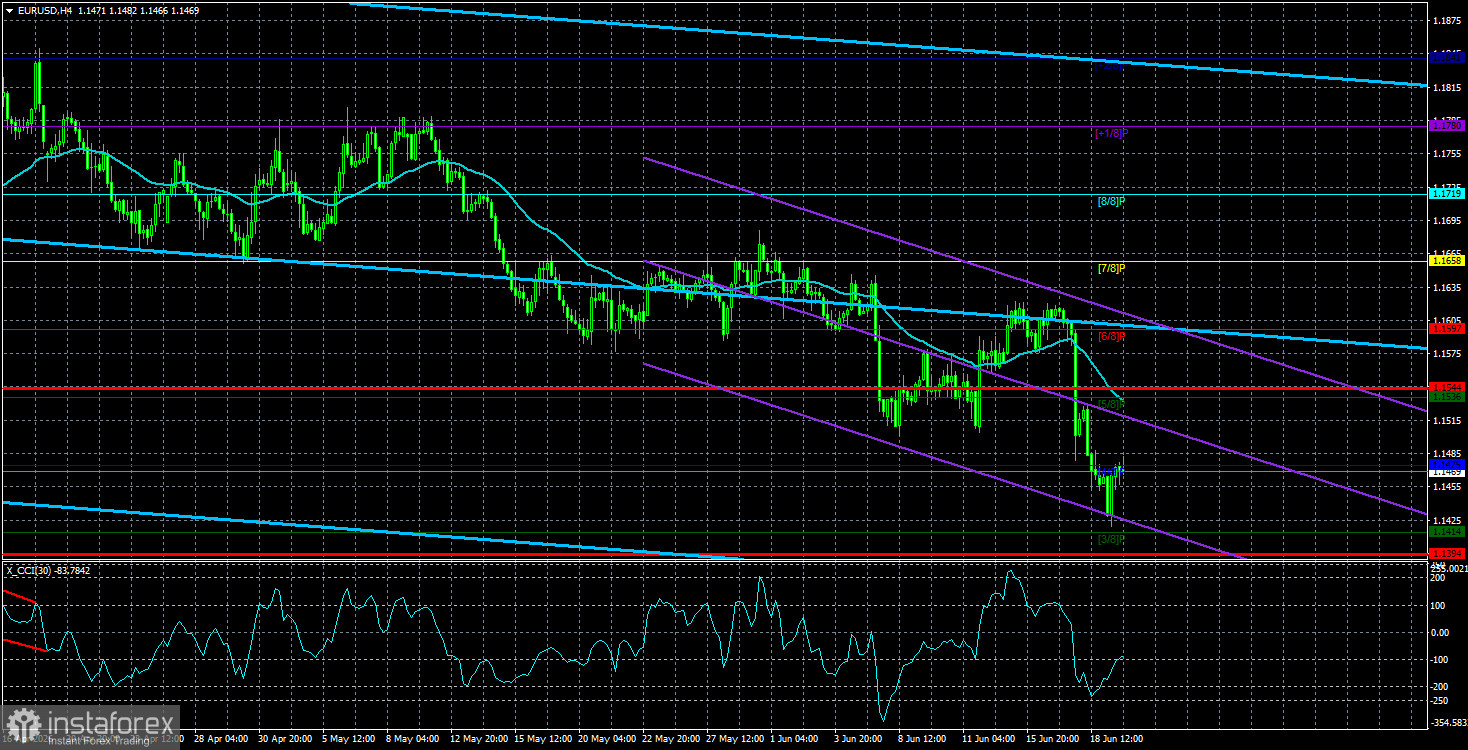
The EUR/USD currency pair slightly recovered on Friday after a two-day decline; however, the downward trend remains in place. Recall that the pair's decline began in late April, as the market gradually realized that an agreement between Iran and the U.S. was impossible. Two months have passed, and the U.S. and Iran signed a 60-day ceasefire agreement during which negotiations on the nuclear deal are supposed to take place, and the Strait of Hormuz should be opened. And what now? The market still does not believe in the peaceful coexistence of Iran and the U.S., and one cannot say that the traders are wrong!
For example, how should one react to the fact that a peace agreement was signed last week, yet by Sunday, representatives of the IRGC announced a new blockade of the Hormuz Strait? The matter is that Donald Trump somehow managed to reach an agreement with Tehran, making significant concessions and even giving a verbal permission to possess a certain number of ballistic missiles with nuclear warheads (this shows how much Trump wants to end the war), yet at the same time, Israel, which has its own conflict with Lebanon and Hezbollah, was not involved in this deal at all. In the past few days, Jerusalem has been making strikes in southern Lebanon, to which Iran intends to once again block the Hormuz Strait and withdraw from further negotiations with the U.S. Therefore, all traders can assess the effectiveness of the negotiations conducted by Trump's team.
Last week, the market had every reason to sell the dollar since the conflict had de facto ended. However, it seems that the market once again simply did not believe it. We have previously wondered how Washington and Tehran plan to agree on the nuclear deal if the former insists on the complete abandonment of nuclear fuel and weapons by the latter, while the latter refuses to abandon the former's ultimatum. It seems that most traders in the market are also grappling with vague doubts, which is why the euro and the British pound did not experience any surge of strength after the ceasefire agreement. Partly, the situation was also influenced by the Federal Reserve, which signaled a possible tightening of monetary policy in the second half of the year. However, in our opinion, these expectations are still purely hypothetical. We do not believe the Fed triggered the strong dollar move on Wednesday and Thursday.
Next week, the indices of business activity in the service and manufacturing sectors for June will be released in Europe and Germany, and these are important events scheduled for the next five days. Thus, whether you like it or not, the market will have to closely monitor geopolitics once again. Predicting anything on this topic is pointless, as the setting changes almost every day. No one knows how events will unfold. However, we do know one thing: the dollar will not be able to show growth, for instance, for another year if "geopolitical swings" continue during this time. And the euro cannot expect strong growth until the conflict in the Middle East is fully resolved.
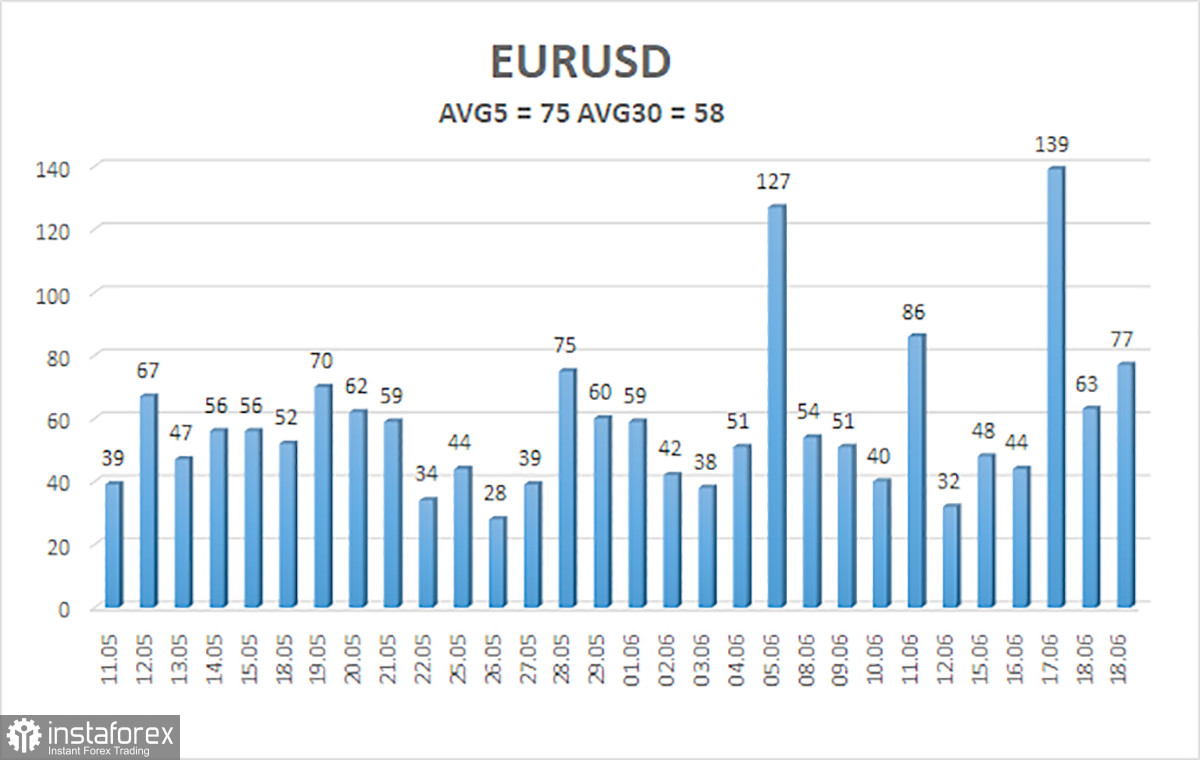
The average volatility of the EUR/USD currency pair over the last 5 trading days as of June 22 is 75 pips, which is considered "average." We expect the pair to move between 1.1394 and 1.1544 on Monday. The upper linear regression channel has turned sideways, indicating the downward trend is incomplete. The CCI indicator has entered the overbought area and formed a "bullish" divergence, which again warns of a possible end to the downward trend.
S1 – 1.1414
S2 – 1.1353
S3 – 1.1292
R1 – 1.1475
R2 – 1.1536
R3 – 1.1597
The EUR/USD pair continues its downward movement, which is presumed to be a correction within a global upward trend, clearly visible on the daily or weekly timeframe. The global fundamental backdrop for the dollar remains negative, but in 2026, first geopolitics and then the Fed's "hawkish" stance provided strong support for the American currency. When the price is below the moving average, short positions can be considered with targets of 1.1414 and 1.1394. Above the moving average line, long positions targeting 1.1597 and 1.1658 are relevant. The resolution of the conflict in the Middle East did not create any problems for the dollar. Bears are currently extremely strong, but the daily timeframe remains sideways, limiting the potential for dollar growth.
Linear regression channels help determine the current trend. If both are directed in the same direction, it means the trend is currently strong;
The moving average line (settings 20.0, smoothed) defines the short-term trend and the direction in which trading should currently be conducted;
Murray levels are target levels for movements and corrections;
Volatility levels (red lines) indicate the likely price channel in which the pair will spend the next day based on current volatility indicators;
The CCI indicator entering the oversold area (below -250) or overbought area (above +250) indicates that a trend reversal in the opposite direction is approaching.
InstaForex analytical reviews will make you fully aware of market trends! Being an InstaForex client, you are provided with a large number of free services for efficient trading.


