 Maradok
Kereskedési feltételek
Products
Eszkozok



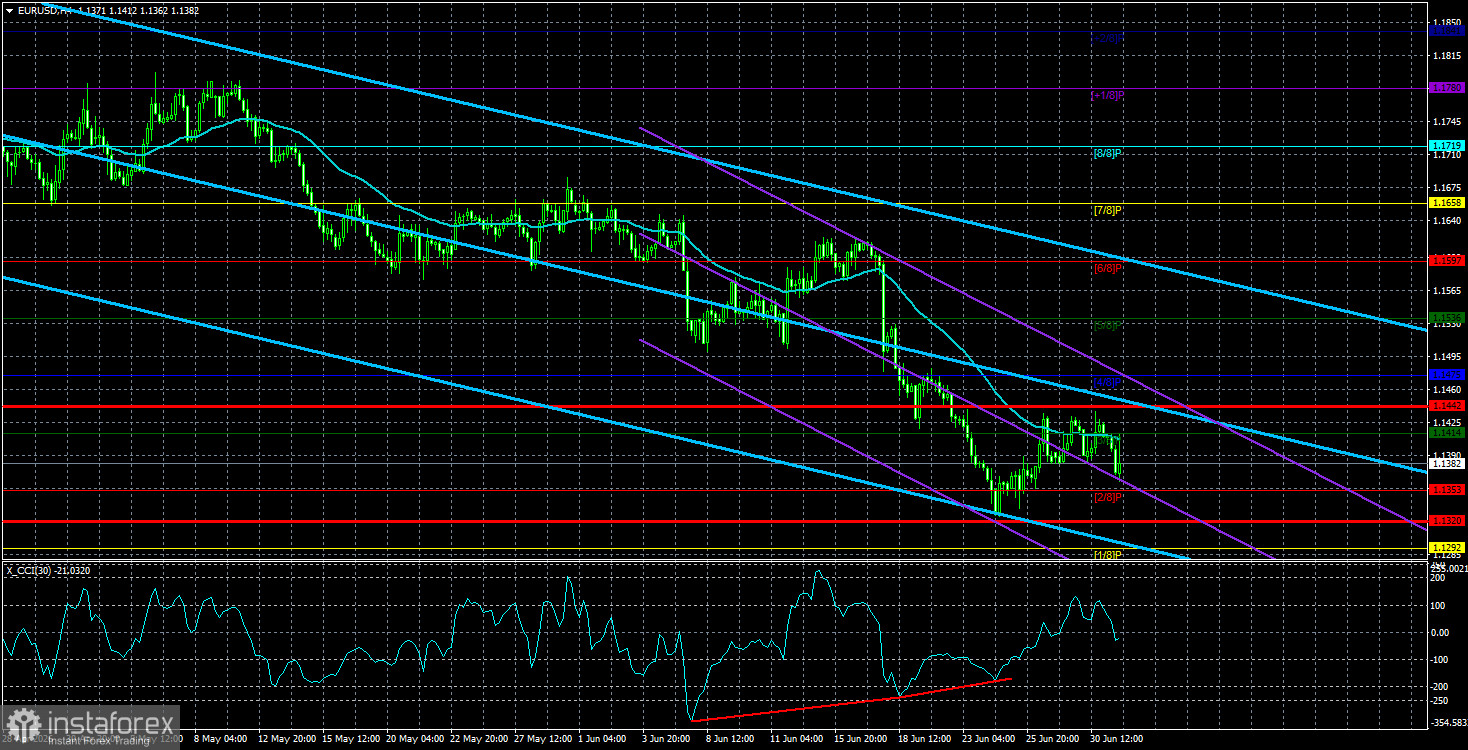
The EUR/USD currency pair continued to trade near its "bottom" on Wednesday, remaining in a downward trend for two consecutive months while preserving a global upward trend. As is often the case, the market ignored all macroeconomic releases of the day, and market volatility again remained weak. In our view, the key event of the day was the inflation report from the EU rather than the speeches by Christine Lagarde, Andrew Bailey, or Kevin Warsh—let alone the U.S. ADP and ISM reports. European inflation was supposed to answer the question: should we expect another rate hike from the European Central Bank in July? We believe the answer is clear: we should not.
The consumer price index for June slowed to 2.8%, although experts had forecast a decrease to 3%. A day earlier, inflation in Germany slowed to 2.3%. Core inflation in the EU fell to 2.4%. Thus, there is every reason to believe that the inflation spike caused by the war in the Middle East, the closure of the Strait of Hormuz, and rising energy prices was temporary. For two months now, Iran and the U.S. have not engaged in active hostilities; both sides want to resolve the conflict, Washington is not inclined to launch new attacks on Iranian infrastructure, and oil prices have dropped to pre-war levels. Thus, the groundwork for reducing inflation has been laid, and in June, the ECB reinforced this by tightening monetary policy.
However, the current official figures indicate that further tightening is not necessary. Just a month ago, no one knew or understood when and how the conflict in the Middle East would conclude or when the Strait of Hormuz would reopen. Now it can be stated with reasonable confidence that the conflict is either over or at least on a long pause.
We have already mentioned that it makes no sense for Donald Trump to resume a full-scale war. Iran understands this and is seeking as many concessions from the U.S. as possible. Trump has congressional elections approaching, and a new escalation in the Middle East would lead to renewed blockades of the Strait of Hormuz and a new rise in oil prices, which would drive up fuel prices in the U.S. and spark a new round of inflation. In that case, retaining a majority in the Senate would be out of the question. Therefore, at the moment, we base our outlook on the assumption that the conflict has ended.
However, the market does not seem to acknowledge this fact. The dollar continues to strengthen in the medium term, and the inflation report has been ignored, as have many other releases in recent months. The EUR/USD pair may continue to decline simply because the market is positioned for selling—both technically and speculatively. At the same time, we still do not see any fundamental or geopolitical reasons for strengthening the U.S. dollar, and the higher time frames continue to show an upward trend and a range that has persisted for about a year. Technically, the decline of the euro could end at any moment.
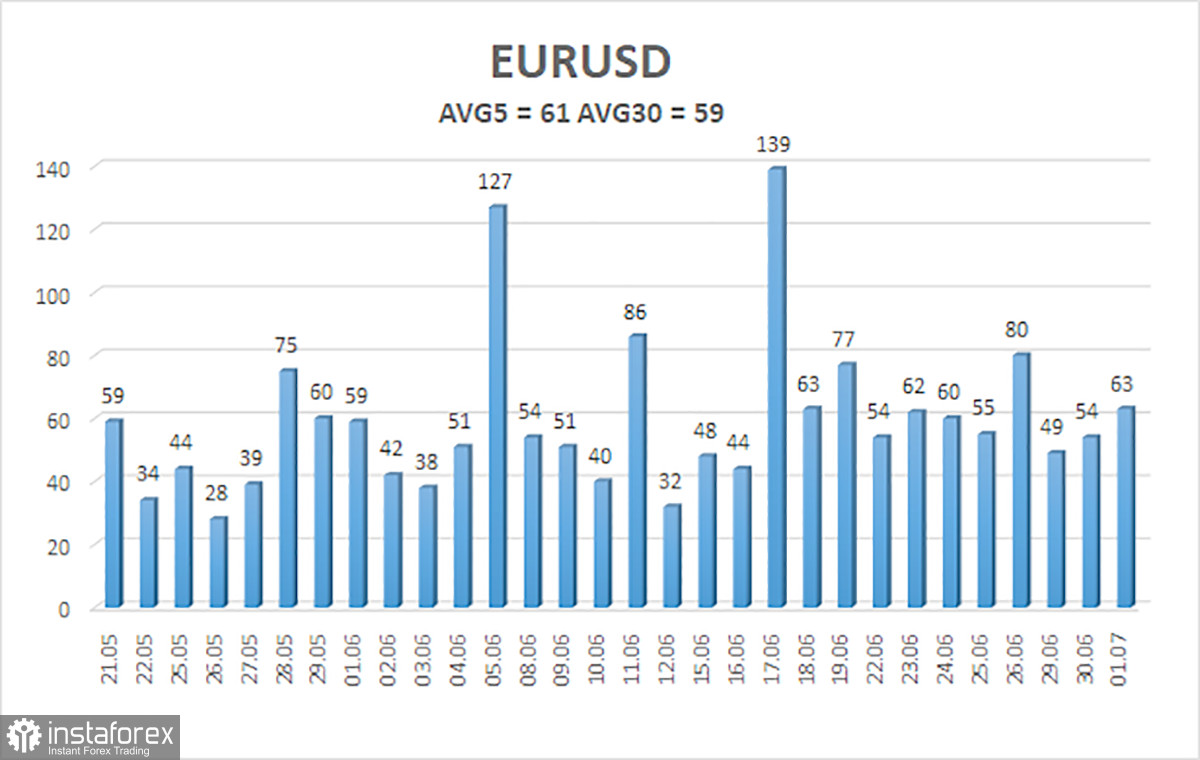
The average volatility of the EUR/USD currency pair over the last five trading days as of July 2 is 61 pips, which is considered "average." We expect the pair to move between 1.1320 and 1.1442 on Thursday. The upper linear regression channel has turned downward, indicating the continuation of the downward trend. The CCI indicator has entered the oversold area and formed two bullish divergences, which again warn of a potential end to the downward trend.
S1 – 1.1353
S2 – 1.1292
S3 – 1.1230
R1 – 1.1414
R2 – 1.1475
R3 – 1.1536
The EUR/USD pair maintains a downward trend, presumably a correction within a broader upward trend, clearly visible on the daily or weekly time frames. The global fundamental backdrop for the dollar remains negative, but in 2026, first geopolitics and then the Fed's hawkish stance provided powerful support for the U.S. dollar. Below the moving average, short positions can be considered with targets at 1.1353 and 1.1320. Above the moving average line, long positions remain relevant with targets at 1.1536 and 1.1597. Bears are currently very strong for no visible reason.
Linear regression channels help determine the current trend. If both are directed in one direction, it indicates a strong trend;
The moving average line (settings 20,0, smoothed) determines the short-term trend and the direction in which to trade;
Murray levels are target levels for movements and corrections;
Volatility levels (red lines) indicate the likely price channel in which the pair will spend the next day based on current volatility metrics;
The CCI indicator—its entry into the oversold area (below -250) or the overbought area (above +250) signals that a trend reversal is approaching in the opposite direction.
InstaForex analytical reviews will make you fully aware of market trends! Being an InstaForex client, you are provided with a large number of free services for efficient trading.


