 Maradok

Kereskedési feltételek
Products
Eszkozok


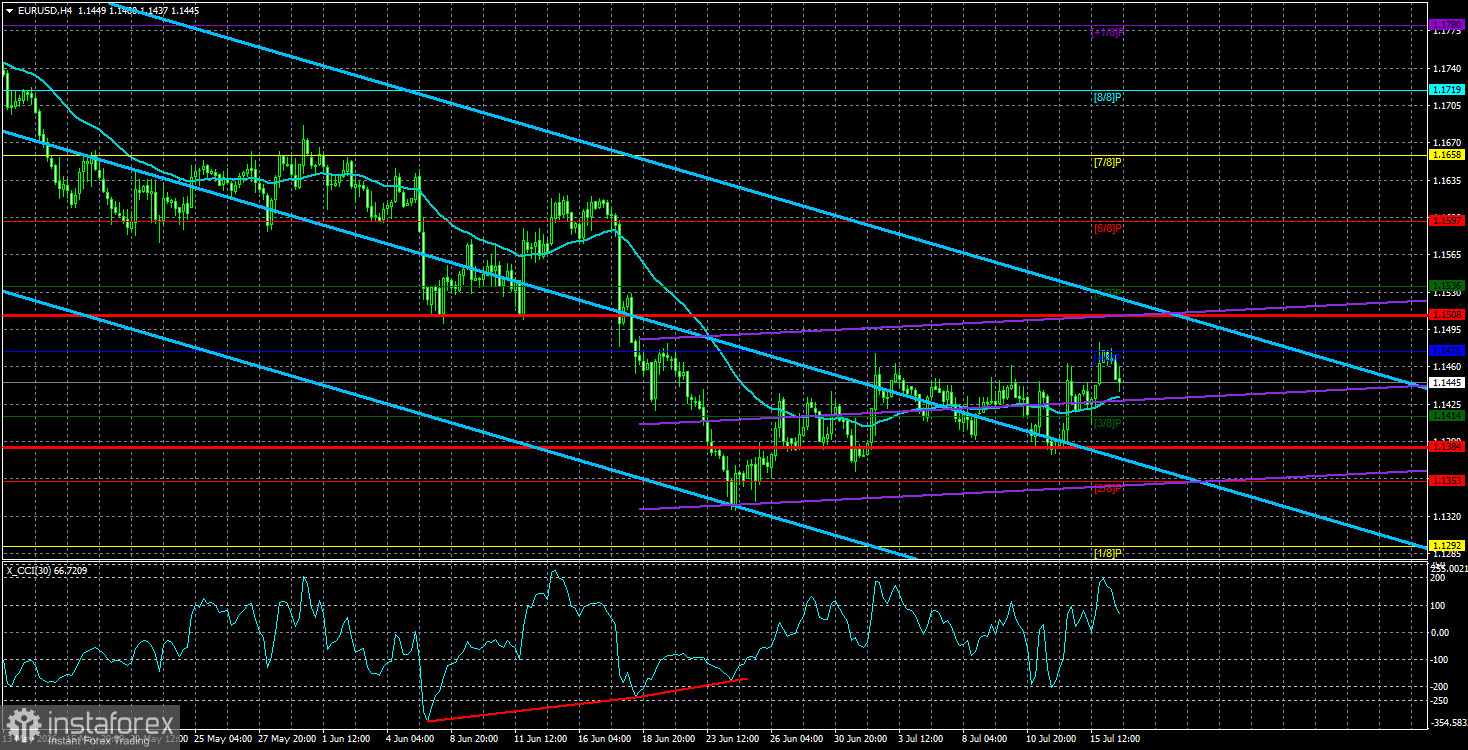
The EUR/USD currency pair traded very calmly on Thursday. On the 4-hour timeframe, it is clear that over the past three weeks, the euro has risen by only 140 pips. Thus, we have witnessed a prolonged correction, which will likely end with a new decline of the single European currency. Are there solid reasons and grounds for this? No. There weren't even any during the period from June 17 to June 24 when the market was actively factoring in a future interest rate hike by the Federal Reserve, which may not even occur, and it seems to be preparing for another completely inadequate rise of the U.S. dollar.
Of course, no matter how the movement of the past three weeks looks, we cannot be certain that a new leg of the downtrend is inevitably ahead. However, it is hard to disagree that if the price declines by 285 pips in a week and then crawls up by 140 pips over three weeks, it's worth questioning where the trend is and where the correction is. The most interesting thing is that the market continues to ignore almost any macroeconomic or fundamental information. Three weeks ago, the market was confident in the Fed's monetary tightening in 2026, ignoring the European Central Bank's already implemented policy tightening and the (at that time) resolution of the conflict in the Middle East. Now it actively disregards the decline in inflation in the U.S. and the moderating hawkish tone of Fed representatives. If Kevin Warsh were to openly refuse a rate hike tomorrow, the dollar would likely rise in that case as well.
This week, the pair essentially traded only one day — Tuesday. On that day, the U.S. inflation report for June was released, raising significant doubts about the Fed's willingness to hike interest rates in the near future. Inflation dropped to 3.5%, and Warsh began speaking much more gently and cautiously about inflation and monetary policy. This suggests that the U.S. dollar should have lost the last market support factor, but instead, it is preparing for another rise.
It is worth noting that the British pound showed a brilliant rise of 400 pips over the past three weeks, which, in our view, is completely logical and justified. We expect growth from the British currency, as well as from the euro, in the medium term. However, the European currency demonstrates only one thing — a complete unwillingness to rise, regardless of fundamentals and macroeconomic conditions. Perhaps the problem lies not with the traders? Perhaps the ECB has begun currency interventions, or the reasons are not visible to most traders? After all, the British pound cannot rise while silently watching the euro fall.
Let's say this: any new decline of the EUR/USD pair would be inherently illogical. However, the market (especially market makers) cannot be prohibited from buying dollars, selling euros, or trading in a more logical manner. Therefore, traders may soon witness another illogical rise in the dollar, accompanied by explanations from analysts who will speak of "growing risk-averse sentiment." We can only hope for common sense.
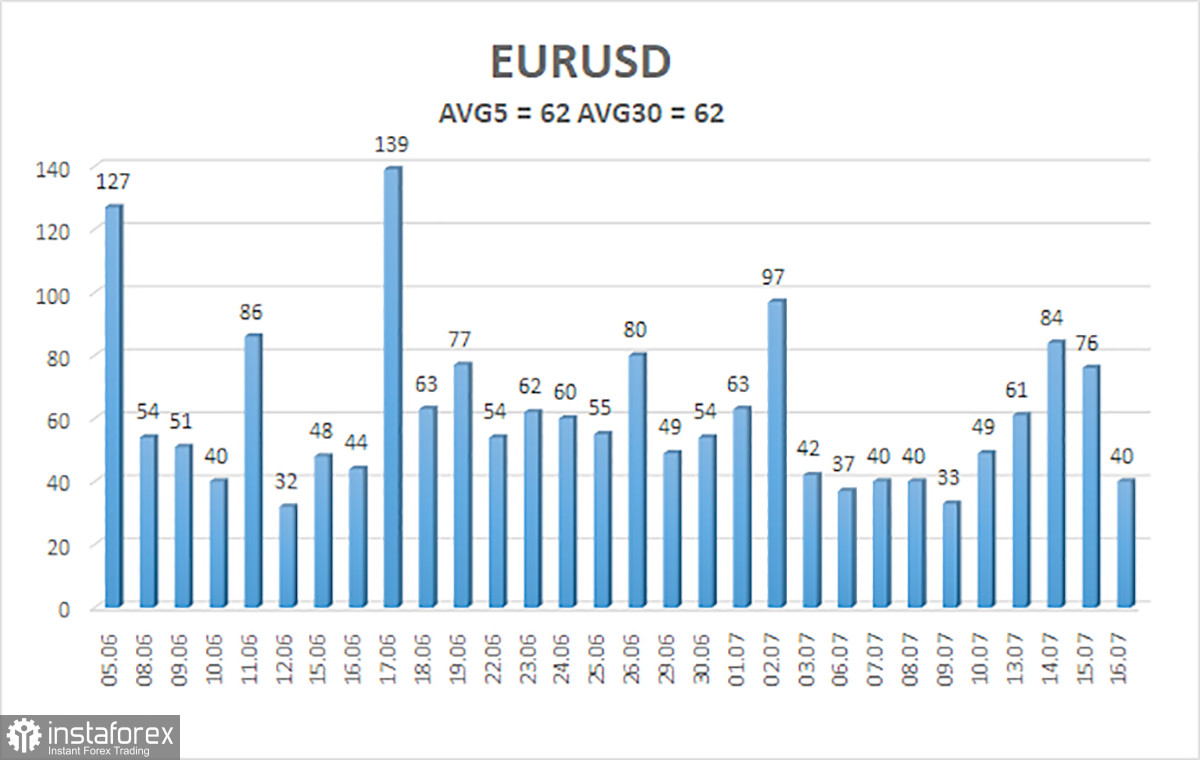
The average volatility of the EUR/USD currency pair over the last 5 trading days as of July 17 is 62 pips and is characterized as "average." We expect the pair to move between levels 1.1384 and 1.1508 on Friday. The upper linear regression channel is directed downward, indicating the continuation of the downtrend. The CCI indicator has entered the oversold zone and formed two "bullish" divergences, suggesting a possible end to the downtrend.
S1 – 1.1414
S2 – 1.1353
S3 – 1.1292
R1 – 1.1475
R2 – 1.1536
R3 – 1.1597
The EUR/USD pair maintains a downward trend, presumably a correction within a global uptrend, clearly visible on the daily or weekly timeframe. The global fundamental backdrop for the dollar remains negative, but in 2026, first geopolitics and then the Fed's "hawkish" stance provided strong support for the U.S. currency. If the price is located below the moving average, shorts can be considered with targets at 1.1384 and 1.1353. Above the moving average line, long positions are relevant with targets at 1.1475 and 1.1508. Bears are maintaining winning positions, and the market has been flat for three consecutive weeks.
Linear regression channels help determine the current trend. If both are directed in one direction, it means the trend is currently strong;
The moving average line (settings 20,0, smoothed) determines the short-term trend and the direction in which trading should currently be conducted;
Murray levels are target levels for movements and corrections;
Volatility levels (red lines) represent the likely price channel in which the pair will move over the next day based on current volatility indicators;
The CCI indicator's entry into the oversold zone (below -250) or overbought zone (above +250) indicates that a trend reversal in the opposite direction is approaching.
InstaForex analytical reviews will make you fully aware of market trends! Being an InstaForex client, you are provided with a large number of free services for efficient trading.


