 Maradok

Kereskedési feltételek
Products
Eszkozok


On Thursday, the Bank of England held its fifth meeting of the year, and for the sixth consecutive time, the interest rate remained unchanged. At the last meeting (when inflation in the UK was much higher than it is now), two members of the MPC Committee voted in favor of tightening monetary policy. As of June, inflation in Britain slowed to 2.6% year-on-year, but the MPC voted 6-3 to maintain the rate. Three members (Huw Pill, Megan Greene, and Catherine Mann) believe that an increase will follow the current decline in inflation in the second half of the year. They argue that the BoE should take preventive measures. Their votes were not enough for a rate hike, but the trend is clear – the BoE's stance is becoming increasingly hawkish.
In the accompanying statement, the BoE noted that oil and energy prices remain volatile and that uncertainty related to the conflict in the Middle East is high. The impact of the energy shock on the UK economy is impossible to predict. Monetary policy cannot influence energy prices but can affect economic adaptation and bring inflation down to the target level. The BoE's monetary policy will focus on achieving its goals but will depend on the scale and duration of the energy shock and its repercussions for the economy. The longer high oil prices persist and the higher they are, the greater the inflationary risks. Recent data continues to indicate disinflation, but this process could turn into renewed price acceleration at any moment.
The BoE also stated that inflation forecasts could change significantly under the pressure of the Middle Eastern conflict, and the central bank is ready to make necessary decisions to stabilize prices. In the third quarter of this year, the central bank expects inflation to rise to 2.9%, and in the fourth quarter – to 3.2%. Next year, the consumer price index is expected to slow to 2.1%.
Based on all of the above, one conclusion can be made. The longer the conflict in the Middle East continues, the higher the likelihood of rising inflation and the greater the likelihood of tightening monetary policy by the BoE. A similar situation exists in the United States, so both central banks may raise interest rates in the second half of the year.
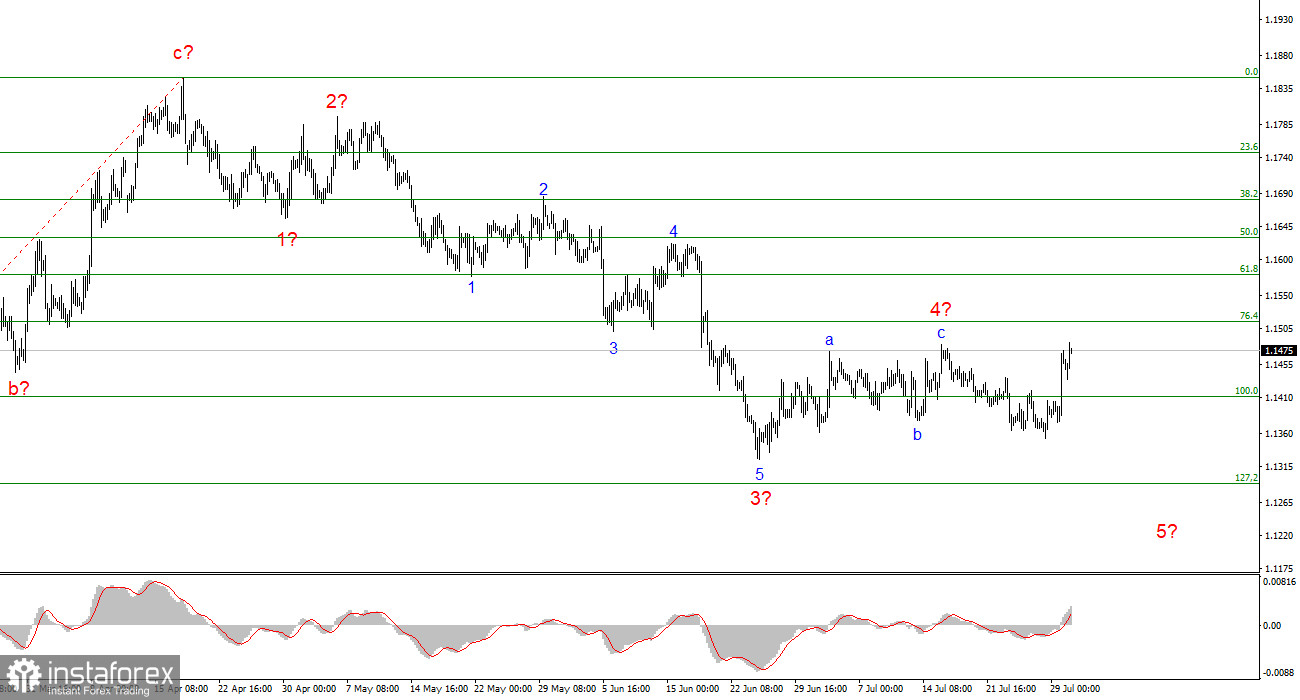
Based on the analysis conducted for EUR/USD, I conclude that the instrument remains within an upward portion of the trend, and in a shorter-term plan, within a downward portion of the trend. In my opinion, this is a good time to try to establish long positions. However, the instrument may still drop to the 13 figure within wave 5 in C. Wave analysis often brings surprises, so I would already be adjusting toward purchases.
The wave pattern for the GBP/USD instrument has become quite complex. At this time, the instrument has formed three waves down, while for EUR/USD, 5 waves may be in progress. Therefore, the pound could build another wave down, just like the euro, but this wave could be the second within a new upward portion of the trend. Thus, the divergence in the wave patterns of the euro and pound will exist but be insignificant. Based on this, the downward correction may continue for some time, and then I expect the construction of wave 3 of a new upward segment of the trend, with targets around the 37-38 level.
InstaForex analytical reviews will make you fully aware of market trends! Being an InstaForex client, you are provided with a large number of free services for efficient trading.


