 Maradok

Kereskedési feltételek
Products
Eszkozok


The conflict between Iran and the U.S. is reaching a bifurcation point beyond which there will be no turning back. The U.S. has been conducting strikes against Iran for ten consecutive days in response to what it claims is a violation of the memorandum's terms, demanding that Iran return to the negotiating table. In my opinion, Washington's demands to return to negotiations best illustrate Donald Trump's true stance toward this war. The U.S. President wants to achieve the announced goals and objectives as quickly as possible to end this conflict, aiming to retain at least one chamber of Congress for the Republican Party in the upcoming elections. Iran is not allowing him to do this; it continues to resist and demands full control over the Strait of Hormuz and the preservation of its right to nuclear developments and enriched uranium. The situation is referred to as a "stalemate." However, this "stalemate" suits Tehran.
Time is on Tehran's side, as the closer the congressional elections come, the lower the chances of the Republicans retaining power. If the Republicans lose power, Trump will no longer be able to bomb Iran at his discretion. Therefore, Iran's goal is to endure until November. Trump understands what Iran hopes to achieve. According to Axios, the conflict is approaching a decisive point, after which America and its allies could begin a new military campaign aimed at the complete destruction of Iran or secure a new ceasefire. It has been reported that U.S. allies and intermediaries are proposing a new ceasefire arrangement—this time for ten days. Frankly, I don't understand why a new ceasefire is necessary when the previous five have already failed, and the conflicting parties cannot find common ground in negotiations. According to insider information from Axios, Trump will make a decision regarding Iran in the coming days, and somehow I suspect that it will involve intensifying military actions.
Thus, the world should prepare for a blockade of the Bab-el-Mandeb Strait. Yesterday, the Yemeni Houthis already announced a naval blockade of Saudi Arabia, which essentially equates to a blockade of the Bab-el-Mandeb Strait. As of now, there has been no official information regarding the blockade, but as I have mentioned many times before, imposing a blockade is a matter of minutes. It just takes an announcement and then firing upon all passing vessels. The Middle East could "explode" again this week.
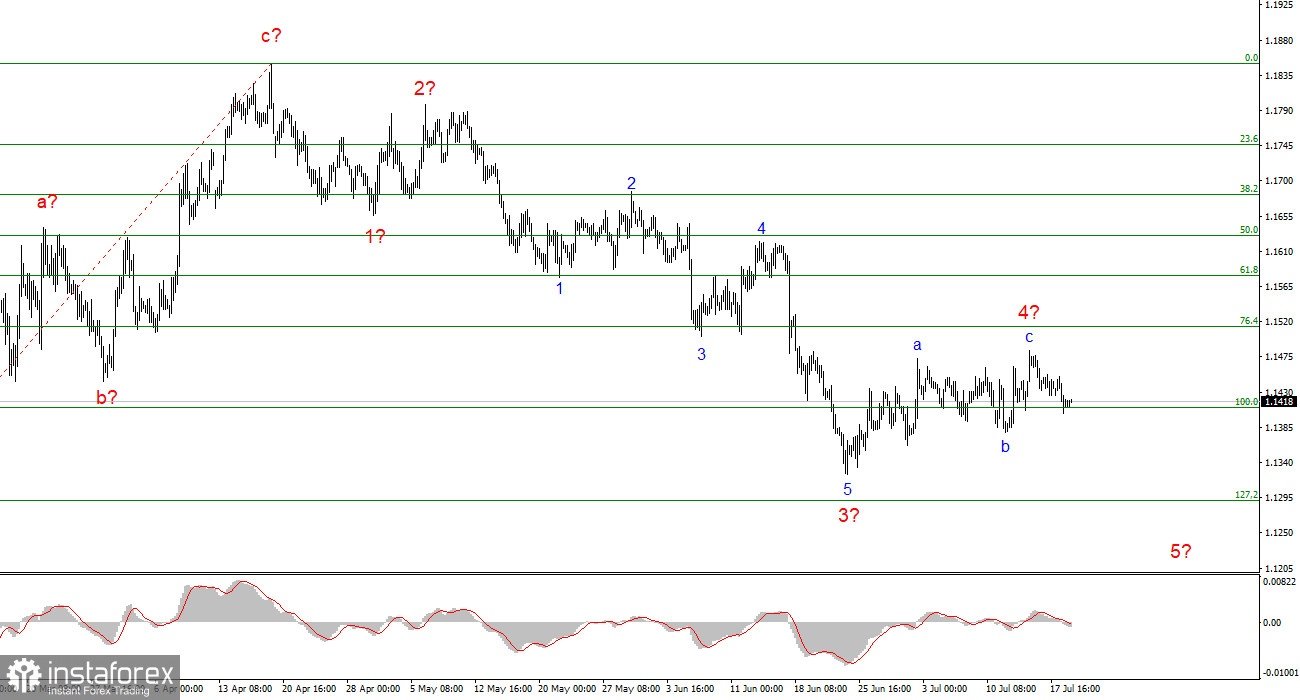
Based on my analysis of EUR/USD, I conclude that the instrument remains within an upward segment of the trend, but in the short term, it is within a downward segment. In my opinion, now is a good time to try to form long positions, but the instrument may still drop to the 13th figure within wave 5 in C. Wave analysis often presents surprises, so I would start to reorient towards buying now.
The wave structure for the GBP/USD instrument has taken on a rather complicated shape. Currently, the instrument has built three waves down, while EUR/USD may have constructed five waves. Consequently, the British pound may build another wave down, just like the euro, but this wave could be the second within a new upward segment of the trend. Thus, the divergence in wave counts between the euro and the pound will exist, but it will be insignificant and minor. Based on this, I expect a pullback downward in the near term, followed by the formation of a new upward section of the trend with initial targets around the 37-38 figures.
InstaForex analytical reviews will make you fully aware of market trends! Being an InstaForex client, you are provided with a large number of free services for efficient trading.


