 Permanecer

Condições de Negociações
Ferramentas


On the last day of the week, it is worth summing up the outgoing year and making a forecast for the year ahead. Today, we will focus on the prospects of the U.S. dollar.
So, at the end of last year (2024) and at the beginning of this year, after a local rise amid the election of D. Trump as the 47th President of the United States, the U.S. dollar sharply reversed downward, dragged lower by a whole series of trade wars unleashed by him. In effect, the president's aggressive trade policy turned into a geopolitical war, which had a significant negative impact on an already weak national economy. This became the reason for a sharp drop in demand for the dollar and its steepest decline over the past two years.
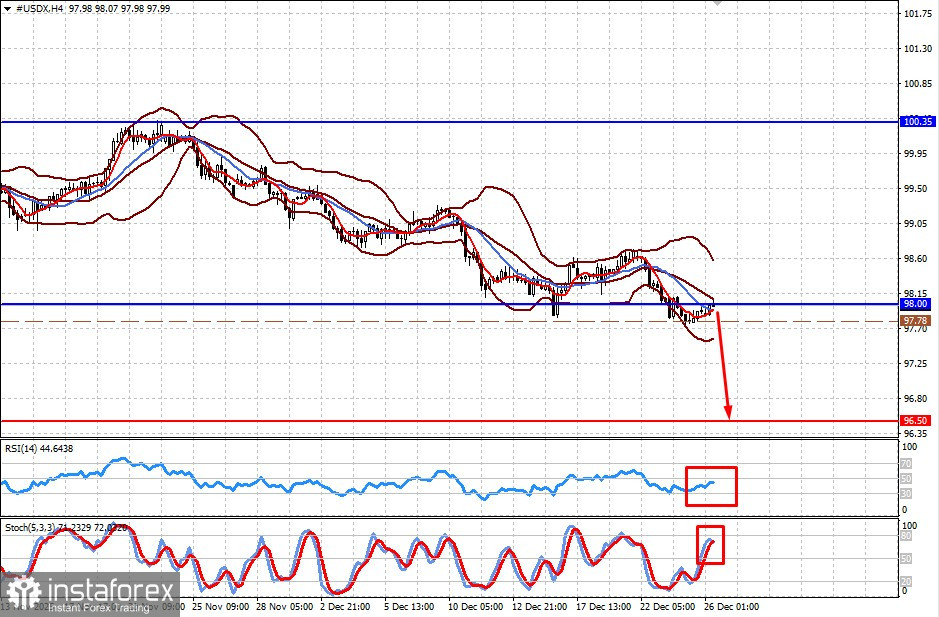
An additional negative factor was the resumption of the Fed's interest rate–cutting cycle in the summer, while the political struggle between Republicans and Democrats in Congress led to a government shutdown that lasted almost a month and a half, causing serious damage to the economy and demoralizing investors in the markets. Against this backdrop, and up to the present time, the dollar index (ICE) has been moving within a rather narrow sideways range, gradually shifting toward its lower boundary at 96.50 points.
The latest inflation and U.S. labor market data indicate that the problems in the country's economy are very serious and that it is in dire need of stimulus—that is, more substantial monetary easing. Such prospects allow for a forecast of a greater number of interest rate cuts by the regulator in the new year. Whereas previously the Fed itself projected only one cut of 0.25%, the market now believes there will be two. However, in my view, if the labor market picture remains negative for a significant period of time and inflation stays below the 3% level, there could be as many as three cuts, which would cumulatively reduce the overall level of interest rates by 1.5% from the current level of 3.75% to 3.25%.
But that is not all. It is expected that J. Powell will be replaced by D. Trump's appointee, K. Hassett, who is a proponent of a significantly more accommodative interest rate policy.
All these factors could lead to a more substantial reduction in borrowing costs, and the key interest rate in 2026 could fall below the 3% level.
Of course, under such a scenario, the U.S. dollar would remain under pressure and, by the end of next year, could fall to the area of 90 points on its index.
What can be expected from the dollar by the end of the year?
I believe that already at the beginning of the year, the dollar will fall to the 96.50 level.
Daily forecast:
#USD
The indicator is trading at the 98.00 level. Based on the forecast outlined in the article, I believe it may fall to 96.50 at the beginning of the new year. The level for selling can be considered 97.78.
Bitcoin
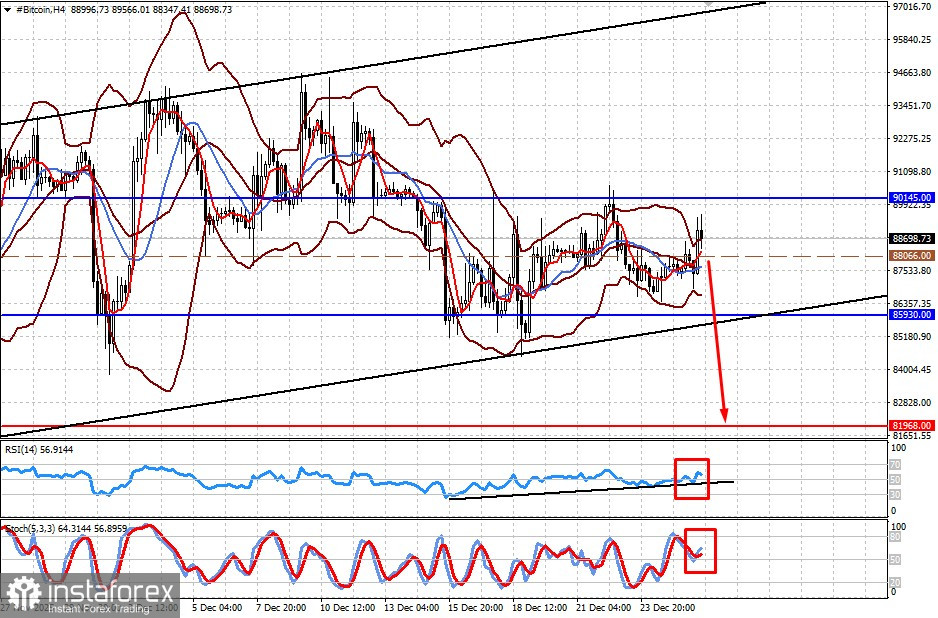
The cryptocurrency remains under pressure, and its inability to rise above the 90,150.00 level may lead to a resumption of the decline, first to 85,930.00 and then to 81,968.00. The level for selling can be considered 78,066.00.
InstaForex analytical reviews will make you fully aware of market trends! Being an InstaForex client, you are provided with a large number of free services for efficient trading.


