 Permanecer

Condições de Negociações
Ferramentas


At the same time (which works for Donald Trump), an increasing number of economists are sounding the alarm. Trump's tariffs not only fill the U.S. budget (but the trade balance remains negative, though the deficit is decreasing), but also have a destructive impact on the economy. What exactly?
First, imports. In the first half of 2025, imports "skyrocketed" because many trading firms and companies, aware of the tariffs, rushed to stock up on goods in advance at old prices. Therefore, the economic spike was caused not by real economic growth but by entrepreneurs' preemptive actions.
Second, economic growth in the third quarter may be a "hollow" one. Economists note that much of it was driven by increased government spending, while the real sector of the economy showed dismal growth. Moreover, in Q3, there was a "shutdown" lasting 1.5 months, and the data may be severely distorted.
Third, exports of American-made products are declining — not raw materials, oil or gas, nor various minerals or food commodities, but American-manufactured goods. Trump imposed his trade terms on some major global market players, and now they are forced to buy oil, gas, and agricultural products from the U.S., not because they want to, but because the corresponding trade deal was signed. No one can force foreign consumers to buy American-made goods. Therefore, total exports have risen in recent months, but exports of American goods have been steadily falling, which hurts the American producers Trump sought to support.
Fourth, American businesses are filing mass lawsuits against the tariffs because they lead to a significant increase in the cost of foreign raw materials and components, which pushes up prices. Companies are forced to cut production volumes, revenues fall, and the workforce is reduced.
Fifth, the labor market. As soon as the tariffs took effect, the U.S. labor market began to "cool." Some cooling may have been observed earlier, but it was not severe enough to prompt the Fed to sharply cut interest rates to stimulate the economy.
Sixth, inflation. It is clear that introducing import tariffs makes goods more expensive, thereby leading to inflation. According to official data, the consumer price index accelerated slightly due to the trade war, but many analysts believe the underlying inflation rate is higher. This especially concerns food and categories of imported goods.
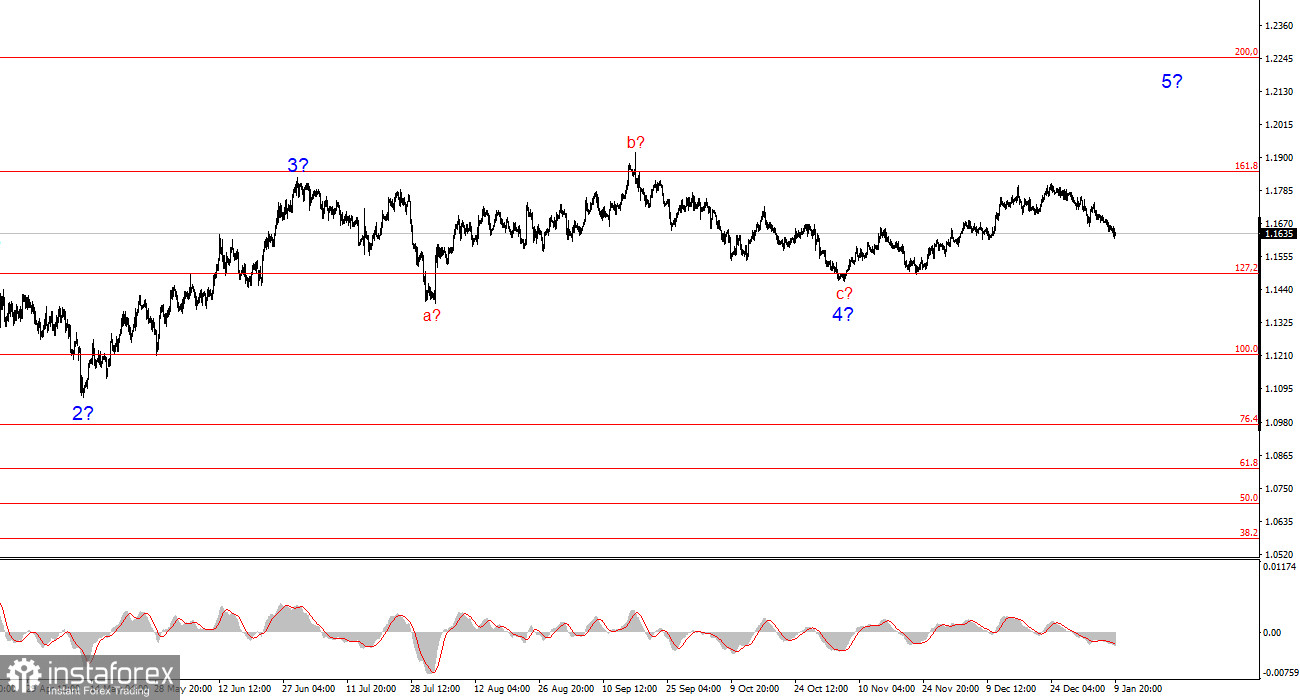
Based on the analysis of EUR/USD, I conclude that the instrument remains in an upward trend. Donald Trump's policy and the Federal Reserve's monetary policy remain significant factors in the long-term decline of the U.S. currency. The targets of the current trend segment may extend to the 25th figure. The current upward wave set may be complete, so the instrument faces a near-term decline. The trend segment that began on November 5 may still take on a five-wave appearance, but, right now, it is a corrective wave.
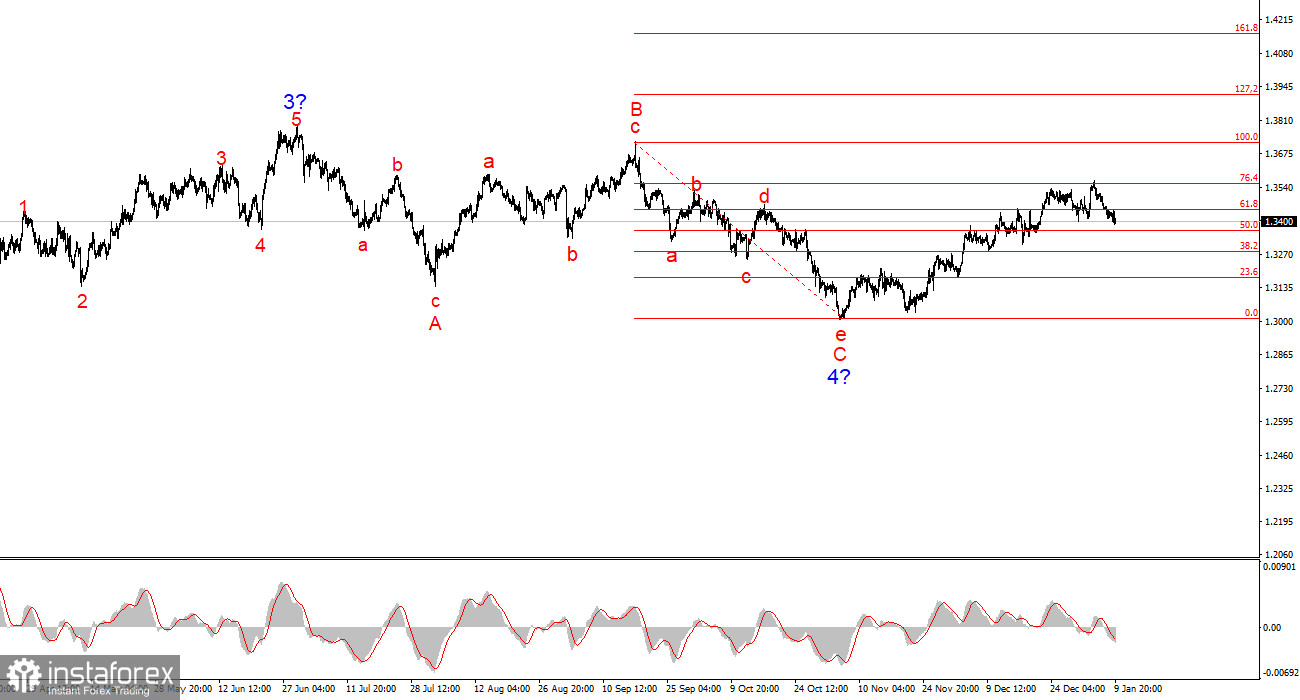
The wave picture of GBP/USD has changed. The downward corrective structure a-b-c-d-e in C of 4 appears to be complete, as does the entire wave 4. If this is indeed the case, I expect the main trend segment to resume its development with initial targets around the 38 and 40 figures.
In the short term, I expected the formation of wave 3 or c with targets located near the marks 1.3280 and 1.3360, which correspond to 76.4% and 61.8% on the Fibonacci scale. These targets have been reached. Wave 3 or C has presumably completed its formation, so in the near term, a downward wave or a set of waves may be observed.
InstaForex analytical reviews will make you fully aware of market trends! Being an InstaForex client, you are provided with a large number of free services for efficient trading.


