 Permanecer

Condições de Negociações
Ferramentas


The EUR/USD pair rebounded from bullish imbalance 12 and reversed in favor of the European currency, as I had warned. However, five days have passed since then, and we have not seen any continuation of the upward movement. Traders received another bullish signal that was too good to ignore, yet in recent days something unusual has been happening in the market.
First, the market reacted in a very one-sided manner to the Nonfarm Payrolls report, according to which only 181,000 jobs were created throughout all of 2025. If that had been a single-month figure, it could have been considered positive. Then the market ignored the fact that inflation in the U.S. slowed to the 2–2.5% range, which significantly brings the Federal Reserve closer to another round of monetary easing. The dollar has not risen strongly on all these reports, but at the same time it continues to climb and may soon retest bullish imbalance 12 for a second time.
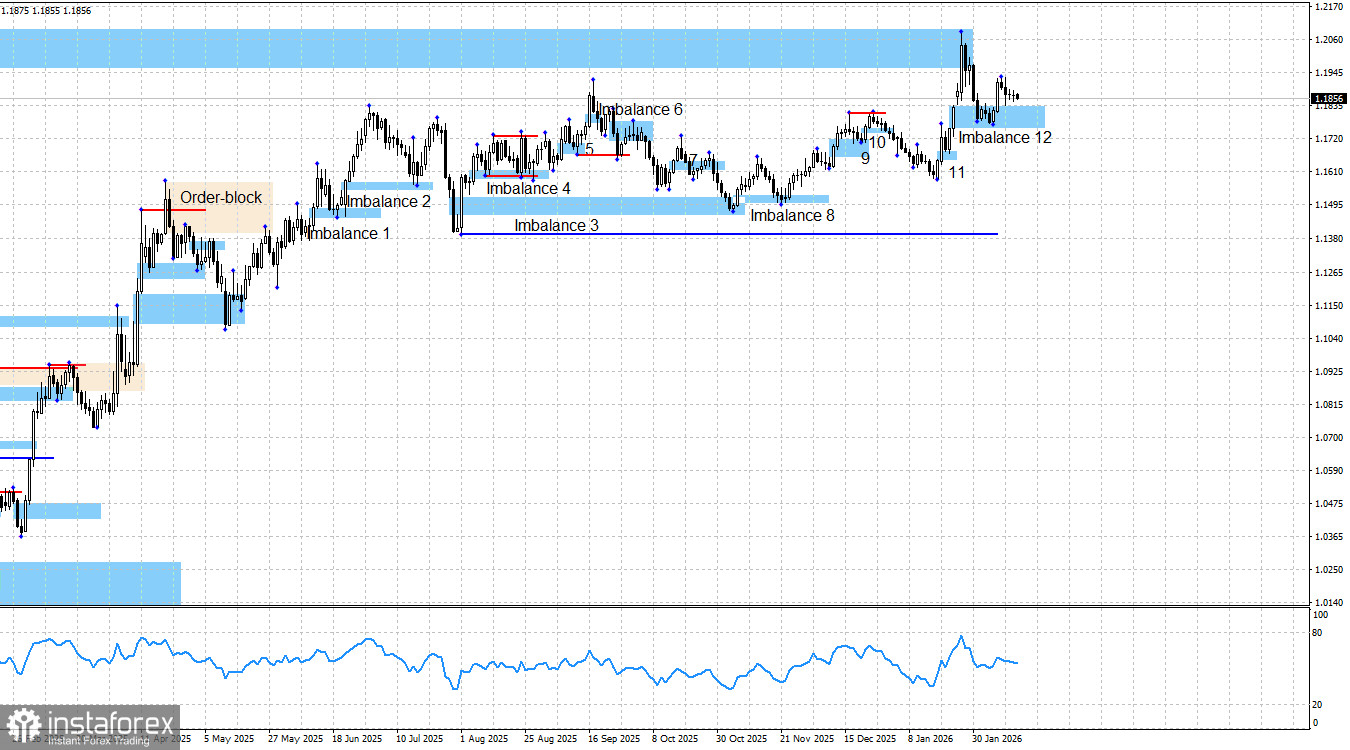
There is nothing alarming about that, but it is rather strange to see the dollar strengthening when almost all the news points toward its decline. Let us observe how the situation develops. Imbalance 12 acts not only as a zone of interest but also as a support zone. If it is invalidated, the European currency could significantly worsen its position.
The chart picture continues to signal bullish dominance. The bullish trend remains intact. A bullish signal was formed within imbalance 11, and later another bullish signal appeared within imbalance 12. Thus, traders can continue holding long positions. If you look closely, another bullish imbalance from February 9 can also be seen. Since it is relatively small, I did not mark it separately on the charts, but it is present, supports the bulls, and may also generate a reaction.
On Monday, the news background created favorable conditions for the bears, as the only report on industrial production in the European Union once again came out negative. Output in December declined by 1.4% month-on-month and increased by 1.2% year-on-year, which was worse than traders' expectations. However, in my view, U.S. data is more important and more pessimistic. Therefore, the five-day euro growth cannot be explained solely by the EU industrial production report.
The bulls have had sufficient reasons for another offensive for the past six to seven months, and each week their arguments only grow stronger. These include the dovish outlook for FOMC monetary policy, the overall policy of Donald Trump (which has not changed recently), U.S.–China tensions (with only a temporary truce), protests by Americans against Trump under the "No Kings" slogan, weakness in the labor market, the autumn government shutdown that lasted one and a half months, and a new shutdown at the beginning of February. Additionally, there is U.S. military aggression toward certain countries, criminal proceedings against Powell, the "Greenland confusion," and worsening relations with Canada and South Korea. Therefore, further growth of the pair seems entirely logical to me.
I still do not believe in a bearish trend. The news background remains extremely difficult to interpret in favor of the dollar, so I do not attempt to do so. The blue line marks the price level below which the bullish trend can be considered over. The bears would need to push the price down by about 460 pips to reach it, and I consider this task unrealistic under the current news background and chart structure, where not a single bearish pattern is present.
As a growth target for the European currency, I previously considered the bearish imbalance at 1.1976–1.2092 on the weekly chart, formed back in June 2021. This pattern has now been fully filled. Above it, two levels can be highlighted: 1.2348 and 1.2564. These correspond to two peaks on the monthly chart.
News Calendar for the U.S. and the Eurozone:
On February 17, the economic calendar contains three entries, none of which are particularly important. The impact of the news background on market sentiment on Tuesday may be very weak.
EUR/USD Forecast and Trading Advice:
In my opinion, the pair remains in the stage of forming a bullish trend. Although the news background continues to favor the bulls, the bears have regularly launched attacks in recent months. Still, I see no realistic reasons for the start of a bearish trend.
From imbalances 1, 2, 4, 5, 3, 8, and 9, traders had opportunities to buy the euro. In all cases, we saw a certain degree of growth, and the bullish trend persisted. Later, a new bullish signal formed from imbalance 11, once again allowing traders to open long positions targeting 1.1976. That target was reached. Last week, another bullish signal formed within imbalance 12, giving traders yet another opportunity to buy the pair. The formal targets remain 1.2348 and 1.2564.
InstaForex analytical reviews will make you fully aware of market trends! Being an InstaForex client, you are provided with a large number of free services for efficient trading.


