 Permanecer
Condições de Negociações
Ferramentas



The EUR/USD currency pair traded in a completely illogical manner on Monday once again. Moreover, the illogic of movements started not yesterday or even Friday. It began the week before last when labor market and unemployment data were published in the U.S. Recall that the unemployment rate fell for the second consecutive month, and the Nonfarm Payrolls (NFP) reached 130,000, which significantly exceeded expert forecasts. So what is negative about this? The issue is that the market currently sees no negativity for the dollar. The January NFP and unemployment figures were encouraging, but how do we handle the year-end data revisions for 2025? Since when did annual data become less important than monthly data? Over the course of 2025, the American economy created 181,000 jobs (slightly more than in January 2026). This should have prompted the dollar to plummet. How can we speak of a recovery in the labor market when the Bureau of Statistics revises its own reports downward every month, and the January outcome was only 130,000 new jobs, which is not very impressive?
Next came the inflation report in the U.S. Inflation slowed to 2.4%, which is even below forecasts. Lower inflation means fewer grounds for the Federal Reserve to keep the key interest rate at its current level. Yet the market did not take this factor into account. The dollar continues to rise. It is rising slowly and modestly, but it is rising nonetheless.
The absurdity culminated last week. First, the U.S. GDP report for the fourth quarter showed growth half the forecast. Let's emphasize this: the growth was not 0.1-0.2% smaller, but a full 50% lower!!! This report also went unnoticed. Then, on Friday evening, the U.S. Supreme Court ruled that Donald Trump's trade tariffs were illegal, but Trump immediately responded with new 15% tariffs on all countries, stating that no one intends to return the money collected in 2025. If the cancellation of tariffs could indeed have been seen as positive for the dollar, the immediate reinstatement of tariffs effectively puts an end to any hopes of their future repeal.
Monday's trading in the American currency started off predictably—with a decline—but by the morning, the U.S. dollar began to appreciate again, adhering to the dynamics of the past two weeks. Thus, we consider the market movements to be illogical. At least, they cannot be explained through fundamentals and macroeconomics. Naturally, if the dollar is rising, it is being bought by someone. However, predicting market makers' actions, especially illogical ones, is impossible. By the way, it is certainly not central banks buying dollars, as the share of dollar reserves over the weekend dropped to its lowest level in the past 20 years—56.9%.
Thus, we believe that under the current circumstances, more attention should be paid to technical analysis. It currently best predicts what to expect from the EUR/USD pair and other currency pairs.
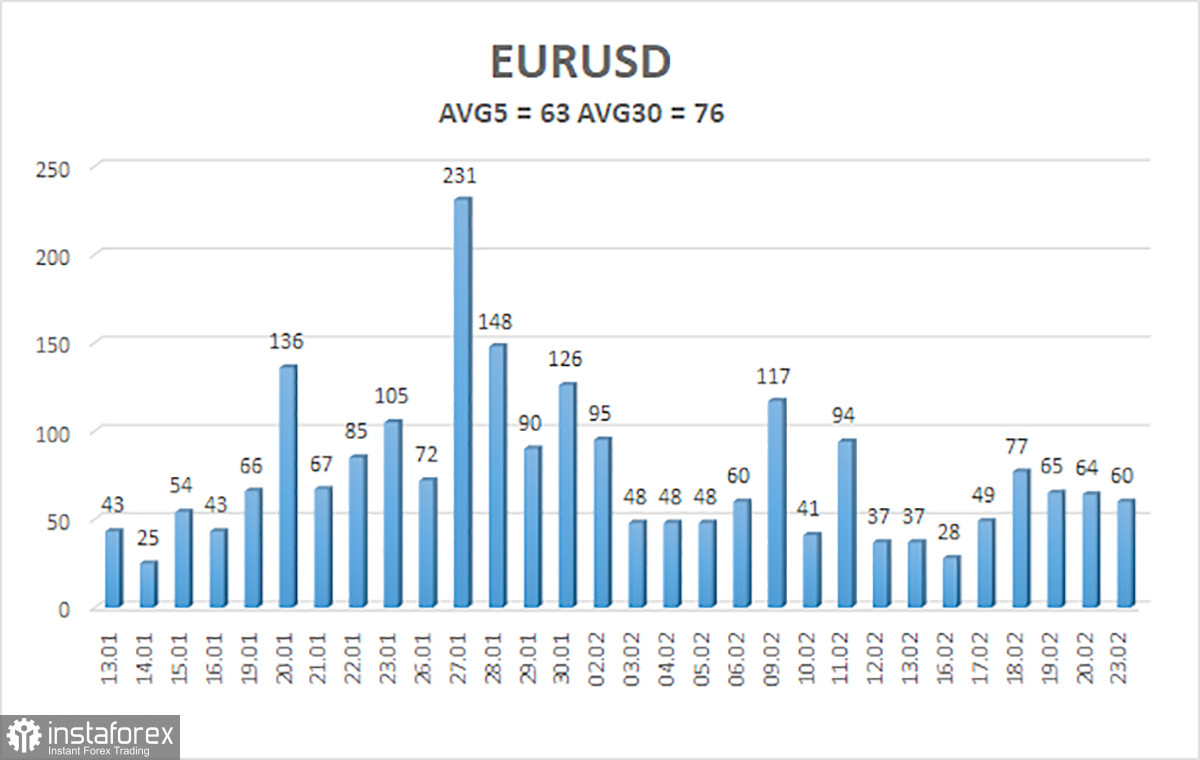
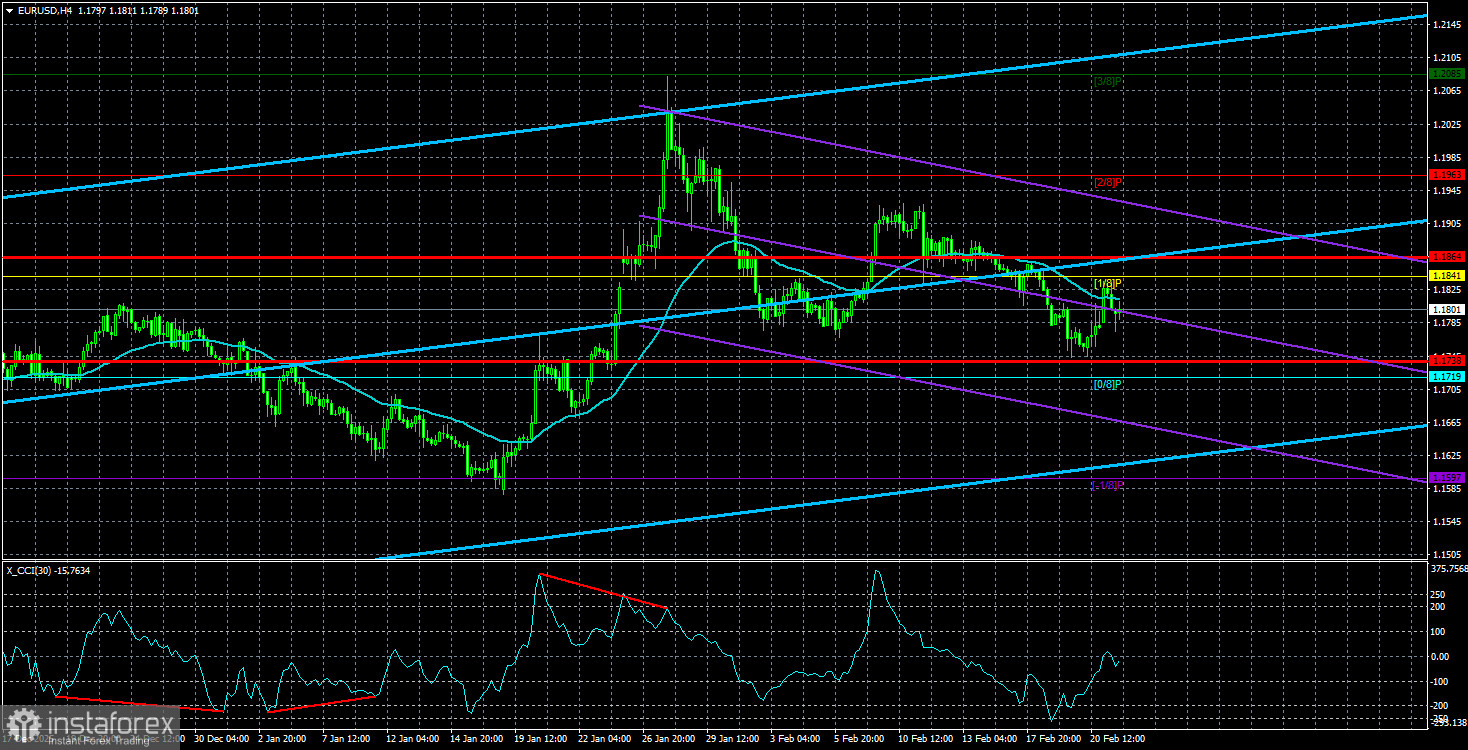
The average volatility of the EUR/USD currency pair over the last 5 trading days as of February 24 is 63 pips, which is considered "average." We expect the pair to trade between 1.1738 and 1.1864 on Tuesday. The upper channel of the linear regression is pointing upwards, indicating further euro growth. The CCI indicator entered the oversold area, signaling a potential resumption of the upward trend.
S1 – 1.1719
S2 – 1.1597
S3 – 1.1475
R1 – 1.1841
R2 – 1.1963
R3 – 1.2085
The EUR/USD pair continues to correct within an upward trend. The global fundamental background remains extremely negative for the dollar. The pair spent seven months in a sideways channel, and it is likely that now is the time to resume the global trend of 2025. The dollar has no fundamental basis for long-term growth. Therefore, everything the dollar can hope for is a sideways move or corrections.
With the price positioned below the moving average, small shorts might be considered with targets at 1.1738 and 1.1719 on purely technical grounds. Above the moving average line, long positions remain relevant with targets at 1.1963 and 1.2085.
Linear regression channels help determine the current trend. If both are directed in the same way, the trend is currently strong;
The moving average line (settings 20,0, smoothed) determines the short-term trend and direction in which trading should currently be conducted;
Murray levels are target levels for movements and corrections;
Volatility levels (red lines) indicate the likely price channel in which the pair will trade over the next 24 hours, based on current volatility indicators;
The CCI indicator entering the oversold area (below -250) or the overbought area (above +250) indicates that a trend reversal is approaching in the opposite direction.
InstaForex analytical reviews will make you fully aware of market trends! Being an InstaForex client, you are provided with a large number of free services for efficient trading.


