 Permanecer

Condições de Negociações
Ferramentas


The war in Iran remains the main topic in the currency market, but it is laden with numerous questions that are extremely difficult to answer. First and foremost, traders are interested in answers to the following questions: How long will the capital flight from risks and war continue? How long will the conflict in the Middle East last? Which countries will be involved in it in one way or another? How will economies react to rising energy prices? What will be the responses from central banks? Will individual countries be able to negotiate the unblocking of the Hormuz Strait for their ships? Will the oil conflict in Yemen escalate? Can Donald Trump end at least one real war in the world?
It is almost impossible to answer all these questions, but I will try to address some of them. Perhaps the most important question for everyone is how long capital will flee from war and risk, and how long the dollar will rise against this backdrop? I would like to note that there is always someone at war in the world, but currency and financial markets do not respond to every conflict. This is because the consequences of many African or Asian conflicts do not pose a threat to the economies of developed countries. I also want to mention that over four years ago, the conflict between Ukraine and Russia began, and in the first months of this conflict, which one side referred to as a "special military operation" and the other as "invasion" and "aggression," the markets were also shaken.
This happened because Ukraine is the nearest border to Europe, and EU countries rightly began to believe they could become involved in the war. On the other hand, Russia is one of the world's largest exporters of oil and gas. Therefore, the Ukraine-Russia conflict directly affected the economy of the European Union and many countries worldwide. But recall how long the markets remained in turmoil? A month or at most two? Then market participants became accustomed to the new objective reality, adapted to it, and thereafter no longer reacted so painfully to news from the Ukraine-Russia front. In my opinion, the situation with the war in the Middle East will be quite similar. If this war lasts a year or two, will demand for the US dollar rise during that time? Especially considering that Donald Trump remains the President of the United States and that all his actions over the past year have only led to capital flight from the dollar?
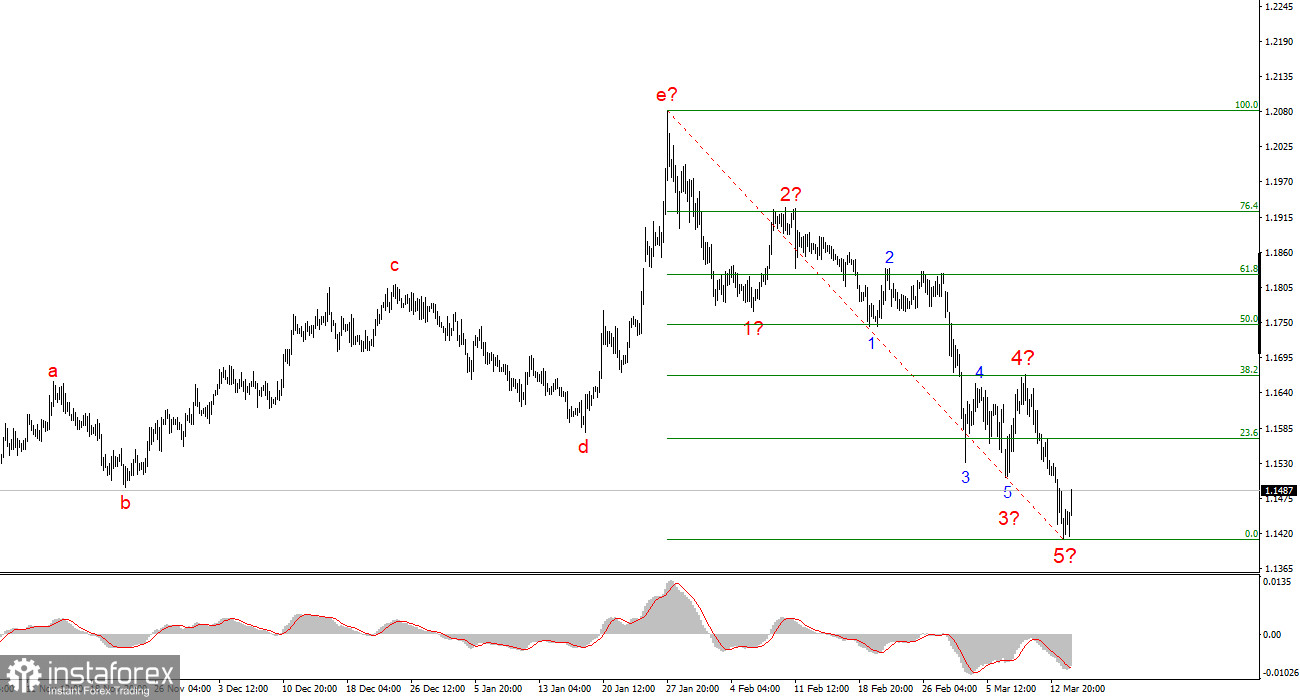
Based on my analysis of EUR/USD, I conclude that the instrument remains within an upward segment of the trend (lower chart), but in the short term, it has begun forming a downward segment of the trend. Since the five-wave impulse structure has been completed, my readers can expect a price increase over the next week or two, with targets around 1.1568 and 1.1666, which correspond to the 23.6% and 38.2% Fibonacci levels. Further movements of the instrument fully depend on developments in the Middle East.
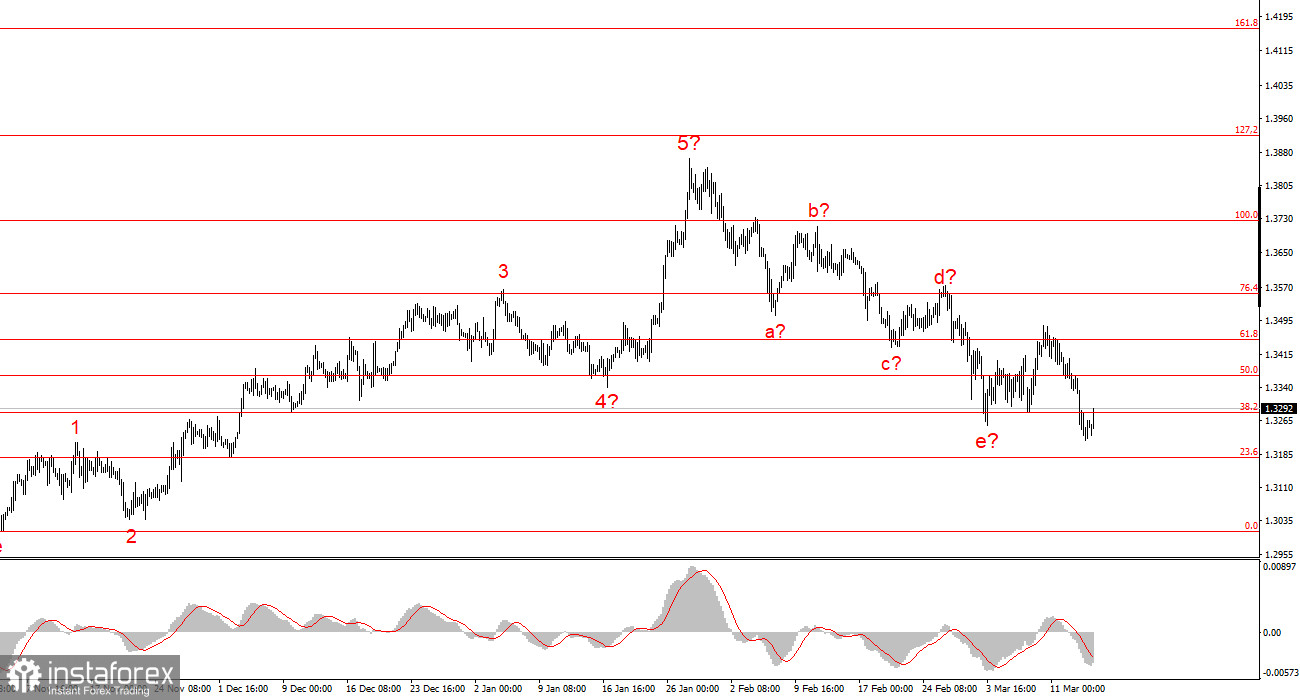
The wave picture of the GBP/USD instrument has become very complex and difficult to read. We now see a seven-wave downward structure on the charts, which is certainly not such. Most likely, there is an extension or complication within one of the waves. However, this does not make the wave count clearer. If the wave picture has once become complicated to the point of unreadability, it can become complicated again several times. Therefore, I believe that one should currently rely on the wave count of the EUR/USD instrument, which looks much more understandable. Also, do not forget the geopolitical factor, which can send both instruments into a new decline at any time. If this does not happen, the euro and the pound may see a slight increase within the context of a correction.
InstaForex analytical reviews will make you fully aware of market trends! Being an InstaForex client, you are provided with a large number of free services for efficient trading.


