 Permanecer
Condições de Negociações
Ferramentas



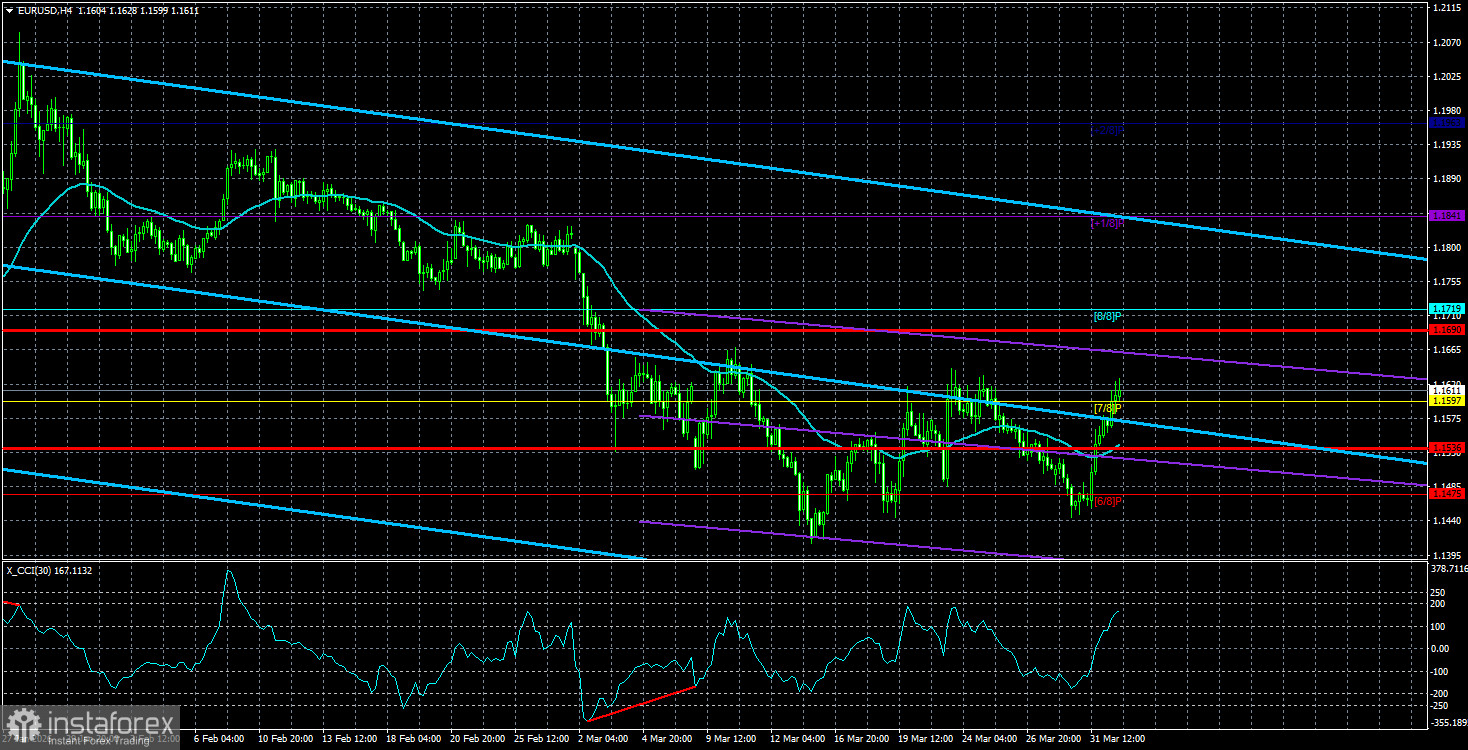
The EUR/USD currency pair continued its upward movement throughout Wednesday, much to the delight of many. Currency traders rejoiced that the geopolitical factor is finally taking a back seat. The whole world celebrated the potential decline in oil and gas prices. Donald Trump was undoubtedly pleased that he would soon conclude the world's tenth war. And Iran was happy that strikes on its territory would cease, but it would now charge for passage through the Strait of Hormuz.
On Monday, Iranian President Masoud Pezeshkian announced that his country was ready to end the conflict, but would demand guarantees of security in return. Pezeshkian stated that his country has never sought war, but at the same time does not shy away from it. Tehran is not prepared to accept foreign ultimatums or live at Washington's whim. However, if there is an opportunity to end the war justly, it should be done.
What conclusions can be drawn from this event? Right now, all markets are experiencing euphoria amid the potential de-escalation. Brent crude oil has fallen from $109 to $100 per barrel. The US dollar against the euro has dropped from 1.1460 to 1.1600. However, we would like to warn traders against opening long positions mindlessly. Most likely, the war will indeed conclude soon, simply because the United States is not interested in a long-term conflict. Therefore, Trump will announce a complete victory over the enemy, having accomplished all objectives. What will happen to the Strait of Hormuz and oil prices is of little interest to Trump. If it remains blocked, it may even be better for the US, since America is the world's largest oil producer. Internal gasoline prices and inflation do not seem to interest the US president much.
However, the key thesis that markets must hear is "if security guarantees are provided." Tehran is ready for peace if it is guaranteed non-aggression in the future. It is unclear who is to act as a guarantor. It is also unclear who in the world would want to serve as a guarantor. Therefore, at this moment, there is no truce. But it is still better for countries to at least be moving in that direction than to simply fight and reject negotiations.
What will happen next with the dollar? The US currency has remained the main beneficiary of the Iranian conflict over the past month and a half. Initially, markets prepared for conflict and then fled from risks into the dollar. Now, however, the dollar has fallen for two consecutive days, and the market is gradually shifting its focus from geopolitics to the economy. We believe that if the geopolitical factor stops supporting the US dollar, the EUR/USD pair could quickly return to its starting positions, which means levels from early 2026, in the range of 1.1800-1.2000.
Why might this happen? If the conflict ends soon, the dollar will lose its only remaining growth driver. Recall that the economic data coming from across the ocean is extremely poor, and the Federal Reserve, unlike the ECB and the Bank of England, has no intention of tightening monetary policy.
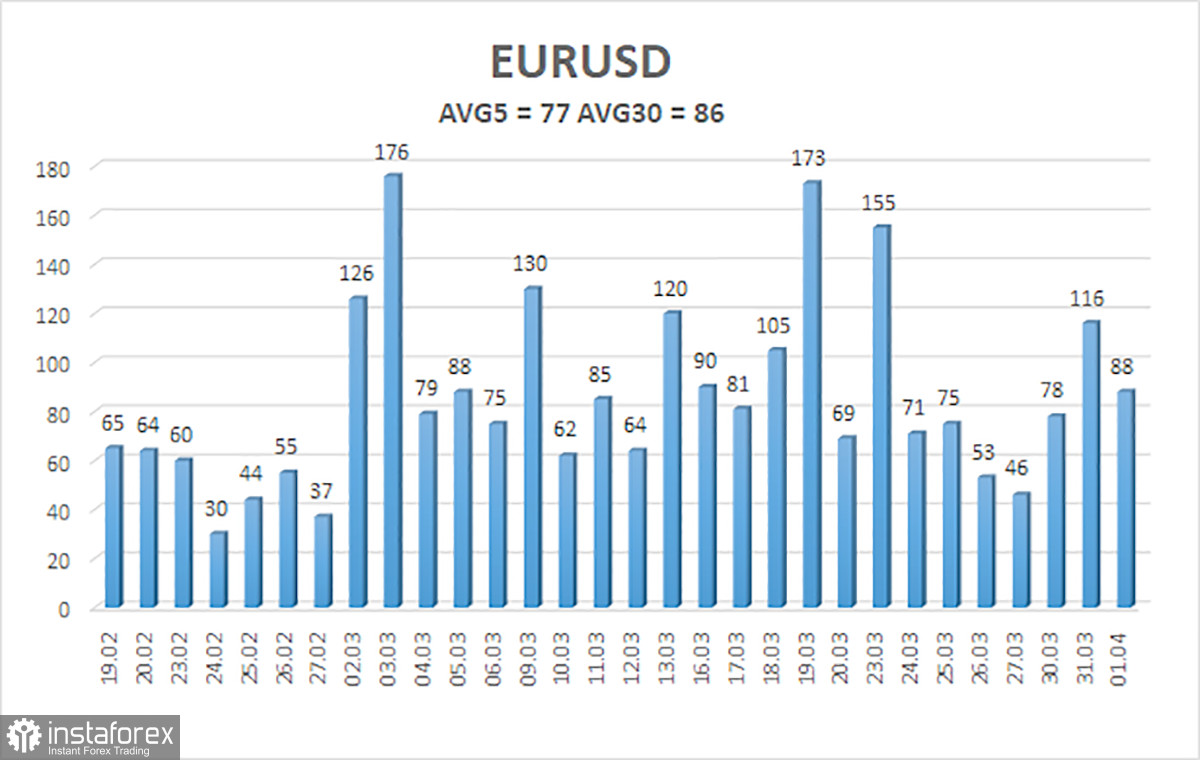
The average volatility of the EUR/USD currency pair over the last 5 trading days as of April 2 is 77 pips, which is considered "average." We expect the pair to trade between 1.1536 and 1.1690 on Thursday. The upper channel of the linear regression has turned downwards, indicating a change in trend. The CCI indicator has entered the oversold area and has formed a "bullish" divergence, which once again warns of the completion of the downward trend.
S1 – 1.1597
S2 – 1.1475
S3 – 1.1353
R1 – 1.1719
R2 – 1.1841
R3 – 1.1963
The EUR/USD pair continues its downward movement, prompted by geopolitics. The global fundamental backdrop for the dollar remains extremely negative; however, for over a month, the market has focused solely on geopolitics, so other factors have little significance. With the price below the moving average, shorts can be considered, with targets at 1.1475 and 1.1353. Above the moving average line, long positions are relevant with targets of 1.1690 and 1.1719. For stronger upward movement, the geopolitical backdrop must begin to stabilize.
Linear regression channels help define the current trend. If both are oriented in the same direction, it indicates that the trend is strong;
The moving average line (settings 20.0, smoothed) defines the short-term trend and the direction in which trading should currently be conducted;
Murray levels are target levels for movements and corrections;
Volatility levels (red lines) represent the probable price channel in which the pair will remain over the next day, based on current volatility indicators;
The CCI indicator entering the oversold area (below -250) or the overbought area (above +250) indicates that a trend reversal in the opposite direction is approaching.
InstaForex analytical reviews will make you fully aware of market trends! Being an InstaForex client, you are provided with a large number of free services for efficient trading.


