 Permanecer

Condições de Negociações
Ferramentas


The EUR/USD pair reversed in favor of the US dollar at the beginning of the week, fully moved through bullish imbalance 14, and has now reached imbalance 13, which has not yet been tested. Honestly, the decline in the euro this week is concerning. It cannot be called groundless; there were strong reasons behind it. However, the market seems to have simply grown tired of waiting for positive news. I believe the main issue lies in geopolitics rather than the Fed's monetary policy, inflation reports, or the UK political crisis. These latter factors may have intensified pressure on the euro, but over recent years political crises in the UK have occurred with alarming regularity, and the Fed has not yet sent any signals about potential monetary tightening.
Thus, I believe the market spent about a month pricing in the end of the Middle East conflict and the reopening of the Strait of Hormuz. It has now completely lost faith in this scenario. This is what is driving the renewed strength of the US dollar. At present, Donald Trump is again urging Iran to sign an agreement with the United States as soon as possible, indirectly hinting at possible strikes otherwise. Iran continues to insist on its list of demands and refuses to make concessions. Negotiations are currently at an impasse.
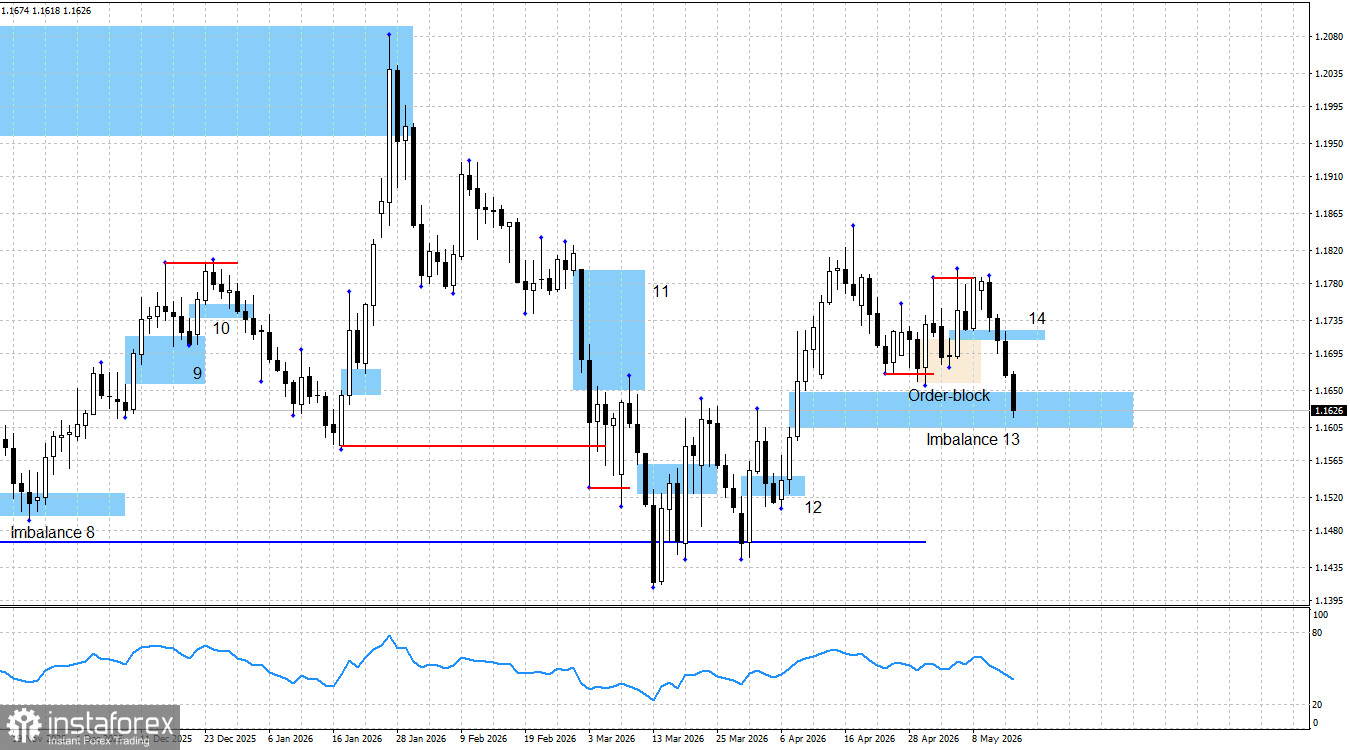
In the current situation, traders are left waiting for a reaction at imbalance 13, which represents the last bullish pattern in the current bullish impulse. If the decline in the pair is treated as a corrective pullback, it may well conclude within imbalance 13. It should be noted that patterns alone do not provide trading entry signals. They must be confirmed by signals on lower timeframes—for example, a break of structure or bullish patterns. In other words, there must be signs of a reversal. If there are none, then there is no signal either. Thus, at the moment I am waiting for a reaction at imbalance 13. I consider this week's decline excessive. The war in the Middle East has not resumed.
I cannot help but note once again that the entire rise of the US dollar in January–March was driven solely by geopolitics. As soon as the US and Iran agreed on a ceasefire, the bears immediately retreated, and for more than a month bulls have been in control. At present, the truce is quite fragile, but negotiations continue, and the chances of peace still remain. I have repeatedly said that I do not believe in the end of the bullish trend, despite the breakdown of important trend-defining lows and despite the war in Iran. The market often prices in the most pessimistic scenario immediately, trying to anticipate the most extreme outcome. Thus, I assume that traders have already fully priced in the geopolitical conflict in the Middle East. In this case, I do not expect a strong bearish advance.
The overall chart structure is currently as clear as day. The bullish advance remains intact but urgently requires support. Ideally, this support would be geopolitical—namely, the resumption of negotiations between Iran and the US and eventual concessions from both sides. Without a positive news backdrop, it will be difficult for the euro to strengthen.
The economic backdrop on Friday was once again in favor of the dollar. Today, only one report was released on US industrial production, and it came in stronger than traders expected, which only reinforced the bearish momentum. Throughout all five days this week, the market has had solid reasons to sell EUR/USD.
There are still many reasons for bulls to remain active in 2026, and even the start of the Middle East war has not reduced them. Structurally and globally, the policy of Donald Trump—which led to a significant drop in the dollar last year—has not changed. In the coming months, the US currency may occasionally strengthen due to risk-off flows, but this requires continuous escalation of the Middle East conflict. I still do not believe in a bearish trend. The dollar has received temporary support from the market, but what would sustain long-term bearish momentum?
Economic calendar for the US and the Eurozone:
On May 18, the economic calendar contains no noteworthy events. The macroeconomic backdrop will have no impact on market sentiment on Monday.
EUR/USD forecast and trading advice:
In my view, the pair remains in the process of forming a bullish trend. The information backdrop changed sharply three months ago, but the trend itself cannot be considered broken or completed. Thus, in the near term, bulls may well resume their advance if geopolitics does not continue to undermine traders' confidence in a positive resolution of the conflict.
Traders had opportunities to open long positions based on the imbalance 12 signal, as well as the order block signal. The upward movement may resume all the way to the yearly highs from imbalance 13. However, in the coming days it is important for bulls to maintain control of the market. For uninterrupted euro growth, the Middle East conflict must move toward a stable peace, and some signs of de-escalation do occasionally appear. However, this remains a rare occurrence. Bullish traders currently do not have sufficient support for a new impulse. The buying zone is imbalance 13.
InstaForex analytical reviews will make you fully aware of market trends! Being an InstaForex client, you are provided with a large number of free services for efficient trading.


