 Permanecer

Condiciones de negociación
Products
Herramientas


The euro and pound ignored the fact that U.S. President Donald Trump instructed his administration to consider imposing retaliatory tariffs on multiple trading partners, increasing the likelihood of a broader U.S. trade war with the rest of the world. However, the U.S. dollar did not see strong demand as a result. The primary reason for this appears to be the more gradual approach to imposing trade barriers than initially expected.
Yesterday, President Trump signed an executive order directing the U.S. Trade Representative and the Secretary of Commerce to propose new tariffs on each country as part of an effort to restore trade balance. This is a large-scale process that could take weeks or months, with the findings expected to be finalized by April 1.
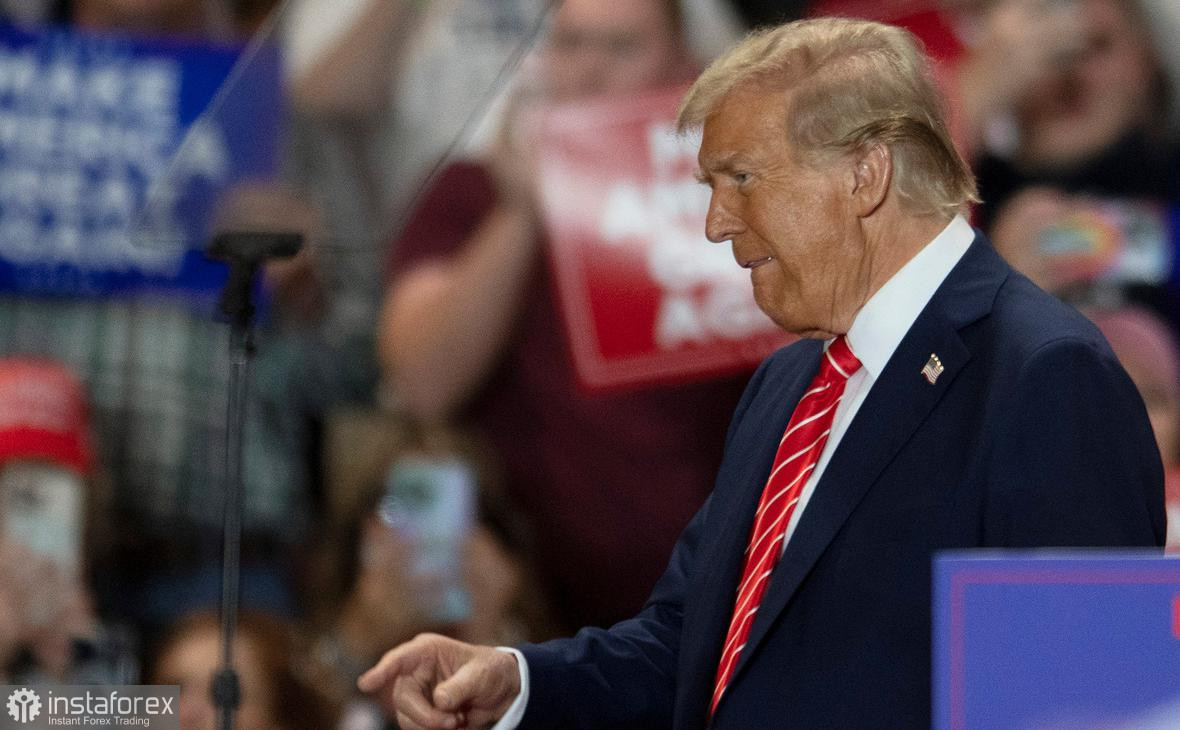
"New import tariffs will be adjusted for each country to compensate not only for their own tariffs on U.S. goods but also for non-tariff barriers, including unfair subsidies, regulations, value-added taxes, exchange rates, weak intellectual property protections, and other trade restrictions against the U.S.," the White House stated in a memorandum released yesterday.
Markets reacted positively to signs that tariffs would not be imposed immediately.
"In the interest of fairness, I have decided to impose reciprocal tariffs—that is, the same tariffs that countries impose on the United States," Trump said in the Oval Office. "In almost all cases, they charge us far more than we charge them, but those days are over."
Trump also announced plans to impose tariffs on automobiles, semiconductors, and pharmaceuticals in the future.
The president specifically criticized the European Union's VAT-related trade barriers, indicating that the U.S. will respond. He also singled out Japan and South Korea, accusing them of taking advantage of the U.S., suggesting they could be the next targets of his latest trade efforts.
Experts note that reciprocal tariffs would be Trump's broadest action yet to address the U.S. trade deficit and what he sees as unfair global trade practices. The U.S. has already imposed 10% tariffs on Chinese goods and plans to introduce 25% tariffs on all steel and aluminum imports next month.
However, as mentioned earlier, Trump's decision not to implement tariffs immediately suggests an attempt to initiate negotiations—a strategy he has previously used to extract concessions from Mexico, Canada, and Colombia—rather than a firm commitment to imposing tariffs.
Traders interpreted these steps as a reason to buy risk assets. Speculation that negotiations could ease tariffs has temporarily reduced fears of a full-scale trade war, which could otherwise harm global growth and fuel inflation.
Trump's maneuvering on the edge of a trade war introduces uncertainty into the global economy, as businesses and consumers await potential economic disruptions from policy changes that could strain U.S. trade relations worldwide.
If tariffs are eventually implemented, they could lead to higher prices for imported goods in the U.S., worsening inflation concerns.
As for the current technical picture of EUR/USD, now buyers need to think about how to take the 1.0500 level. This is the only way to target the 1.0530 level. From there, you can climb to 1.0570, but it will be quite problematic to do this without the support of major players. The furthest target will be a maximum of 1.0600. In the event of a decline in the trading instrument only around 1.0430, I expect some serious actions from major buyers. If no one is there, it would be nice to wait for the low of 1.0380 to be updated, or to open long positions from 1.0320.
As for the current technical picture of GBP/USD, the buyers of the pound need to take away the nearest resistance of 1.2600. Only this will allow us to aim at 1.2640, above which it will be quite difficult to break through. The furthest target will be the level of 1.2665. If the pair falls, the bears will try to take control of 1.2535. If this can be done, a breakdown of the range will deal a serious blow to the bulls' positions and push GBPUSD to a low of 1.2480 with the prospect of reaching 1.2435.
¡Los informes analíticos de InstaForex lo mantendrá bien informado de las tendencias del mercado! Al ser un cliente de InstaForex, se le proporciona una gran cantidad de servicios gratuitos para una operación eficiente.


