 Permanecer
Condiciones de negociación
Products
Herramientas




The EUR/USD pair has been continuing its decline for three weeks. The market is reacting in a rather strange and ambiguous way to the news backdrop. At the beginning of the month and the year, frankly weak data on the US labor market, business activity, and unemployment created absolutely no problems for the dollar. Trump carried out a military coup in Venezuela, virtually ordered an airstrike on Iran, announced readiness to seize Greenland by military force, promised tariffs against Iran's partner countries, and introduced new trade tariffs against countries that do not support the sale of Greenland to the United States. And all of this news not only failed to have any noticeable impact on the dollar — it was met with almost no reaction from traders at all. Today, the US dollar slipped slightly and bears retreated. However, market activity remains low, and reactions to events are extremely lethargic.
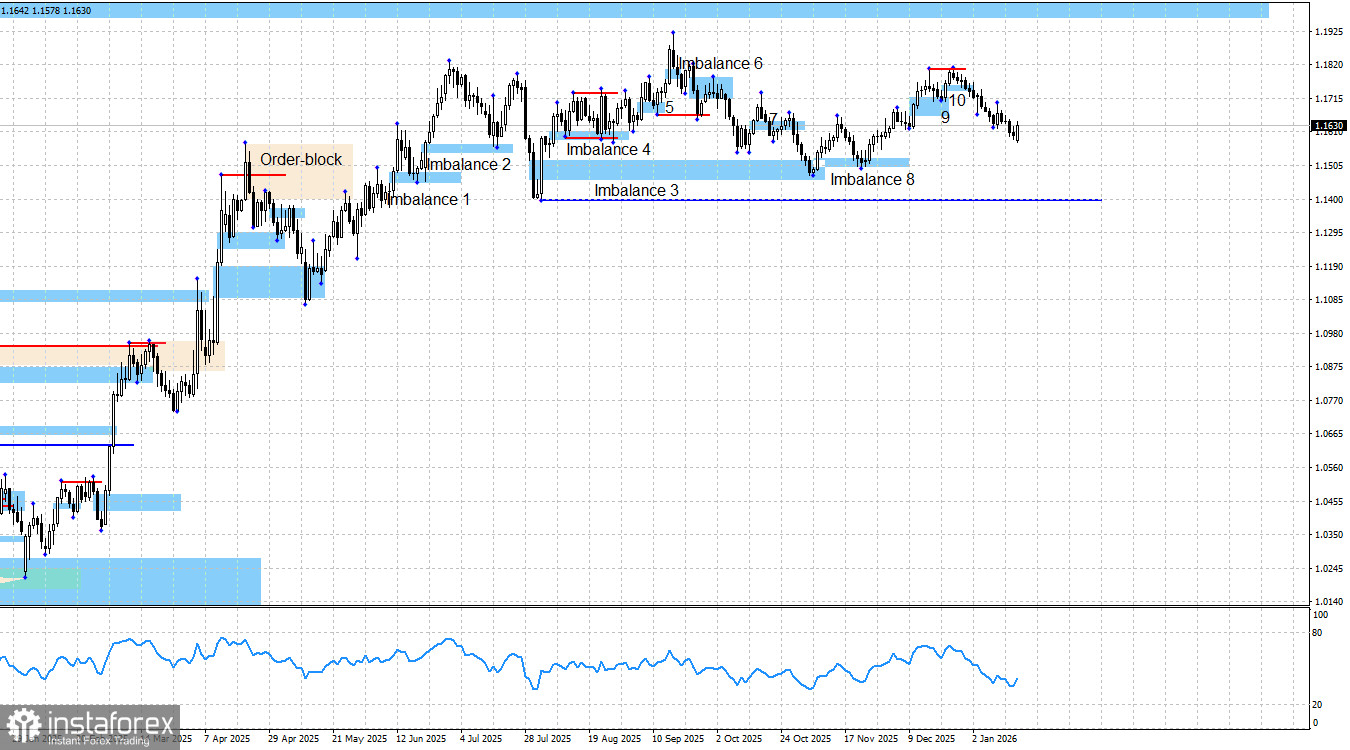
At the moment, traders have two possible trading options. Since the bullish trend remains intact despite the bulls' temporary loss of initiative, one can wait for the formation of new bullish patterns or at least liquidity sweeps of clearly defined bearish swings. The second option is to trade short from bearish patterns, which are currently absent but may appear in the future. However, under the current circumstances, the pair's decline may only be a corrective pullback, which should be kept in mind when opening short positions.
The chart picture continues to signal bullish dominance, but only in the long term. The bullish trend remains in place, but it is merely being maintained rather than developing. A new bullish signal may take quite a long time to form, as there are currently no established, workable bullish patterns.
The news backdrop on Monday can be divided into two parts: economic and political. The economic component was of no value to traders, as the final inflation reading turned out to be even lower than the preliminary one — 1.9% year-on-year. The lower the inflation, the higher the chances of further ECB monetary easing, which is negative for the euro. However, the euro is rising today because the political backdrop (in particular, new trade tariffs from Donald Trump) is more important. Trump introduced new 10% tariffs against a whole list of EU countries and the United Kingdom in response to their refusal to recognize US claims to Greenland. At the very least, the EU is preparing a package of retaliatory tariffs and countermeasures. Thus, the trade war is not only continuing but is gaining new momentum in 2026.
The bulls have had plenty of reasons for a renewed offensive for the past four to five months, and with each passing day those reasons only increase. These include the (in any case) dovish outlook for FOMC monetary policy, Donald Trump's overall policy (which has not changed recently), the US confrontation with China (where only a temporary truce has been reached), protests by the American public against Trump under the "No Kings" banner, weakness in the labor market, bleak prospects for the US economy (recession), and the government shutdown (which lasted a month and a half but was clearly not priced in by traders). And now there is also US military aggression toward certain states, the criminal prosecution of Powell, and new trade tariffs from Trump. Thus, in my view, further growth of the pair is entirely logical.
I still do not believe in a bearish trend. The news backdrop remains extremely difficult to interpret in favor of the dollar, which is why I am not trying to do so. The blue line marks the price level below which the bullish trend could be considered over. Bears would need to push prices down about 240 points to reach it, and I consider this task impossible under the current news backdrop and circumstances. The nearest upside target for the European currency remains the bearish imbalance 1.1976–1.2092 on the weekly chart, which was formed back in June 2021.
The economic calendar for January 20 contains two entries that are not of particular interest. The impact of the news backdrop on market sentiment on Tuesday may be extremely weak.
In my view, the pair remains in the stage of forming a bullish trend. Despite the fact that the news backdrop continues to favor the bulls, bears have been mounting regular attacks in recent months. Nevertheless, I see no realistic reasons for the start of a bearish trend.
From imbalances 1, 2, 4, 5, 3, 8, and 9, traders had opportunities to buy the euro. In all cases, some growth followed, but the bullish trend was not extended. New long positions are acceptable if a new bullish signal is formed. However, at the moment there are no workable bearish or bullish patterns.
¡Los informes analíticos de InstaForex lo mantendrá bien informado de las tendencias del mercado! Al ser un cliente de InstaForex, se le proporciona una gran cantidad de servicios gratuitos para una operación eficiente.


