 Permanecer

Condiciones de negociación
Products
Herramientas


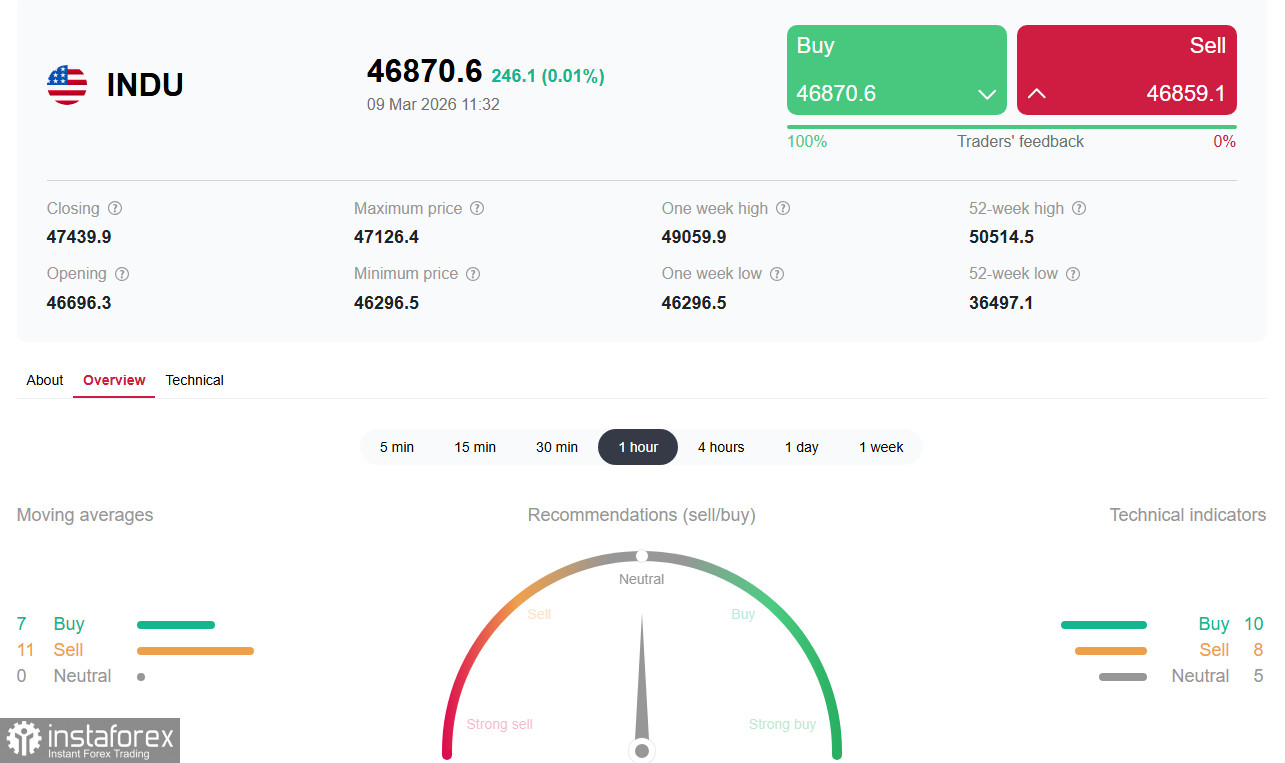
*See also: InstaForex trading indicators for DJIA (INDU)
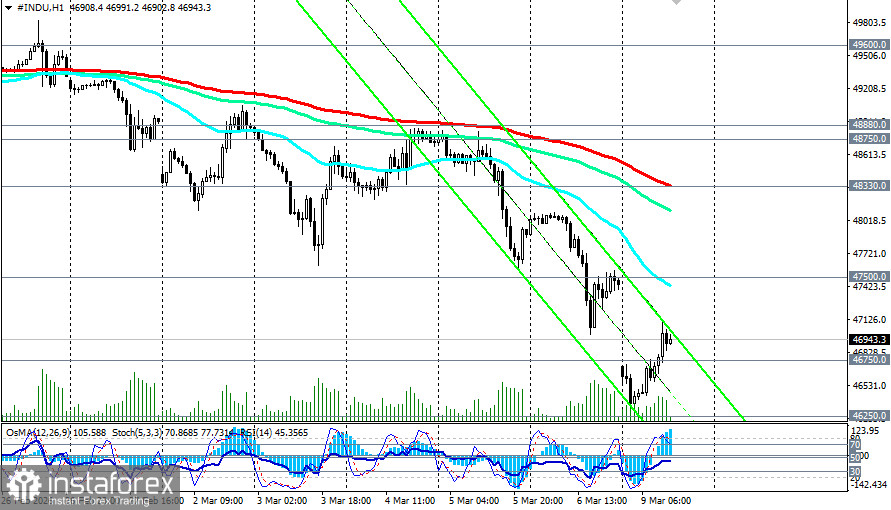
Futures on the Dow Jones index (DJIA) plunged 1.74% on Monday, falling below 46,300.00 during the Asian session. The sell-off was a direct consequence of an explosive rise in oil prices, with Brent topping $113.00 per barrel, and an escalation of the Middle East conflict now in its second week. The market has been caught in the grip of stagflationary fears, where higher energy costs threaten both slower growth and renewed inflationary pressure.
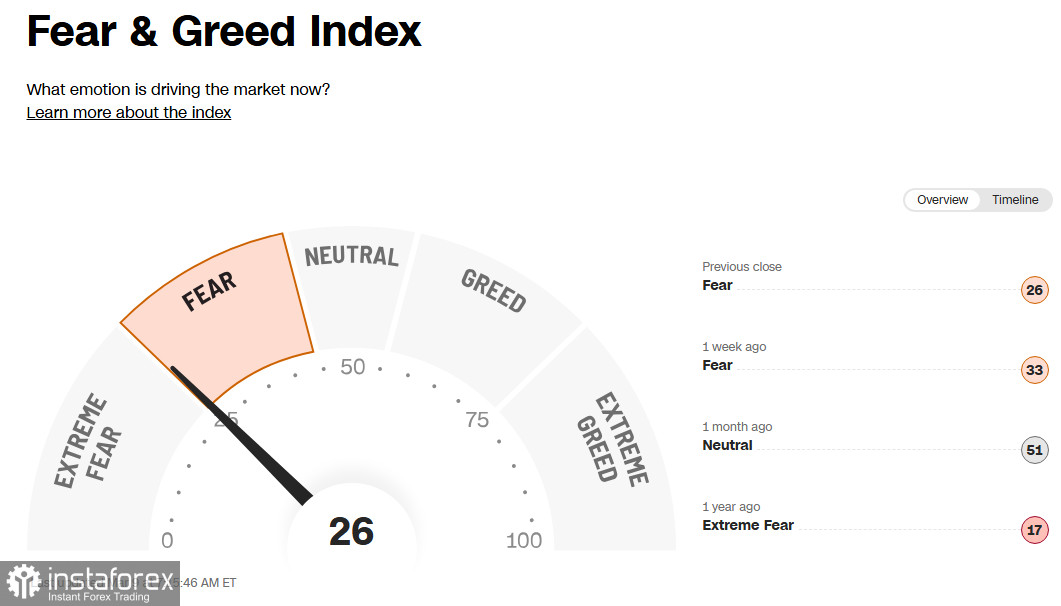
The escalation of the US–Israel campaign against Iran, now in its second week, continues to dominate market sentiment.
The so-called investors' fear & greed index remains in the "fear" zone at 26 (out of 100), essentially on the edge of "extreme fear."
Against this backdrop, the US dollar index (USDX) rose 0.5% on the day to 99.30, and after a more than 1% gain last week, it reached a fresh high since November 2025.
The dollar is being supported not only as a safe-haven asset but also by a reassessment of Fed rate expectations: the rise in oil prices is increasing inflation concerns and forcing investors to push back the timing of monetary easing, as we noted in today's review "USD/CAD: in the grip of geopolitics and an oil rally."
Current situation: perfect storm
Unprecedented oil shock
Crude oil prices exploded higher on Monday: WTI topped $110.00 per barrel (a nine-month high), and Brent climbed above $114.00. Prices rose more than 25% in a single day amid fears of supply disruptions through the Strait of Hormuz.
By mid-European trading, prices had corrected to about $100.00 and $105.00, respectively, after reports that the G7 may coordinate emergency releases from strategic oil reserves.
Market reaction: flight from risk
The S&P 500 and Nasdaq 100 futures fell 1.61% and 1.75%, respectively, dropping below 6,600.00 and 24,000.00 in the Asian session (last week the Dow Jones already lost 3%, the S&P 500 2%, and the Nasdaq 100 1.2%).
The CBOE Volatility Index (VIX) jumped nearly 13%, reaching levels not seen since April 2025.
Asian markets also suffered heavy losses: Japan's Nikkei 225 fell 5.2%, Hong Kong's Hang Seng declined 1.4%, and China's Shanghai Composite dropped 0.7%.
Economists do not rule out the possibility of a market crash of as much as 35% over the rest of the year, worrying that a protracted oil shock could leave the Fed facing a twin challenge: rising inflation and rising unemployment.
At the same time, many believe that if oil prices do not spike and remain elevated only temporarily, the Iran conflict is unlikely to derail expectations for US equities over the next 6–12 months. Historically, geopolitical risks have not produced sustained volatility in US markets.
Meanwhile, the yield on 10-year US Treasuries rose to 4.180% (currently), as investors priced in the chance of higher inflation. Higher energy prices are feeding those expectations: IMF managing director Kristalina Georgieva warned that a sustained 10% rise in oil prices could raise global inflation by about 0.4 percentage points.
Cleveland Fed president Loretta Mester recently said policy should remain unchanged for quite some time until there is clear evidence of lower inflation and labor market stabilization. Inflationary pressure remains broad-based, and tariffs are just one of several concerns for businesses.
According to the CME FedWatch tool, investors now expect a first 25-bp rate cut only in September, whereas before the conflict's escalation, markets had been fully pricing a cut in July. Some traders are even betting the Fed may not cut rates at all this year.
Short technical analysis
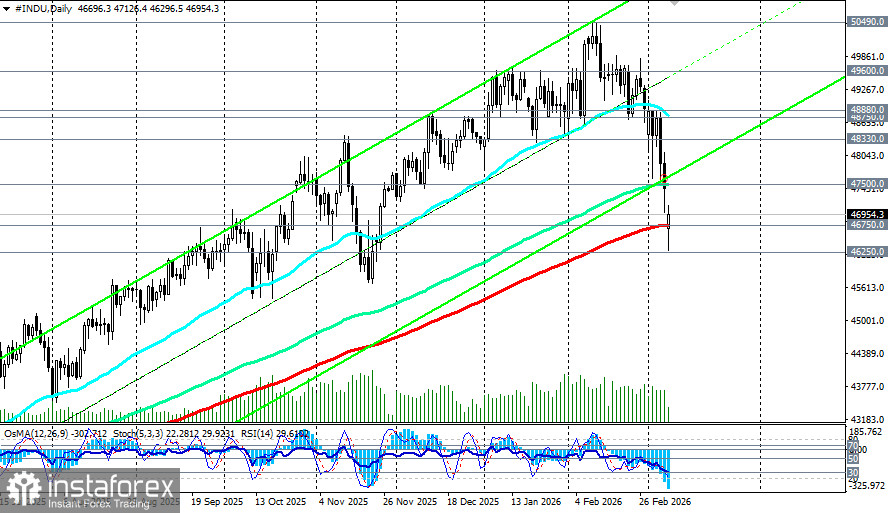
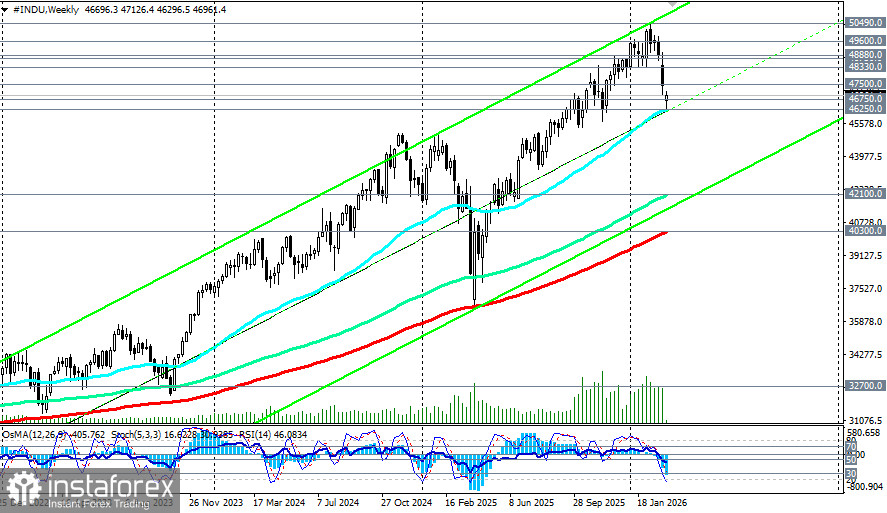
Today, DJIA futures (INDU in the trading terminal) tested key support at 46,750.0 (EMA200 on the daily chart), which separates a medium-term bull market from a bear market, and approached important medium-term support at 46,250.0 (EMA50 on the weekly chart).
Technical indicators (RSI, OsMA, Stochastic) on the daily and weekly charts favor short positions, and on the monthly chart, indicators have also turned to the sell side.
Daily RSI (14): crossing below the 30 level, maintaining a bearish bias (strong negative momentum).
The long-term and global trend of the DJIA remains bullish. However, a break of the 46,250.0–46,000.0 support zone would open the way to further declines.
Key levels
Support: 46,750.0, 46,250.0, 46,000.0, 45,000.0
Resistance: 47,500.0 (EMA144 on the daily chart), then the 48,750.0 (EMA50 on the daily chart)–49,000.0 zone
Short-term scenario (1–5 days)
The key zone remains 46,750.0–47,500. Further action will be determined by diplomatic developments and any G7 measures to stabilize the oil market. Any signs of deescalation could trigger a technical rebound, whereas conflict escalation could push indices to new lows.
Near-term drivers:
· Wednesday: US CPI for February
· Friday: PCE (the Fed's preferred inflation gauge) and vacancies data
· Corporate reports: Oracle, Adobe, Hewlett-Packard Enterprise
Medium-term outlook
Investors will look to this week's CPI and PCE releases for direction. Economists expect inflation to remain around 2.4% year-on-year. Any upside surprise would increase pressure on markets, while softer data would reinforce hopes for Fed easing.
Conclusion
The US equity market has entered a phase of extreme volatility dominated by geopolitical risk. An oil shock driven by the Strait of Hormuz blockade and production disruptions in the region is creating stagflationary fears that put the Fed in a difficult position and force investors to revise forecasts.
The key zone 46,750.0–47,500.0 will be decisive in the coming days—holding it would allow bulls to target a recovery to 48,750.0–49,000.0, while a break would open the way to a deeper correction. Under any scenario, volatility will remain high, and investors should monitor headlines from the Persian Gulf, US inflation data, and central bank responses to the energy crisis closely.
¡Los informes analíticos de InstaForex lo mantendrá bien informado de las tendencias del mercado! Al ser un cliente de InstaForex, se le proporciona una gran cantidad de servicios gratuitos para una operación eficiente.


