 Permanecer
Condiciones de negociación
Products
Herramientas



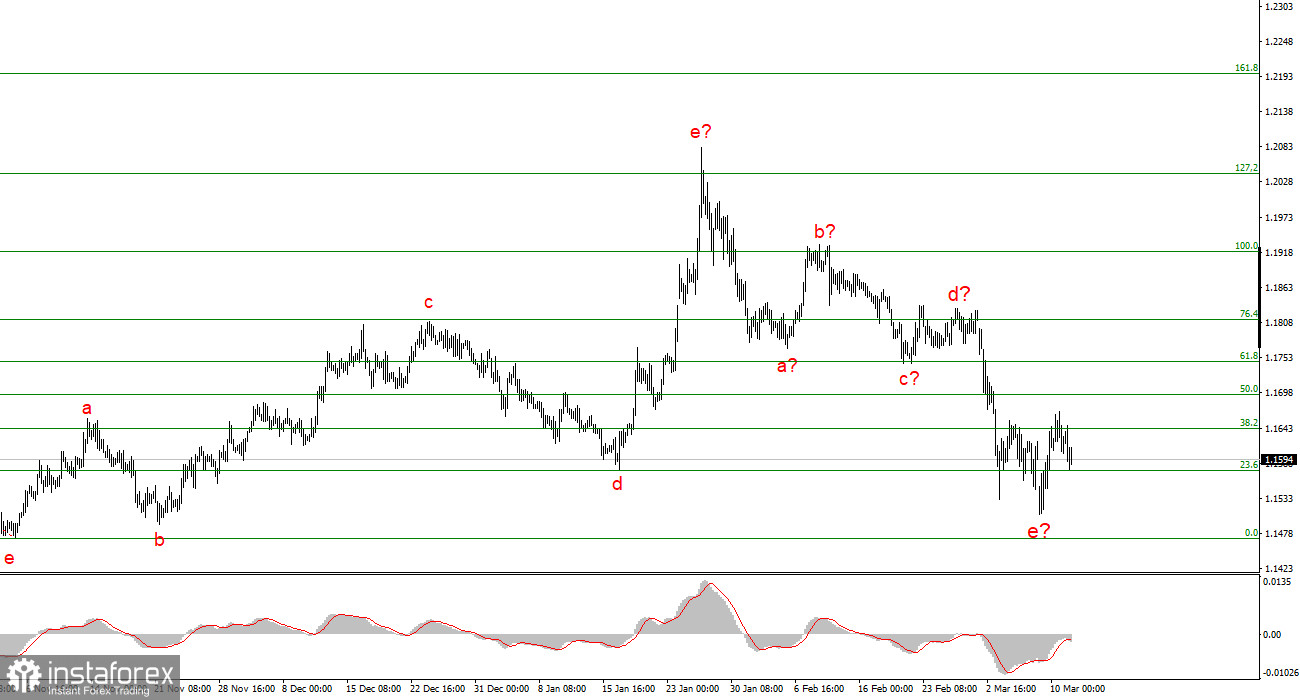
The 4-hour chart wave structure for EUR/USD has taken on a less desirable appearance, but it still raises no major questions. There is still no talk of canceling the upward trend segment that began in January of last year; only the internal wave structure is occasionally adjusted.
In my opinion, the instrument has completed the construction of global wave 4 (lower chart). If this assumption is correct, wave 5 is currently developing. It could become quite extended, with targets reaching as high as the 1.25 level.
The internal structure of the supposed wave 5 is somewhat ambiguous (upper chart). The upward wave sequence cannot be considered impulsive due to the relatively strong corrective waves. Therefore, it is currently interpreted as a-b-c-d-e. However, if wave 5 becomes extended, its internal structure may also become quite complex.
I expect the EUR/USD pair to resume its upward movement, and the a-b-c-d-e corrective structure already appears fairly complete. Unfortunately, it could extend further due to the conflict in the Middle East.
The EUR/USD rate fell by 20–30 basis points on Wednesday, and buyers again received no support from the news background. Today, market participants focused on two main topics: U.S. inflation and geopolitics.
At the beginning of the week it might have seemed that the conflict in Iran was moving toward a resolution, but by Wednesday that no longer appeared to be the case. Iran continues to threaten to block the Strait of Hormuz, which could push oil prices up to $200 per barrel.
In addition, Tehran launched missile strikes against several tankers in the Persian Gulf, while the United States continues bombing Iranian cities.
Thus, the calm observed at the start of the week turned out to be only temporary. By mid-week, oil prices began rising again. Along with oil, the U.S. dollar also strengthened, as demand for it increased due to the lack of any real signs of de-escalation in the war involving Iran.
Donald Trump promised on Monday to end the war soon, but the market has already learned to treat the American president's promises calmly, understanding that they often mean little. Many still remember Trump's promise to end the Russia-Ukraine war within 24 hours.
The second topic—inflation—was also disappointing because it showed no change in February. Neither headline inflation nor core inflation showed any movement compared with the previous month.
Therefore, it is difficult to conclude whether the market's dovish expectations have strengthened or weakened. In my opinion, however, dovish sentiment should currently prevail because U.S. labor market reports in February disappointed even pessimists, and the latest GDP report again raised concerns about a possible recession.
However, for the market, the geopolitical factor remains the dominant influence, and it now contradicts the current wave structure.
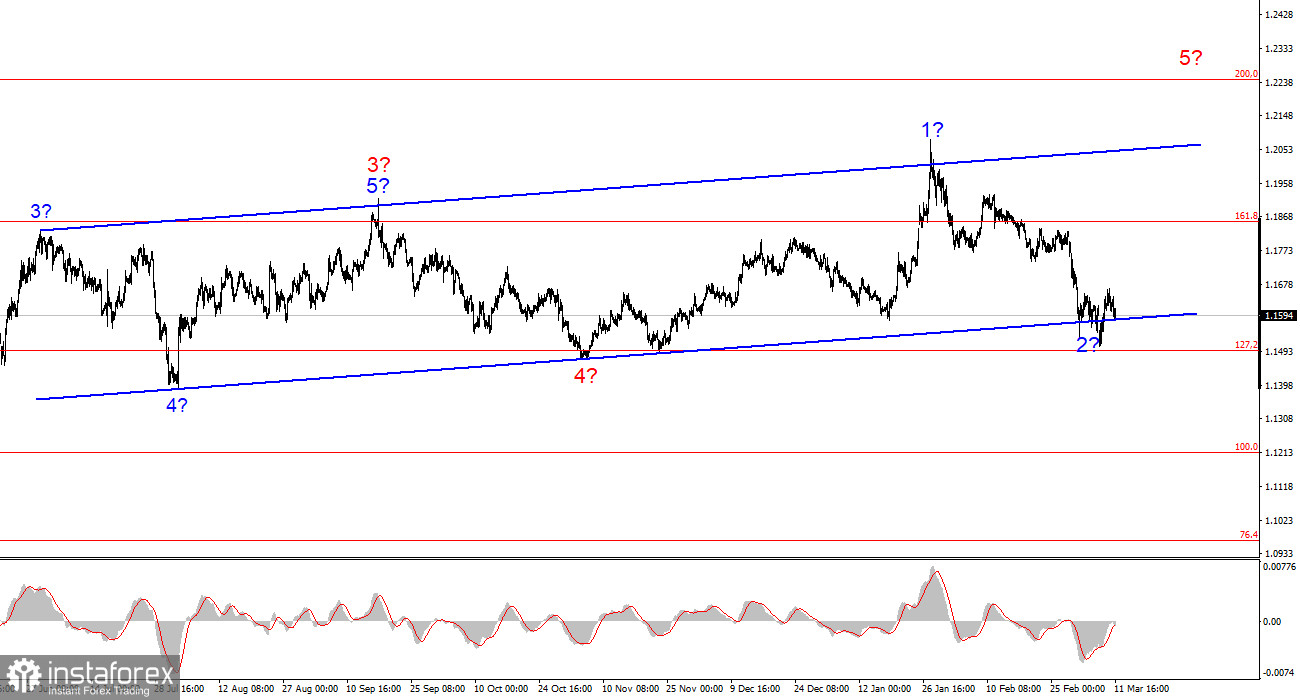
Based on the analysis of EUR/USD, I conclude that the instrument continues forming an upward trend segment. The policies of Donald Trump and the Federal Reserve's monetary policy remain significant long-term factors contributing to the weakness of the U.S. dollar.
The targets of the current trend segment could extend toward the 1.25 level.
At the moment, I believe the instrument remains within global wave 5, so I expect higher quotes in the first half of 2026. The a-b-c-d-e corrective structure may end at any time since it already appears quite convincing.
I currently consider it reasonable to look for buying opportunities with targets around 1.2195 and 1.2367, which correspond to 161.8% and 200.0% Fibonacci levels.
On a smaller scale, the entire upward trend segment is visible. The wave structure is not entirely typical, as the corrective waves differ in size. For example, the larger wave 2 is smaller than the internal wave 2 within wave 3. However, such situations do occur.
It is better to focus on clear and understandable structures on charts rather than rigidly assigning every wave. At the moment, the upward wave structure does not raise doubts.
Key Principles of My Analysis
¡Los informes analíticos de InstaForex lo mantendrá bien informado de las tendencias del mercado! Al ser un cliente de InstaForex, se le proporciona una gran cantidad de servicios gratuitos para una operación eficiente.


