 Permanecer

Condiciones de negociación
Products
Herramientas


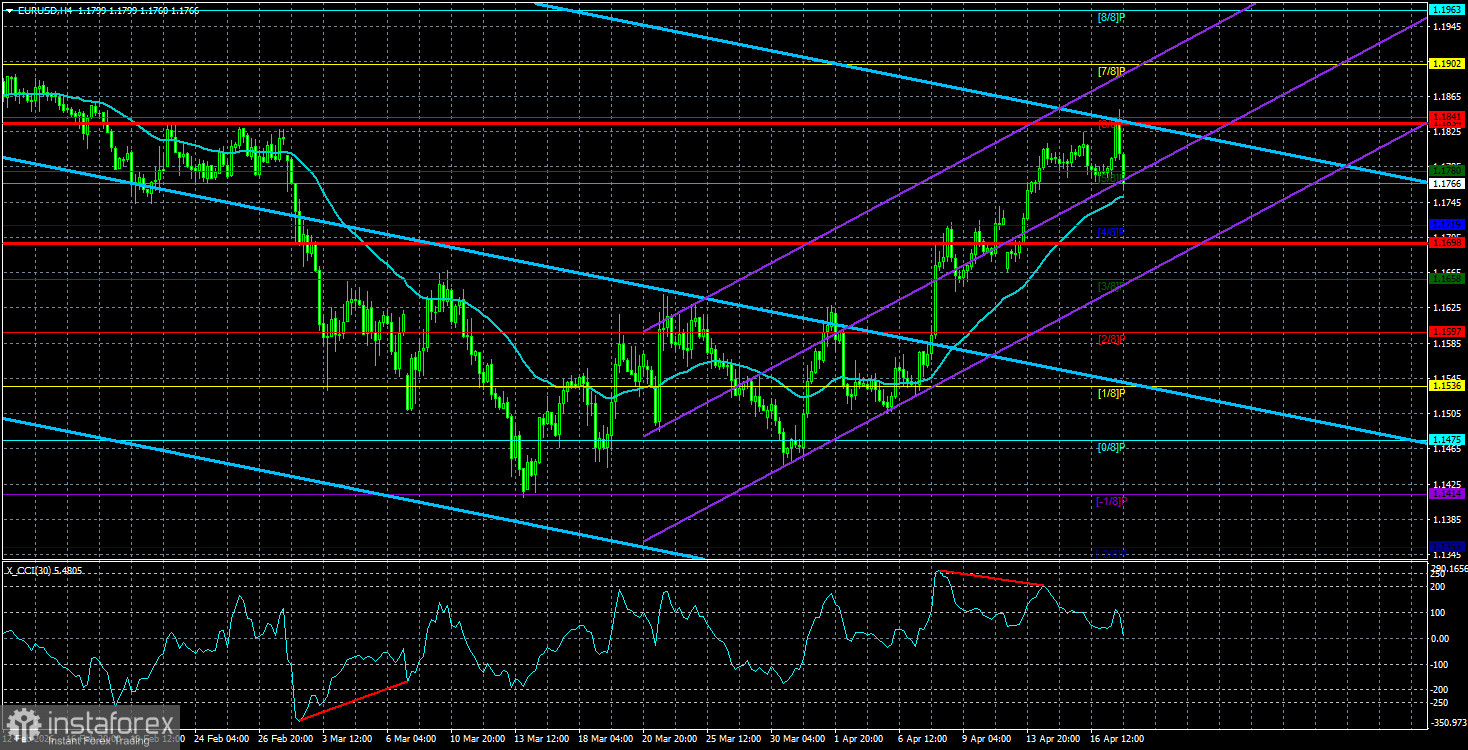
The EUR/USD currency pair has been trading higher over the past two weeks, but the fairy tale of the European currency seems to be coming to an end. In recent weeks, the market believed that negotiations between Washington and Tehran would at least reopen the Strait of Hormuz and lead to a cessation of hostilities. The Strait of Hormuz was indeed opened on Friday, only to be closed again on Saturday. This time, the US and Iran could not agree on the American blockade of the Strait. Iran initially stated that the blockade would be lifted, as Israel and Lebanon had agreed to a 10-day ceasefire. However, it later became clear that Iran lifted its blockade, while the US did not. Consequently, Iranian ports remain blocked, which, of course, did not sit well with Tehran.
As of now, the Strait is once again blocked, and oil prices could start climbing today, along with the US dollar exchange rate. As we have mentioned many times, reaching a comprehensive agreement between Washington and Tehran will be extremely difficult. The key issue has been and remains related to nuclear energy. On Sunday, it was reported that Iran once again refused to export all enriched uranium beyond its borders, so we do not even understand what the participants in the conflict are negotiating about. It is evident that Iran will not relinquish its nuclear energy and armament. What Trump aims to achieve in these negotiations remains unclear. Due to Hormuz's new closure and the failure of negotiations, the dollar may rise again next week, and these events will likely impact almost everything else.
For instance, we are pretty sure that macroeconomic reports will again hold no value for traders. Therefore, we won't even consider them. On Monday and Wednesday, there are scheduled speeches by European Central Bank President Christine Lagarde, whose rhetoric on monetary policy may change again. Recall that last week, Lagarde said there was no need to rush with interest rate hikes since the situation in the Middle East could improve. However, we do not yet see what could improve in the near future. A ceasefire is a positive fact, but how long will it last if the parties cannot find common ground on key issues?
If an agreement is not signed and the Strait of Hormuz remains blocked, then there should be no expectation of falling oil prices. Consequently, inflation will continue to rise globally. In this case, the ECB may again shift to a more "hawkish" stance. Thus, we consider Lagarde's speeches to be the most significant events in the European Union. However, even without Lagarde's speeches, demand for the US currency may start to rise again, simply because the most optimistic market expectations for the Middle East are not being borne out in practice.
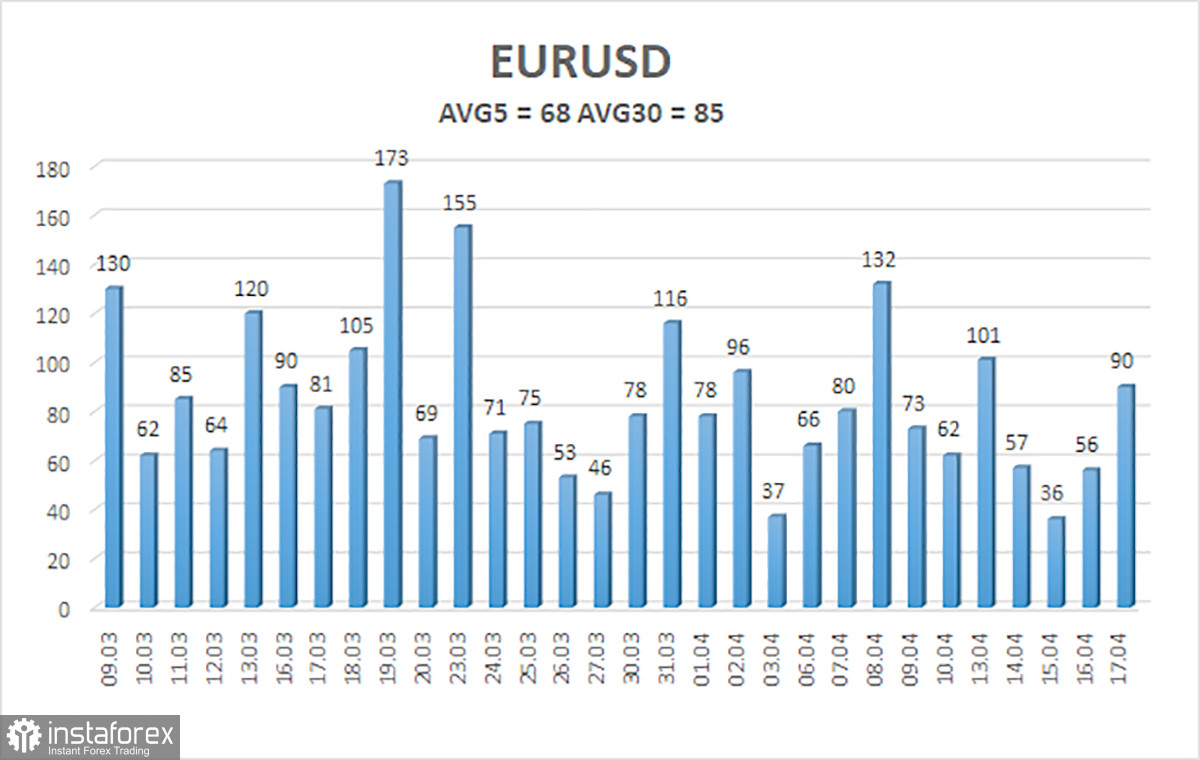
The average volatility of the EUR/USD currency pair over the last 5 trading days as of April 20 is 68 pips, which is considered "average." We expect the pair to move between levels 1.1698 and 1.1834 on Monday. The upper linear regression channel has turned down, indicating a trend change to the bearish side. However, a bullish trend that began in 2025 may actually resume now. The CCI indicator has entered overbought territory and formed a "bearish" divergence, warning of a downward pullback.
S1 – 1.1719
S2 – 1.1658
S3 – 1.1597
R1 – 1.1780
R2 – 1.1841
R3 – 1.1902
The EUR/USD pair continues its upward movement amid weakening geopolitical influences on market sentiment. The global fundamental backdrop for the dollar remains extremely negative, so in the long term, we still anticipate the pair's growth. When the price is below the moving average, shorts can be considered with targets of 1.1698 and 1.1658 based on technical grounds. Long positions above the moving average line remain relevant with targets at 1.1902 and 1.1963. The market is gradually moving away from geopolitical factors, and the situation has significantly improved over the past two weeks, leading to lower market tensions.
Linear regression channels help to define the current trend. If both are directed in the same way, it means the trend is currently strong;
The moving average line (settings 20,0, smoothed) determines the short-term trend and the direction in which trading should currently be conducted;
Murray levels are target levels for movements and corrections;
Volatility levels (red lines) indicate the probable price channel in which the pair will operate over the next day, based on current volatility readings;
The CCI indicator – its entrance into the oversold area (below -250) or the overbought area (above +250) indicates that a trend reversal in the opposite direction may be approaching.
¡Los informes analíticos de InstaForex lo mantendrá bien informado de las tendencias del mercado! Al ser un cliente de InstaForex, se le proporciona una gran cantidad de servicios gratuitos para una operación eficiente.


