 Permanecer
Condiciones de negociación
Products
Herramientas



Kevin Warsh formally assumed the chairmanship of the Federal Reserve on May 18, 2026. He took charge at a moment that many describe as a perfect storm: inflation at a three-year high, the Strait of Hormuz blocked for an eleventh week, bond markets under severe stress, and a president publicly demanding lower rates. The first FOMC meeting under Warsh's leadership is set for June 16–17, less than six weeks away.
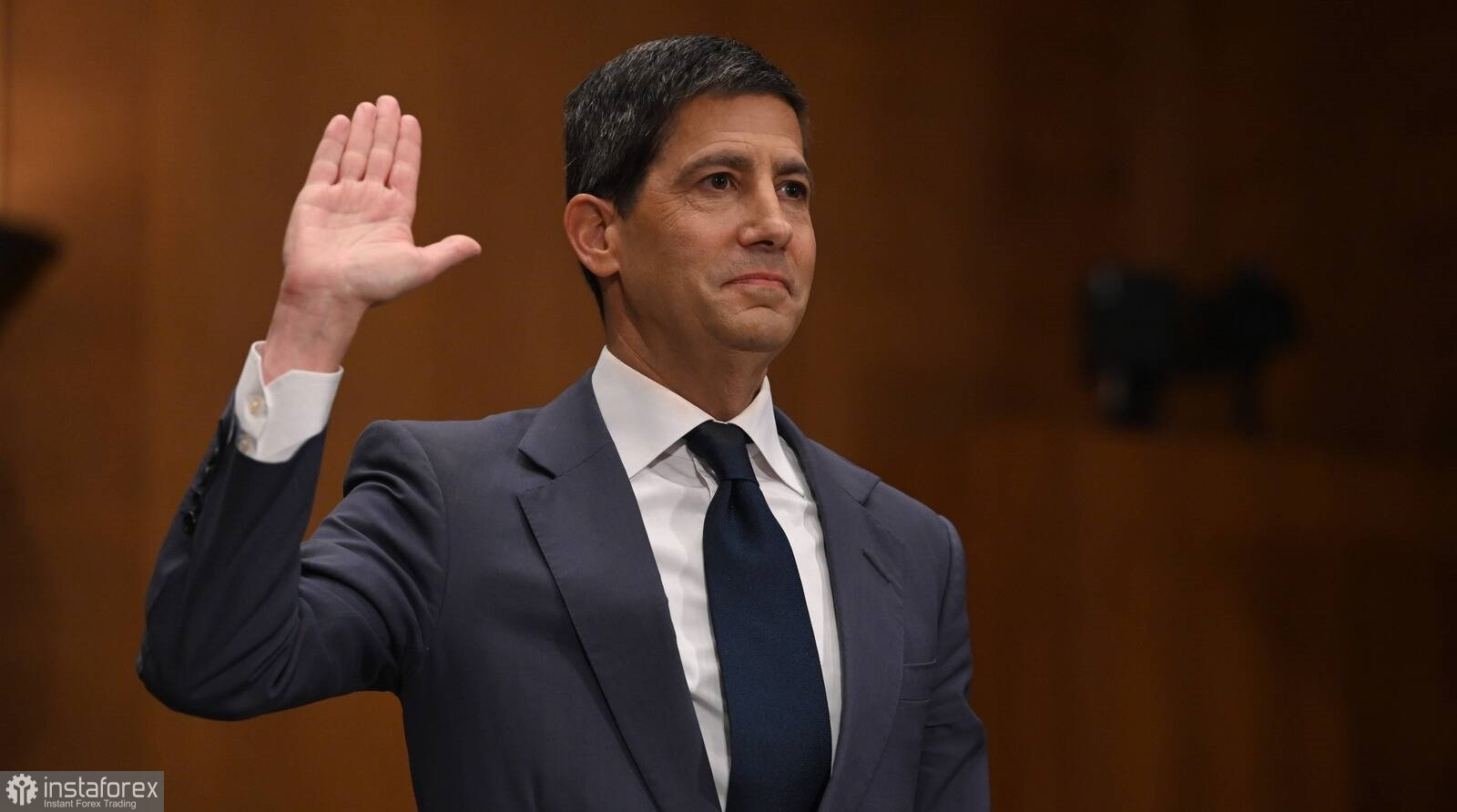
Political scientists and market observers have portrayed Warsh as a figure who has secured control of the vehicle but has not yet decided where to steer it. He spent years advocating publicly for the Fed chair role, criticizing the central bank's policy framework, forecasting architecture, and communication strategy. Now the vehicle is in his hands, and it is heading into a potentially perilous stretch.
The Senate confirmed Warsh by a 54–45 vote—the narrowest margin in the history of Fed chair confirmations. By comparison, Jerome Powell was confirmed in 2022 by an 80-vote margin. Only one Democrat, Senator John Fetterman of Pennsylvania, crossed party lines to support Warsh. Just weeks earlier, his confirmation had been in doubt.
Warsh has long criticized how the Fed manages communication. During his Senate hearings in April, he articulated a central thesis: "But I would say this, I think truth-seeking is more important than repetition." He was referring to the practice in which scores of Fed officials regularly deliver near-identical remarks, creating an illusion of consensus where vigorous debate actually exists. Warsh now proposes a new framework and new communication tools. Details are scarce, but market analysts are already forming expectations about what he has in mind.
A particular target for Warsh is the quarterly "dot plot," under which each FOMC member anonymously records their rate expectations for the next one to three years. He regards the tool as both misleading for markets and constraining for policymaking flexibility. He said that markets treated the dot plot as a signal, even though the FOMC had consistently cautioned that it was not a commitment. Abandoning the dot plot or radically altering it would be unprecedented and would almost certainly trigger market volatility. Over the past three decades the Fed has built a reputation on transparency—Powell introduced regular post-meeting press conferences and clearer public signaling. A departure from that model would prompt mixed reactions from investors.
Warsh has also questioned the value of holding a press conference after every FOMC meeting. Returning to a quarterly press conference cadence would turn interim meetings into technical pauses, a change that in itself would send a signal and complicate market interpretation of Fed behavior.
At his Senate hearing, Warsh said he wants "livelier" meetings with open debate. He appears likely to get them: at the April FOMC meeting, four of the 12 committee members dissented from the final statement—not because they opposed holding rates steady but because they judged the statement's softer language inappropriate in a period of rising inflation.
Warsh also remains under the watchful eye of President Trump.
A central paradox of the moment is that Mr. Trump picked Warsh precisely because he had publicly advocated lower rates. But the context has changed dramatically. When Warsh articulated his views on policy rates, oil was trading near $70 a barrel, inflation stood at 2.4 percent, and the Strait of Hormuz was open. Today oil trades above $107, CPI is 3.8 percent, and producer prices are near 6.0 percent. Some economists already warn that cutting rates with CPI at 3.8 percent and oil above $100 would risk destroying a reputation as an inflation fighter for a decade.
Warsh, however, cannot openly defy the president. His confirmation was part of a political bargain in which a tacit understanding of presidential preferences played a role. The critical question, therefore, is not what Warsh privately thinks about rates but how long he can follow the data while framing policy in a way that satisfies White House expectations.
Six weeks remain before Warsh's first FOMC as chair. The probability that he will hold the policy rate unchanged at that meeting exceeds 97 percent. Yet the character of the decision—what is said at the press conference, whether the dot plot remains, and how the statement is worded—will reveal more about Warsh's approach as chair than the vote itself.
As for a technical picture of the EUR/USD pair, buyers need to secure 1.1615 to target 1.1635. A move above that could reach 1.1660, but progress beyond that level without support from large players will be difficult; the more distant target is 1.1690. On the downside, only buying interest near 1.1590 would prompt substantial action by major buyers. Absent that support, it would be prudent to wait for a break below the 1.1570 low or to consider long entries from 1.1550.
As for the GBP/USD pair, sterling buyers should first clear resistance at 1.3415 to target 1.3445; advancing beyond that point may prove difficult, with a further target at 1.3475. If the pair falls, bears will seek control at 1.3380. A successful break below 1.3380 would likely inflict significant damage on bullish positions and push GBP/USD toward 1.3340, with a potential extension to 1.3300.
¡Los informes analíticos de InstaForex lo mantendrá bien informado de las tendencias del mercado! Al ser un cliente de InstaForex, se le proporciona una gran cantidad de servicios gratuitos para una operación eficiente.


