 Permanecer
Condiciones de negociación
Products
Herramientas



The wave pattern on the 4-hour chart for EUR/USD has changed somewhat. There is still no indication that the upward trend segment (lower chart), which began in January of last year, has been canceled. However, the trend structure has now taken on a corrective form. In the long term, the formation of wave C can be expected, with its low likely to fall below the low of wave A. At the current stage, it is difficult to believe in such a strong decline of the euro, but the first quarter of 2026 demonstrated that geopolitics can dramatically reverse market trends.
On the lower timeframe, I can identify a classic three-wave upward corrective structure. Following the completion of this structure, the market began forming a new downward trend segment, which logically should be impulsive in nature. If this assumption is correct, then we should expect the development of a five-wave structure within wave C of the higher degree, with targets below the 1.1400 level. Are there fundamental reasons to expect such a strong strengthening of the dollar? In my opinion, at the moment — no. Last week showed that Tehran and Washington continue negotiations, which could theoretically end successfully. As long as these chances remain, it will be difficult for the dollar to continue strengthening.
During Thursday's session, EUR/USD first declined by 40 basis points and then recovered by 50. While the overnight decline of the euro raises few questions, the subsequent rebound certainly does. The reason is that another ceasefire violation occurred overnight in the Middle East. First, Iran launched drones toward an American vessel, after which the US Navy responded with strikes on the launch site and intercepted the drones themselves. In addition, Donald Trump accused Oman and Iran of conducting secret negotiations aimed at establishing unilateral control over the Strait of Hormuz, warning Oman about the consequences of such actions. According to the US president, the strait must remain open and safe for all parties, and no single country should control it. Based on all of the above, the strengthening of the US dollar appeared justified.
In the second half of the day, several US economic reports were released — the first major ones this week. In particular, the first-quarter GDP report. The second estimate showed a slowdown compared with the initial reading, down to 1.6%. The US economy once again demonstrated slowing growth, or at least failed to meet market expectations. Therefore, during the second half of the session, the US currency struggled to gain support from traders.
The Core Personal Consumption Expenditures (PCE) Price Index for April was also released, but its reading did not surprise market participants in any meaningful way. Meanwhile, the report on durable goods orders could have provided strong support to the dollar, as the result exceeded forecasts by more than two times, reaching +7.9% month-on-month. However, the market focused primarily on weak US economic growth, which explains the decline of the dollar.
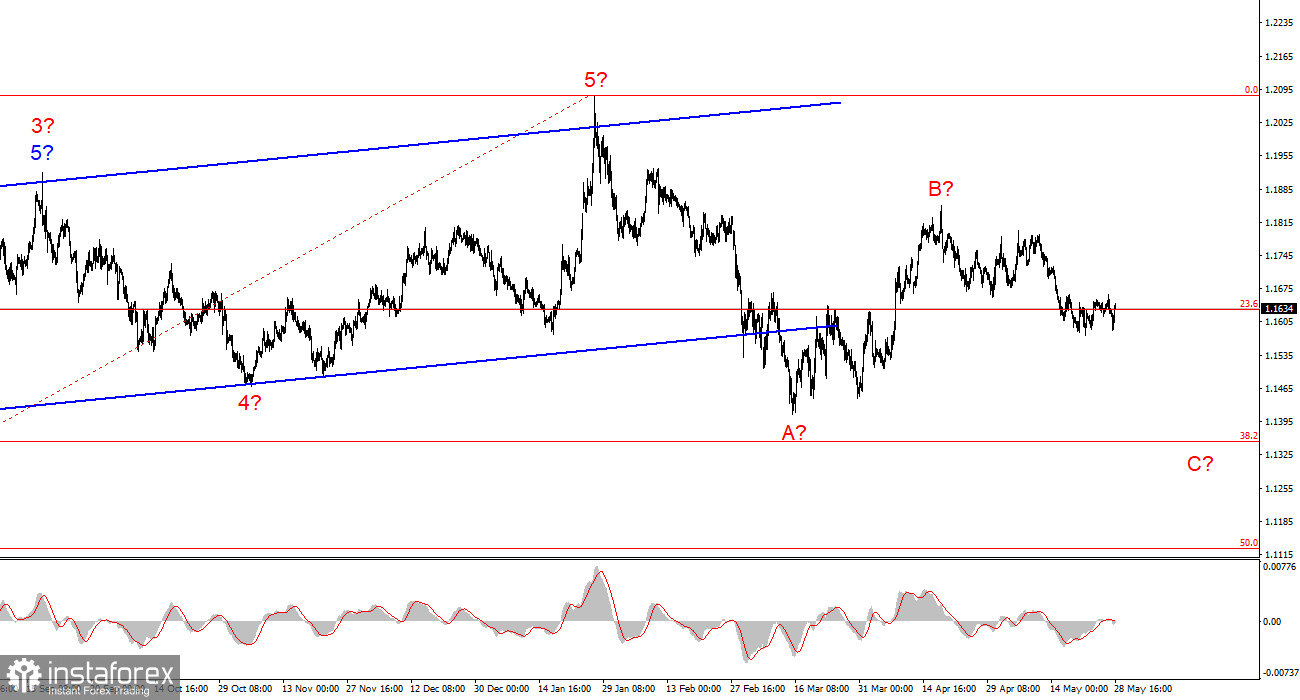
Based on the EUR/USD analysis, I conclude that the instrument remains within an upward trend segment (lower chart), while in the shorter term it remains within a corrective structure. The corrective a-b-c wave formation appears complete. Consequently, wave 3 or c is currently developing, which itself may become part of wave C. The entire wave C (if the current wave structure is correct) may complete much lower than the 1.1400 level. However, such a scenario would require strong geopolitical support. Otherwise, the downward wave structure may instead take the form of an a-b-c correction and complete near the 1.1578 level.
On the higher timeframe, an upward trend segment remains visible, after which a corrective wave structure begins to develop. In the near future, wave C may form with targets located near the 1.1352 level, corresponding to the 38.2% Fibonacci retracement level. Once the A-B-C structure is completed, a new long-term upward trend may begin.
Key Principles of My Analysis:
¡Los informes analíticos de InstaForex lo mantendrá bien informado de las tendencias del mercado! Al ser un cliente de InstaForex, se le proporciona una gran cantidad de servicios gratuitos para una operación eficiente.


