 Permanecer

Condiciones de negociación
Products
Herramientas


While markets await the crypto reaction to US inflation data, Japan's banking sector has taken a historic step: the country's three largest banks—MUFG Bank, Mizuho Bank, and Sumitomo Mitsui Banking Corporation—announced a joint stablecoin issuance and plan to begin real commercial operations using it by March 2027.

In a joint statement published on Wednesday, the banks said the stablecoin will be issued under a trust arrangement in which all three banks will act as co-founders and a trust bank or similar institution will serve as trustee. They will create a dedicated council to develop operational standards and a governance framework. The instrument is classified as an electronic payment instrument under Japanese law and is intended for a broad range of use cases—from corporate settlements to cross-border payments.
The initiative builds on months of preparatory work and enjoys direct regulatory backing. The three banks first joined forces in October last year on a pilot project to study joint stablecoin issuance mechanisms. In November the Financial Services Agency formally supported the initiative, confirming its conformity with existing financial rules.
The project is being implemented under the FSA's "FinTech Proof-of-Concept Hub" program, which has supported fintech experiments since 2017.
It is notable that the announcement from Japan's largest banks fits into a global wave of institutional stablecoin expansion. Mastercard has integrated stablecoin settlements into its payments infrastructure. The BIS and major central banks are testing blockchain settlements with real money under Project Agor. Georgia launched a state stablecoin in partnership with Tether. The US Securities and Exchange Commission registered Paxos as the first blockchain clearing organization in the United States. The Japanese banking system now joins that list in the second-largest developed economy.
It is evident that stablecoins are rapidly evolving from crypto-trading instruments into core settlement infrastructure for global finance. Japan — known for its regulatory caution — by participating decisively tilts the debate toward a structural shift rather than a temporary trend.
Trading recommendations:
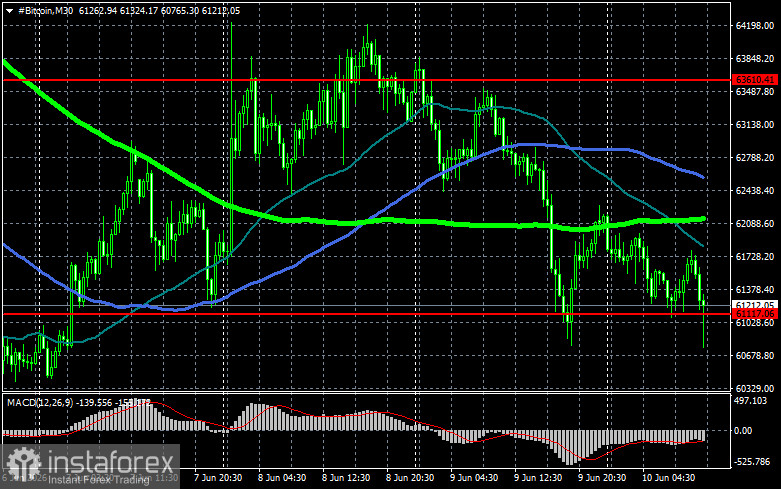
Buyers of Bitcoin are targeting a return to $63,600, a level that would open a direct path to $65,800 and then to $67,700; a breach above $67,700 would indicate attempts to restore the bull market. On the downside, buyers are expected at $61,100. A return of price below that area could quickly push BTC toward $59,600, with a farther target at $58,200.
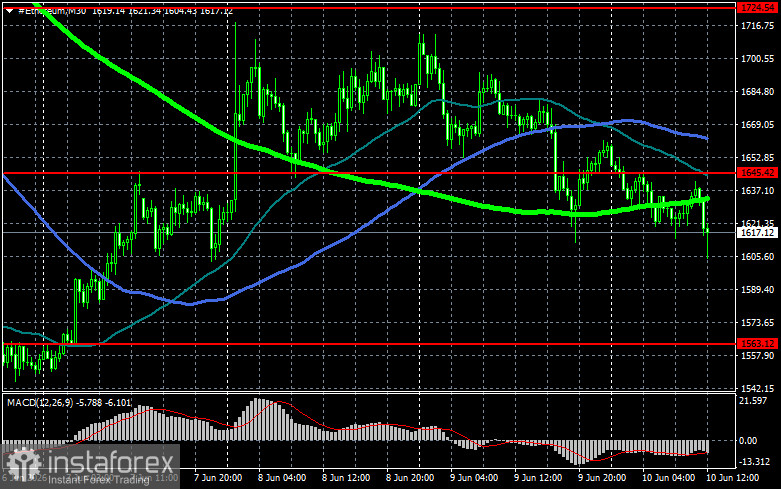
As for Ethereum, a clear hold above $1,645 would open a direct route to $1,724. The farther target is the high near $1,783; a break above that level would signal strengthening bullish sentiment and renewed buyer interest. On the downside, buyers are expected at $1,563. A fall below that level could rapidly send ETH toward $1,476, with a deeper target at $1,401.
What we see on the chart:
- Red lines indicate support and resistance levels where either a price slowdown or active growth is expected;
- Green lines indicate the 50-day moving average;
- Blue lines indicate the 100-day moving average;
- Light green lines indicate the 200-day moving average.
A crossover, or a price test of moving averages, typically either halts the move or sparks fresh market momentum.
¡Los informes analíticos de InstaForex lo mantendrá bien informado de las tendencias del mercado! Al ser un cliente de InstaForex, se le proporciona una gran cantidad de servicios gratuitos para una operación eficiente.


