 Permanecer
Condiciones de negociación
Products
Herramientas



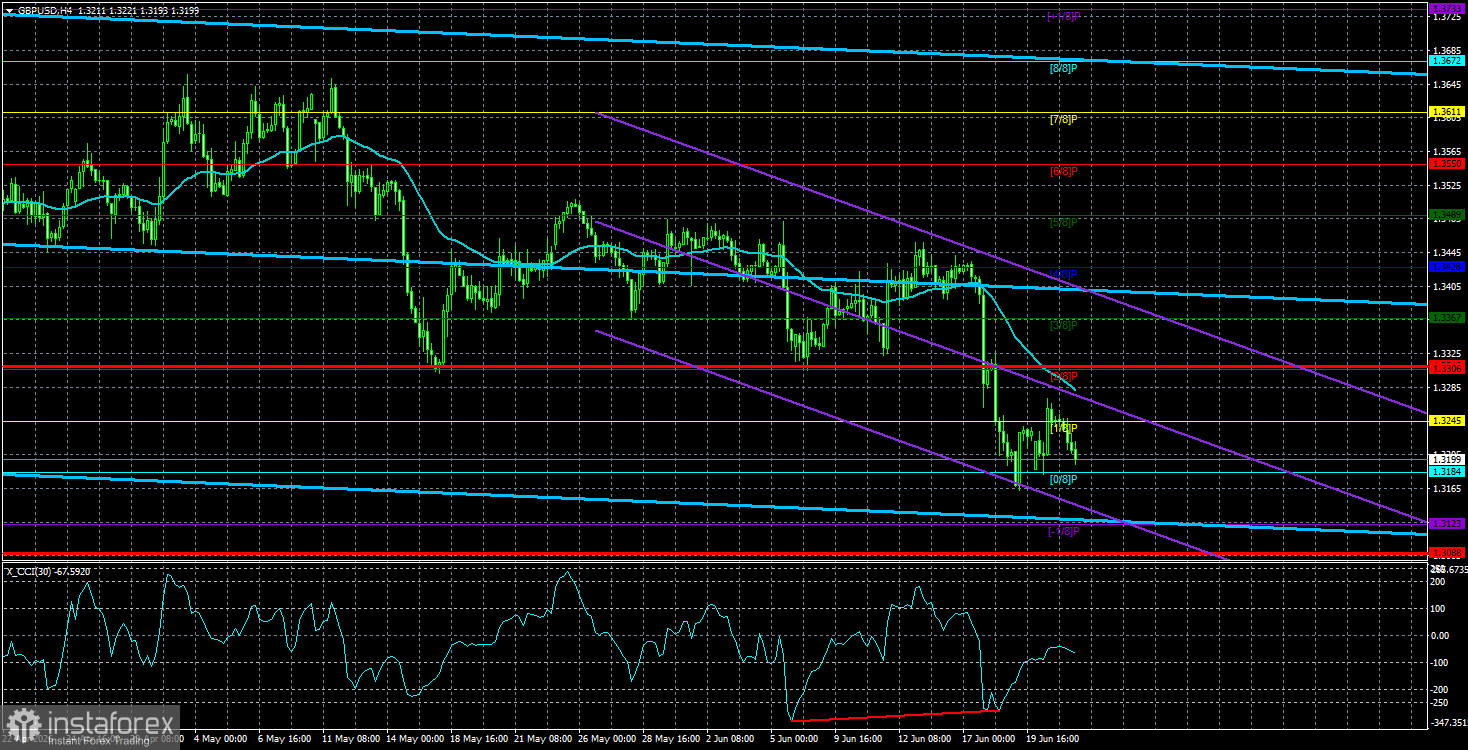
The GBP/USD currency pair also showed a slight decline on Tuesday, but overall it is performing better than the euro, which has been falling relentlessly for an entire week. On Monday, the market even actively bought the British pound despite Keir Starmer's resignation. Why are the euro and pound not trading the same way right now, and why is the dollar rising?
Recall that the geopolitical conflict that provided strong support for the U.S. currency in the first quarter of 2026 can be considered to be over. Of course, it could flare up again with new vigor, but what is the point of dreaming and thinking negatively right now? At this time, there are no prerequisites for renewing the conflict. Even if negotiations between Tehran and Washington proceed slowly, that does not imply that war will resume. Even if Israel and Lebanon do not consider themselves obliged to cease hostilities against each other, that does not mean the U.S. and Iran will pick up their weapons again. Neither Iran nor Trump needs a war ahead of the elections. Therefore, if the dollar rose due to conflict in the Middle East, it should now fall due to the conflict's conclusion.
The British pound is also generally declining, although the reasons are unclear. Geopolitics cannot support the dollar, and almost an entire week has passed since the Federal Reserve meeting. The Bank of England indeed took a less "hawkish" position at its last meeting than expected, although actually, more members of the Monetary Policy Committee voted for a rate hike than anticipated. Thus, ideally, the pound should also have shown growth. But no, only the U.S. dollar has been rising for an entire week.
The first reason for what is happening is the trend. There is a trend, and market participants trade according to it, ignoring other factors or responding only to those that are convenient and suitable. Again, we remind you that commercial banks, brokerage firms, various funds, and other market participants are not obliged to trade strictly in accordance with fundamentals, geopolitics, or macroeconomics. Therefore, it is highly probable that we are witnessing purely inertial movement. The GBP/USD pair is falling simply because it is being sold, and it is being sold because it is falling.
The second possible reason is the market makers' desire to create a trap for bears. All major banks and well-known experts predicted the dollar's decline throughout 2026, even amid the geopolitical conflict between Iran and the U.S. Does this mean everyone is wrong? That doesn't happen. The current rise of the dollar is too illogical; thus, we suspect that major capital is deliberately opening short positions, driving the price down as far as possible to later buy at lower levels and initiate a powerful markup and a new phase of the upward trend.
Thus, we would only trade the current movement intraday. If there is a trend, why not take advantage of it? But we would not expect long-term dollar growth because long-term trends are not formed by inertia or market-maker manipulations. Conclusion: It is possible to trade downward in the short term; the lower the GBP/USD pair falls (and the same goes for EUR/USD), the more attractive long-term positions look.
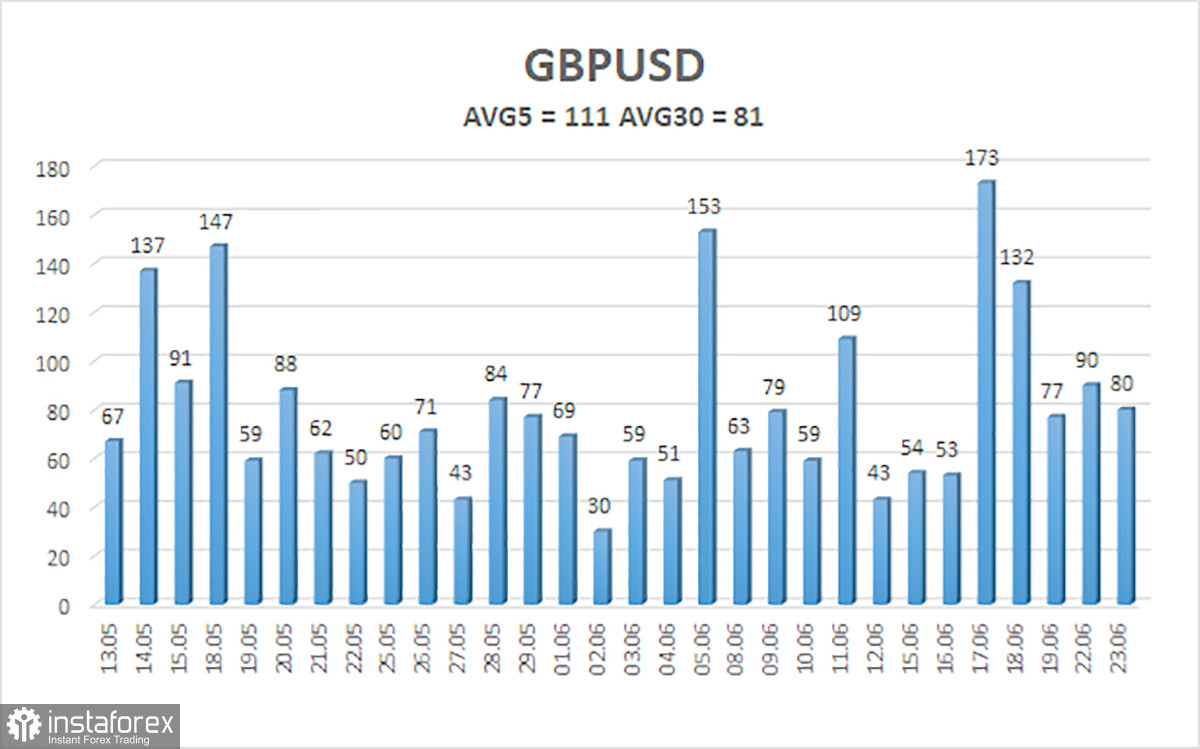
The average volatility of the GBP/USD pair over the last 5 trading days is 111 pips. For the pound/dollar pair, this value is considered "average." On Wednesday, June 24, we expect movement within the range bounded by 1.3088 and 1.3306. The upper channel of linear regression is oriented sideways, indicating trend uncertainty. The CCI indicator has entered the oversold area for the second time and formed a "bullish" divergence, which warns of a possible end to the downward trend.
S1 – 1.3184
S2 – 1.3123
S3 – 1.3062
R1 – 1.3245
R2 – 1.3306
R3 – 1.3367
The GBP/USD currency pair maintains a downward trend. Trump's policies will continue to exert pressure on the U.S. economy, so we do not expect long-term growth in the U.S. dollar. The year 2026 is proving exceptionally positive for the dollar due to geopolitics and, more recently, the Fed's readiness to raise the key interest rate. Long positions targeting 1.3367 and 1.3428 can be considered when the price is above the moving average. If the price is below the moving average line, trading downward with targets of 1.3123 and 1.3088 is advisable.
Linear regression channels help determine the current trend. If both are directed in the same way, it indicates a strong trend;
The moving average line (settings 20,0, smoothed) determines the short-term trend and the direction in which trading should currently be conducted;
Murray levels are target levels for movements and corrections;
Volatility levels (red lines) indicate the probable price channel in which the pair will move over the next day, based on current volatility metrics;
The CCI indicator – its entry into the oversold area (below -250) or the overbought area (above +250) indicates that a trend reversal in the opposite direction is approaching.
¡Los informes analíticos de InstaForex lo mantendrá bien informado de las tendencias del mercado! Al ser un cliente de InstaForex, se le proporciona una gran cantidad de servicios gratuitos para una operación eficiente.


