 Permanecer

Condiciones de negociación
Products
Herramientas


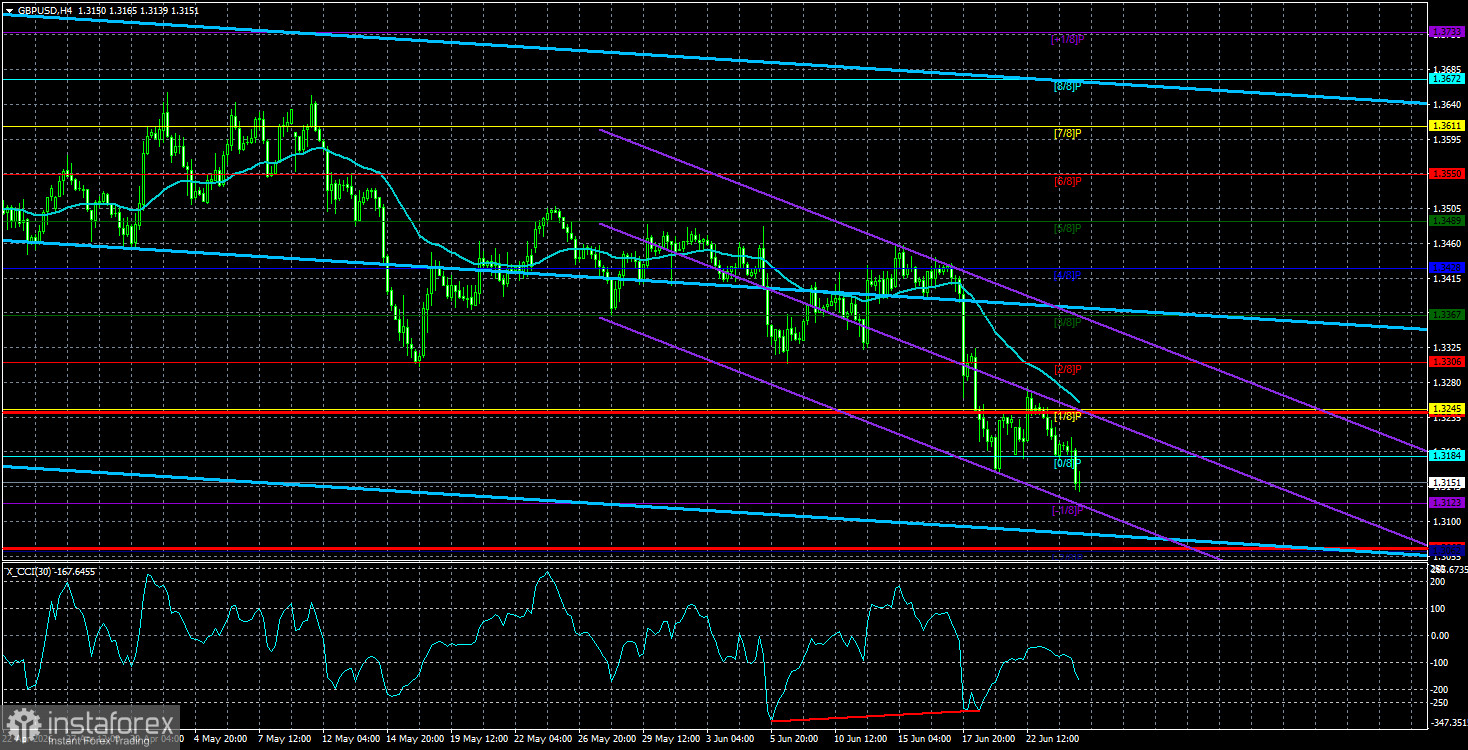
The GBP/USD currency pair also continued its downward movement on Wednesday, although earlier in the week it seemed that the British currency would avoid the same fate as the euro. This impression was due to the announcement on Monday of the resignation of UK Prime Minister Keir Starmer, which caused a market reaction in the form of buying the British pound, somewhat confusing traders. Generally (and this has been consistently emphasized by many experts), a political crisis triggers a decline in the national currency. This was the case a month ago, when Starmer's party lost local elections, prompting calls for the prime minister's resignation. We doubted even then that another political crisis could cause the pound to fall since the prime minister's resignation in Britain is almost akin to a boring Monday. As we can see, the resignation even caused a rise in the pound, but the market adjusted for this factor for just one day before the decline resumed.
In previous articles, we have repeatedly questioned why the U.S. dollar is rising. We do not believe that the market has been pricing in a potential rate hike by the Federal Reserve for an entire week. Could it be geopolitics? But how could geopolitics be to blame when Iran and the U.S. have finally signed a temporary agreement that will open the Strait of Hormuz for two months and kick off negotiations regarding Iran's nuclear energy? The war is over, and whether it will resume remains unknown.
Yes, there are still contradictions and uncertainties in the relations between Tehran and Washington. For instance, Donald Trump stated on Tuesday that Iran has agreed to allow international atomic inspectors access to its nuclear facilities. In simple terms, Iran's nuclear facilities will be under control (according to Trump). However, these statements were refuted by Tehran the very next day. The Iranian Foreign Ministry announced that Tehran has not committed to any new obligations regarding nuclear energy. Thus, cooperation with the IAEA could occur only under prior conditions that do not entail permanent control of nuclear facilities.
Therefore, it could be assumed that there are currently no nuclear agreements between Iran and the U.S., but negotiations are ongoing, and that is already very positive. Could the market not believe in a nuclear agreement and, as a result, expect the resumption of military actions in the Middle East? Theoretically, yes. But this scenario seems far-fetched, given that after the agreement was reached, the Strait of Hormuz was opened, and both sides made concessions. The market still bought the dollar for a week amid fears of a resumed conflict.
As with the euro, we do not see any specific reasons for the GBP/USD pair's decline. The current rise of the dollar is purely speculative, as currency speculators have not left the market. They have formed a trend, possess the strength to maintain it, and thus the dollar rises despite everything, even without taking pauses. Neither fundamentals, macroeconomics, nor geopolitics are relevant to this movement. The decline of the pair will end when professional market participants stop opening dollar positions every day and start taking profits.
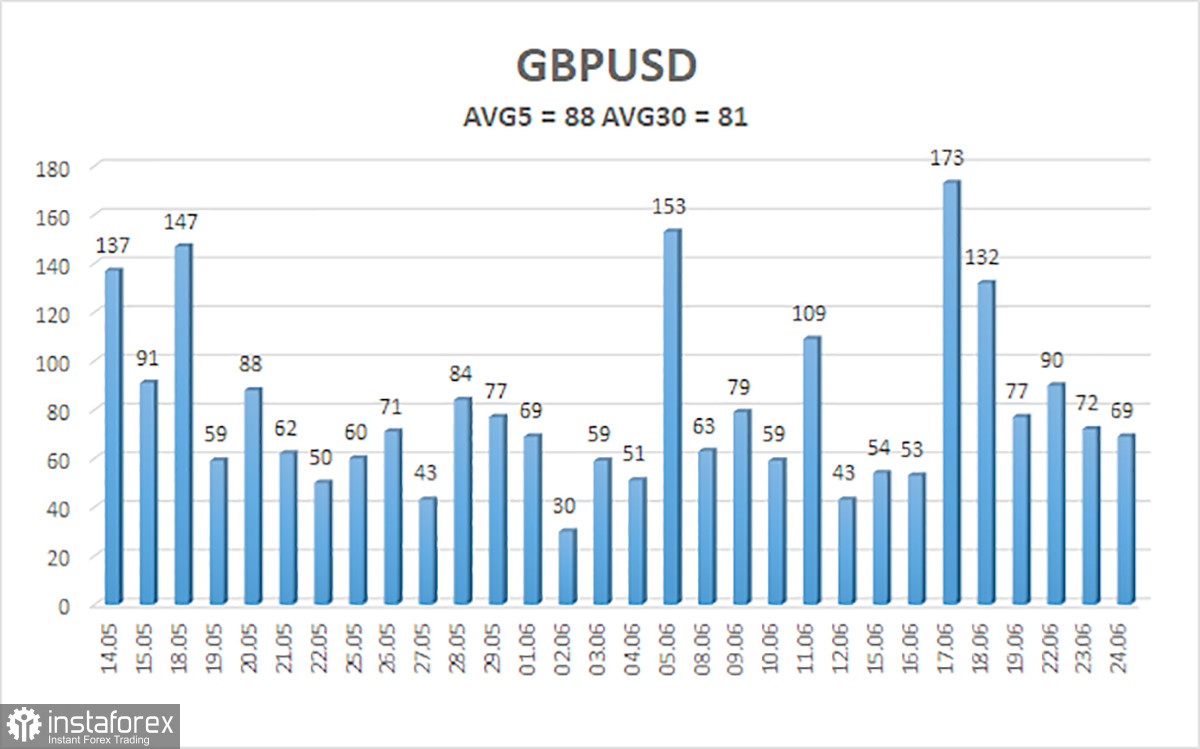
The average volatility of the GBP/USD pair over the last five trading days as of June 25 is 88 pips, which is characterized as "average." On Thursday, June 25, we expect the pair to move within the range bounded by 1.3062 and 1.3241. The upper channel of linear regression is directed sideways, indicating uncertainty in the trend. The CCI indicator has entered the oversold area for the second time and has formed two "bullish" divergences, suggesting a possible end to the downward trend; however, the market is currently ignoring all factors.
S1 – 1.3123
S2 – 1.3062
R1 – 1.3184
R2 – 1.3245
R3 – 1.3306
The GBP/USD pair continues its downward trend. Trump's policies will continue to exert pressure on the U.S. economy, so we do not expect long-term growth in the U.S. dollar. The year 2026 is proving exceptionally positive for the dollar due to geopolitics and, more recently, the Fed's readiness to raise the key interest rate. Long positions can be considered with targets of 1.3306 and 1.3367 when the price is above the moving average, but they are not a priority right now. When the price is below the moving average line, trading downward can continue with targets of 1.3065 and 1.3062.
Linear regression channels help determine the current trend. If both are directed in the same way, it means the trend is currently strong;
The moving average line (settings 20,0, smoothed) determines the short-term trend and the direction in which trading should currently be conducted;
Murray levels are target levels for movements and corrections;
Volatility levels (red lines) indicate the probable price channel in which the pair will move over the next day based on current volatility metrics;
The CCI indicator – its entry into the oversold area (below -250) or the overbought area (above +250) indicates that a trend reversal in the opposite direction is approaching.
¡Los informes analíticos de InstaForex lo mantendrá bien informado de las tendencias del mercado! Al ser un cliente de InstaForex, se le proporciona una gran cantidad de servicios gratuitos para una operación eficiente.


