 Permanecer

Condiciones de negociación
Products
Herramientas


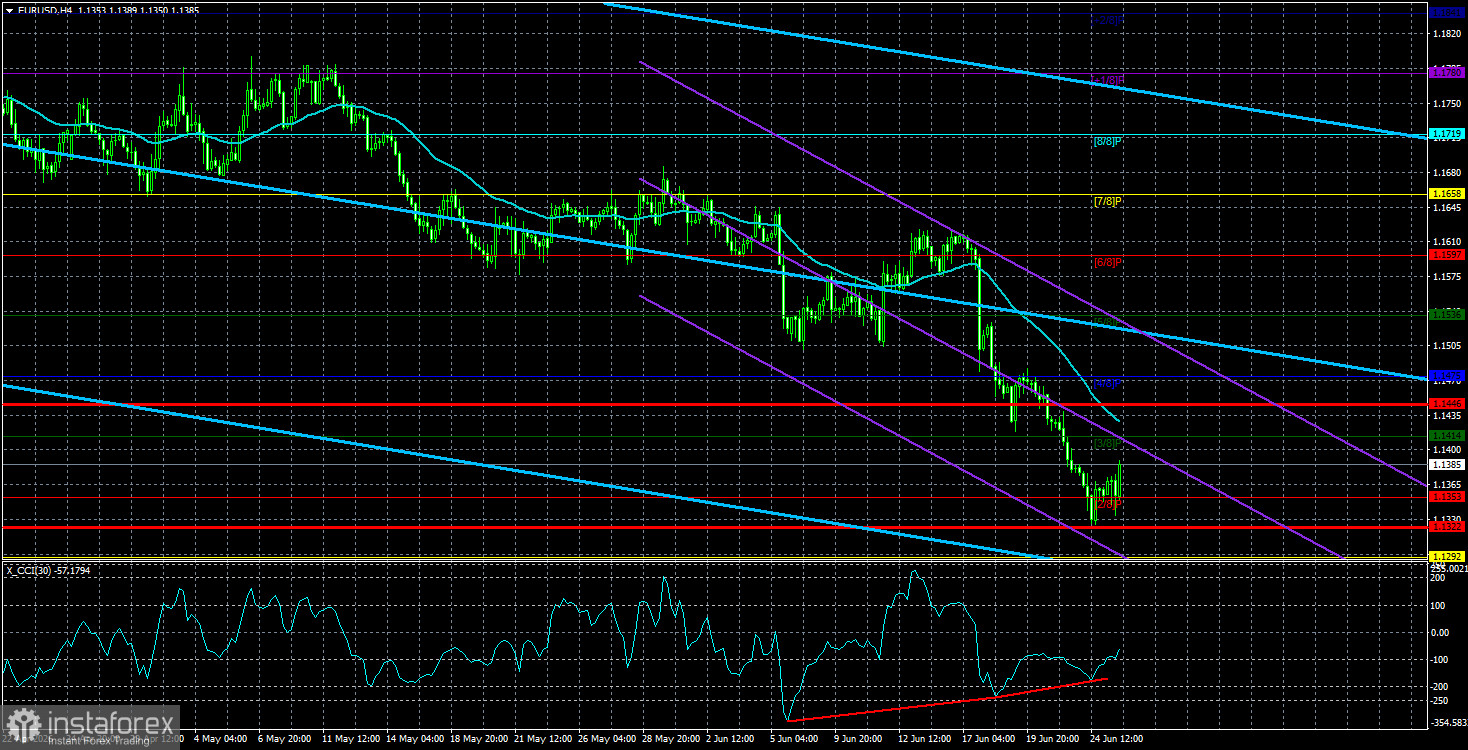
The EUR/USD currency pair attempted to resume its downward movement on Thursday. Despite the fact that a day earlier, on Wednesday evening, the euro began a ridiculous recovery, giving hope for a correction, the euro's quotes fell again on Thursday. This time, an unexpectedly strong report on the U.S. economy worked in favor of the American currency. GDP in the first quarter grew by 2.1%, which is higher than the forecast of 1.6%. The core personal consumption expenditures price index exactly matched market forecasts, as did the durable goods orders report. Thus, the market could react only to the GDP report, and only in the second half of the day, as we observed.
Thank goodness this time the rise of the American currency was not strong or prolonged, once again proving the obvious fact – the dollar has been growing for more than a week every day, not due to fundamental, macroeconomic, or geopolitical events. Judge for yourself, the U.S. GDP report was indeed strong, but it did not provoke a strong rise in the U.S. dollar. The day before, there were no interesting and important reports, yet the U.S. dollar rose by the end of the day. On Tuesday, business activity indices were released, which fell in the Eurozone and the UK, but those are not the data that the market is interested in under the current circumstances. We want to say that when there are specific reasons for the rise of the American currency, the dollar does not rise. And when there are none, it rises, often at a frenzied pace.
We want to remind you that analysts still consider the main reason for the strengthening of the dollar to be the Federal Reserve's intensified hawkish sentiment. Or they simply avoid discussing this topic, preferring not to comment on the giant and illogical growth of the American currency. However, more than a week has passed since the last FOMC meeting, and the market is still reacting... no, not to a rate hike, but to hints from the central bank about a possible increase in the future. Moreover, it is obvious to all traders that if inflation begins to slow amid the resolution of the Middle Eastern conflict, the opening of the Strait of Hormuz, and falling oil prices, the Fed will not need to tighten monetary policy. Other market participants cannot fail to understand this. Thus, the Fed's future tightening is as predictable as the weather.
At the same time, the European Central Bank has already raised rates once and may do so again in July. Although Christine Lagarde's rhetoric softened somewhat after the signing of the deal between Iran and the U.S., other members of the ECB's Monetary Committee still maintain a more hawkish stance. Of course, the ECB may also decide against a new rate hike, as it first needs to understand whether inflation will slow down due to falling oil prices. Therefore, a new tightening in July is unlikely. Nevertheless, the ECB has already implemented a rate hike, while the Fed may do so in the future. However, the market did not even notice the ECB's tightening, yet it has been reacting to the potential Fed tightening for a week...
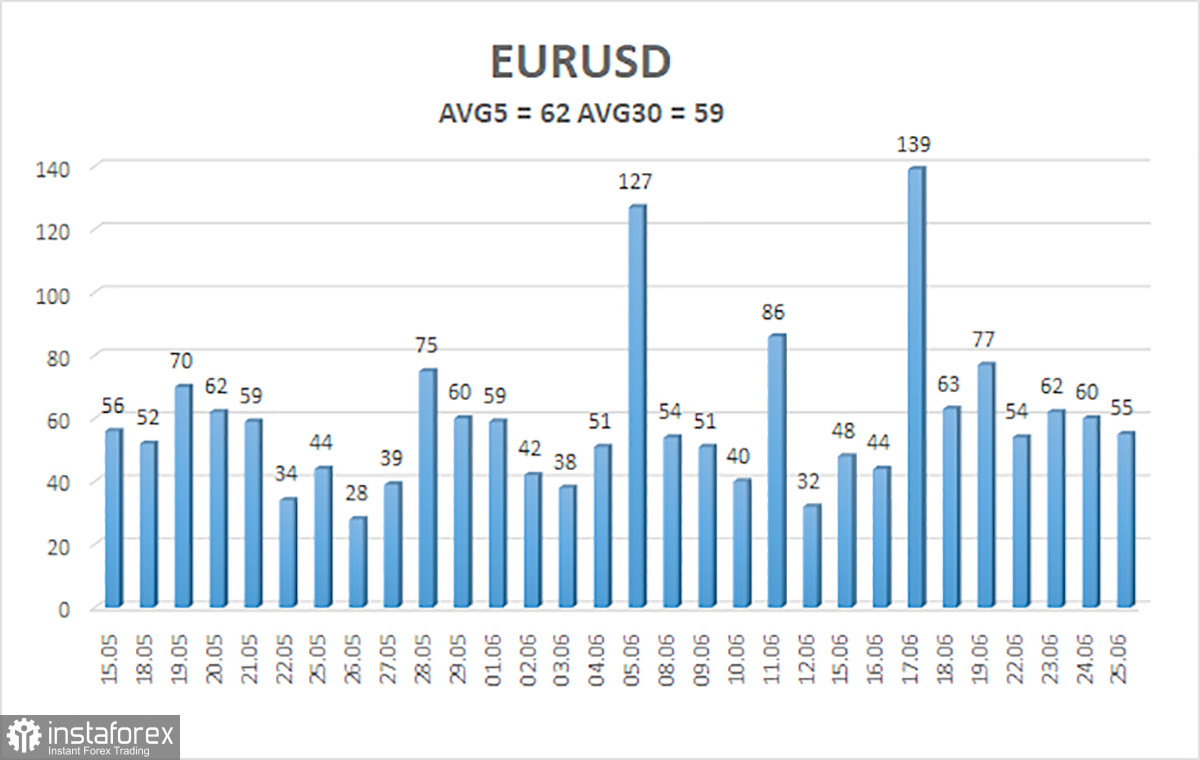
The average volatility of the EUR/USD currency pair over the last 5 trading days, as of June 26, is 62 pips, which is considered "average." We expect the pair to move between 1.1311 and 1.1461 on Friday. The upper channel of the linear regression has turned downwards, indicating a continuation of the downward trend. The CCI indicator has entered the oversold area and has already formed two bullish divergences, again warning of a possible end to the downward trend. However, the market is currently ignoring absolutely all factors.
S1 – 1.1353
S2 – 1.1292
S3 – 1.1230
R1 – 1.1414
R2 – 1.1475
R3 – 1.1536
The EUR/USD pair continues its downward movement, presumably a correction within the framework of a global upward trend, as is clearly seen on the daily or weekly timeframe. The global fundamental backdrop for the dollar remains negative, but in 2026, first geopolitical factors and then the Fed's hawkish stance provided strong support for the American currency. With the price positioned below the moving average, short positions can be considered, targeting 1.1311 and 1.1292. Above the moving average line, long positions become relevant with targets at 1.1536 and 1.1597. The resolution of the conflict in the Middle East has created no problems for the dollar. Bears are currently exceptionally strong for no apparent reason.
Linear regression channels help identify the current trend. If both are directed in the same way, the trend is currently strong;
The moving average line (settings 20.0, smoothed) determines the short-term trend and the direction in which trading should be conducted;
Murray levels are target levels for movements and corrections;
Volatility levels (red lines) indicate the likely price channel within which the pair will stay in the coming day, based on current volatility metrics;
The CCI indicator – its entry into the oversold area (below -250) or the overbought area (above +250) indicates that a trend reversal is approaching in the opposite direction.
¡Los informes analíticos de InstaForex lo mantendrá bien informado de las tendencias del mercado! Al ser un cliente de InstaForex, se le proporciona una gran cantidad de servicios gratuitos para una operación eficiente.


