 Permanecer

Condiciones de negociación
Products
Herramientas


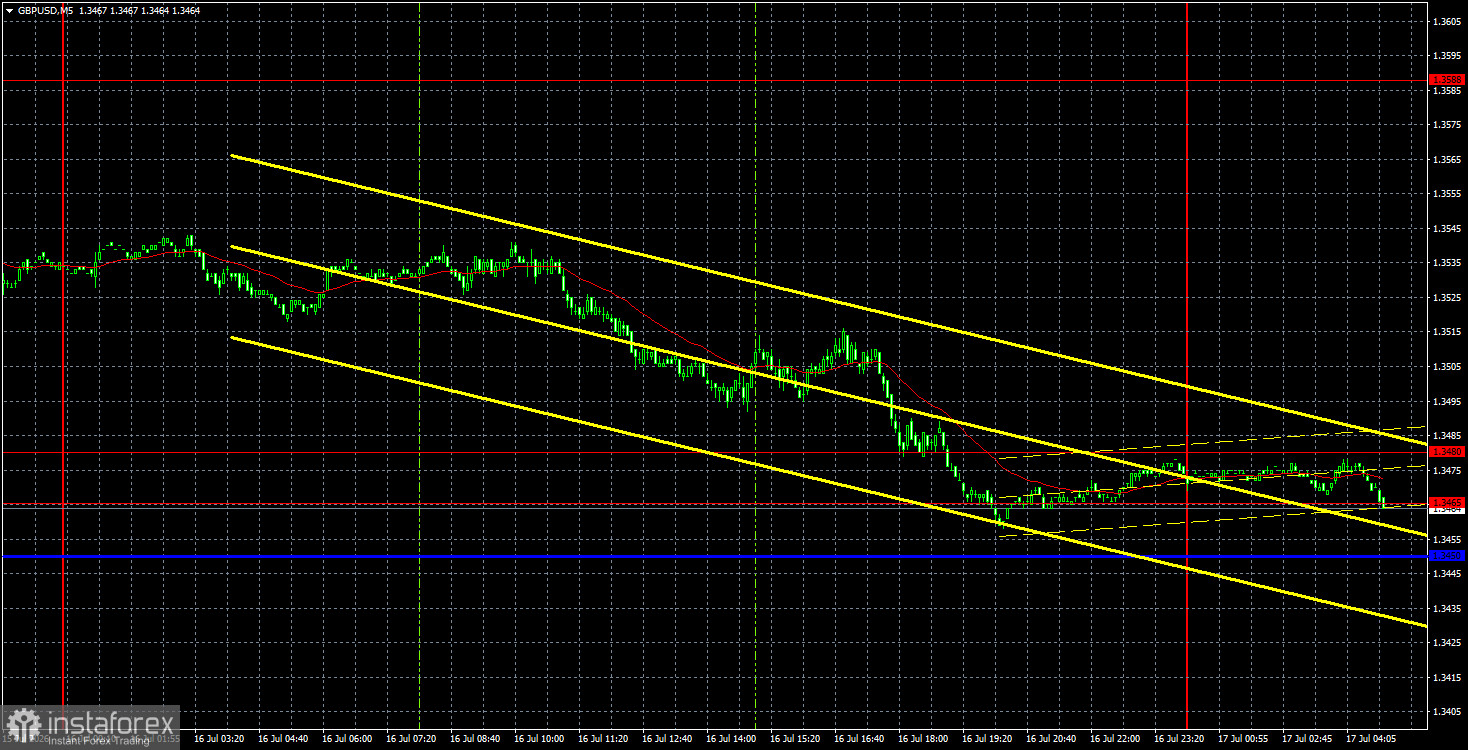
The GBP/USD currency pair declined by 90 pips on Thursday, losing a significant portion of what had been "hard-earned" on Wednesday. Recall that on Tuesday and Wednesday, inflation and the producer price index were published in the U.S., both showing a significant decrease in figures. Weak inflation data reduced the probability of the Federal Reserve tightening monetary policy at its next two meetings, leading to a decline in the dollar. The euro responded very weakly, while the British pound behaved as expected. On Thursday, there were no important events or reports, so the market began to correct. Overall, both the euro and the pound have been rising for three consecutive weeks, with the euro showing extremely weak growth and the pound showing impressive growth. Thus, the technical correction in the pound raises no questions. We fully support further growth in the British currency, as it can rise to 1.3700 or even higher within the sideways channel on higher timeframes. Most likely, after the downward correction, the upward movement will continue. It is also worth noting the rather weak report on UK industrial production, which may have contributed to a slight correction in the British currency.
From a technical perspective, the British pound continues its upward trend. Currently, the GBP/USD pair remains above the 1.3465-1.3480 area and the critical line. Thus, a new growth phase may begin from these levels. However, if they are broken, the correction could continue to the area of 1.3369-1.3377.
On the 5-minute timeframe on Thursday, no trading signals were formed. Only by the end of the day did the pair test the 1.3465-1.3480 area, where it remains on Friday morning. Therefore, we need to wait for a bounce from this area or a break of the Kijun-sen line.
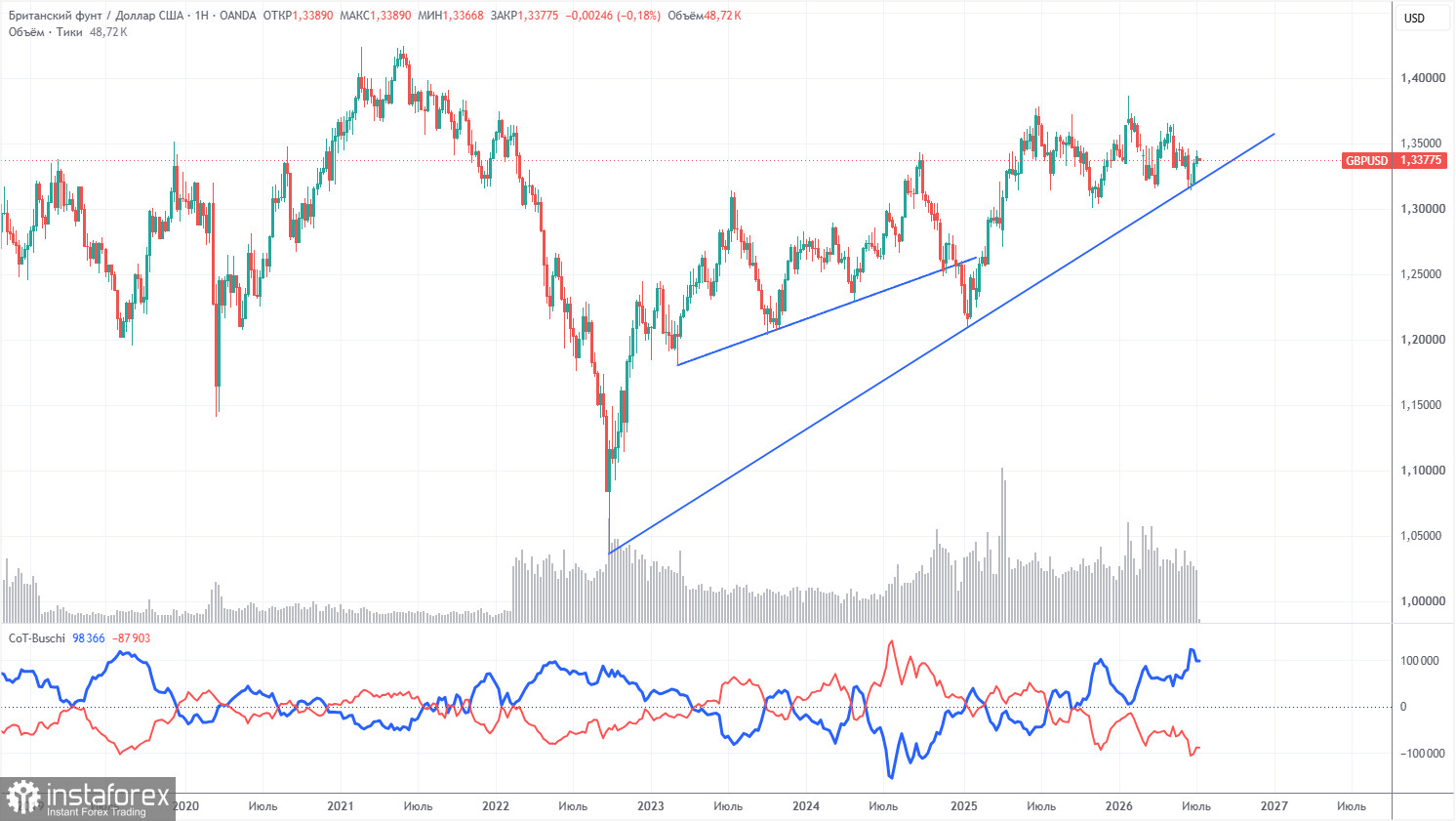
COT reports for the British pound show that non-commercial traders have dominated the market with sales for several months. The net position is negative, despite the long-term uptrend remaining intact. Given the events in the Middle East, it is not surprising that demand for risk currencies remains weak. The war is formally over, but the conflict persists. It is geopolitical factors that may support demand for the U.S. dollar in the near term. However, until a consolidation below the trend line occurs, we would not expect significant declines in the pair.
In the long term, the dollar will continue to decline due to Donald Trump's policies, as is clearly visible on the weekly timeframe (illustration above). The trade war will continue in one form or another for a long time, and Trump's policies are aimed directly and indirectly at weakening the U.S. currency. The long-term upward trend remains, as indicated by the trend line. The price recently tested this line and rebounded from it. According to the latest COT report (dated July 7), the "Non-commercial" group opened 7,400 BUY contracts and closed 6,800 SELL contracts. Thus, the net position of non-commercial traders increased by 14,200 contracts over the week, which does not significantly influence the overall sentiment of professional players.
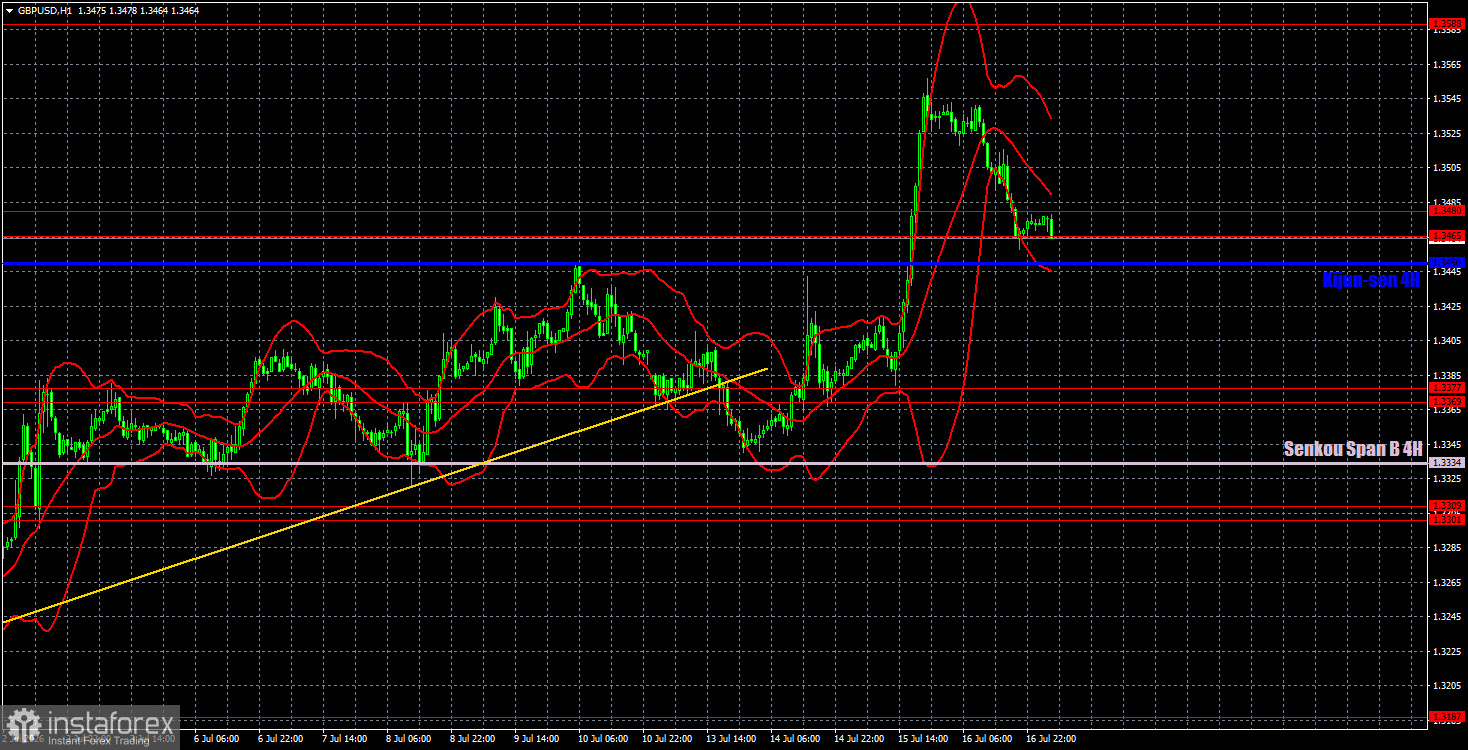
On the hourly timeframe, the GBP/USD pair may begin a correction, as the growth has lasted for three weeks. The market continues to ignore geopolitics, and in the last three weeks, we have observed a technical rise supported by weak inflation data in the U.S. We would not be surprised if the British currency continued to strengthen, as it is on track to reach the upper boundary of the sideways channel, which lies in the range of 1.3720-1.3800.
For July 17, we identify the following important levels: 1.3042-1.3050, 1.3096-1.3115, 1.3179-1.3187, 1.3301-1.3309, 1.3369-1.3377, 1.3465-1.3480, 1.3588, 1.3671-1.3681. The Senkou Span B line (1.3334) and Kijun-sen line (1.3450) may also serve as sources of signals. It is recommended to set the Stop Loss at breakeven after the price moves 20 pips in the correct direction. The Ichimoku indicator lines may move during the day, which should be considered when determining trading signals.
On Friday, there are no significant events or reports scheduled in the United Kingdom, while the U.S. will release reports on housing starts, building permits, and the consumer sentiment index from the University of Michigan. We do not consider these reports to be significant; they may provoke only a weak market reaction. Technical factors will take precedence today.
Today, traders may open short positions targeting the area of 1.3369-1.3377 if the pair consolidates below the Kijun-sen line. New long positions can be opened in the event of a bounce from the area of 1.3465-1.3480 or the critical line, targeting 1.3588.
Support and resistance price levels – thick red lines around which movement may end. They are not sources of trading signals.
Kijun-sen and Senkou Span B lines – lines of the Ichimoku indicator, transferred to the hourly timeframe from the 4-hour one. They are strong lines.
Extreme levels – thin red lines where the price has previously bounced. They are sources of trading signals.
Yellow lines – trend lines, trend channels, and any other technical patterns.
Indicator 1 on COT charts – the size of the net position for each category of traders.
¡Los informes analíticos de InstaForex lo mantendrá bien informado de las tendencias del mercado! Al ser un cliente de InstaForex, se le proporciona una gran cantidad de servicios gratuitos para una operación eficiente.


