 Permanecer

Condiciones de negociación
Products
Herramientas


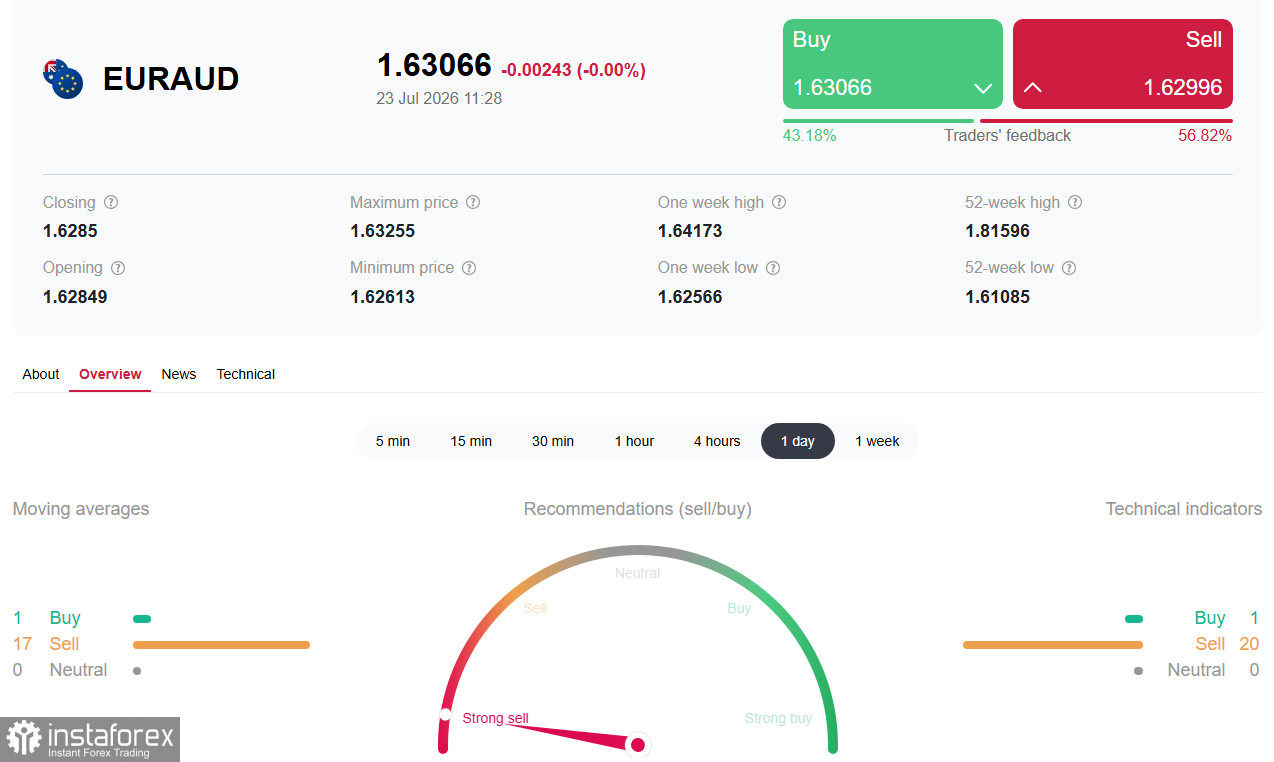
See also: InstaForex trading indicators for EUR/AUD
The EUR/AUD pair continues to consolidate near 1.6300 in the early hours of the European session, balancing between two key fundamental drivers: on the one hand, expectations of a hawkish signal from the European Central Bank support the euro, and on the other hand, strong Australian labor market data strengthen expectations of further tightening by the Reserve Bank of Australia, which constrains the pair's upside.
Meanwhile, markets await the ECB meeting, which will be the day's key event. The regulator is widely expected to keep the deposit rate at 2.25%, but Christine Lagarde's press conference could provide signals about the policy path. Markets price in an additional two to three ECB rate hikes over the next year, which supports the euro.
Fundamental backdrop: monetary divergence and geopolitics
ECB: pause with hawkish tilt
The ECB meeting is the main event for the euro. The regulator is likely to hold rates, but a September hike looks probable amid renewed oil price strength, economists say. Markets price around 23 basis points of tightening, and long-term inflation expectations remain well anchored near the target. However, the euro is unlikely to gain materially from the ECB meeting unless Lagarde delivers hawkish surprises.
RBA: Strong labor prints lift tightening expectations
The Australian labor market delivered a positive surprise: 76,300 jobs were created in June, well above forecasts. The unemployment rate remained at 4.4% despite a rise in the participation rate to 67%. These data strengthen expectations of further RBA tightening.
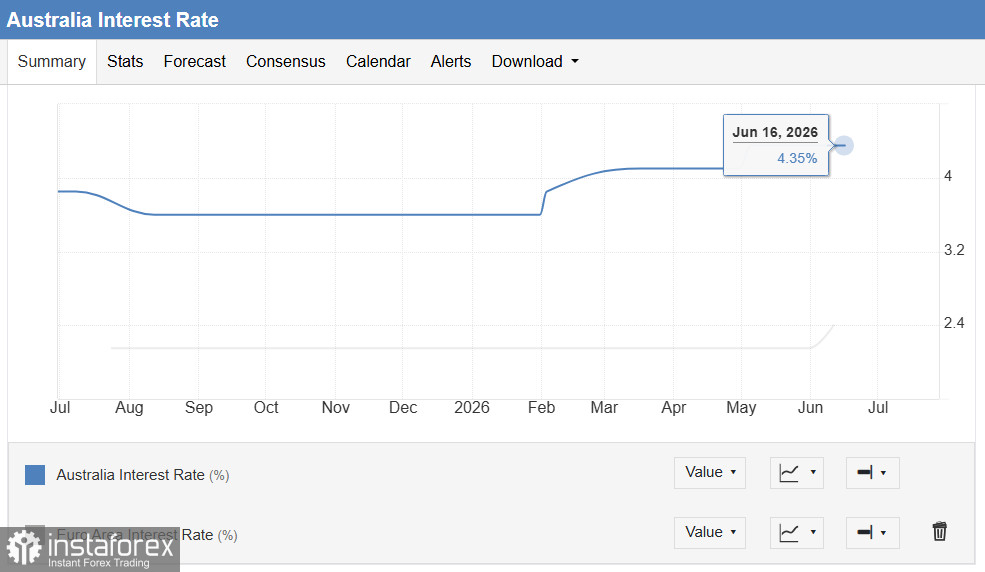
Markets price nearly a 30% chance of a rate hike at the August meeting and an almost full probability by year-end. However, economists warn that risks tilt toward a more prolonged pause in the RBA tightening cycle, which is a negative for the AUD.
Geopolitical factor
Escalation of the US-Iran conflict and threats to block shipping routes are pushing oil prices higher, creating global inflationary pressure. That supports expectations of tighter policy at both the ECB and the RBA, producing an ambiguous impact on the pair.
Brief technical analysis
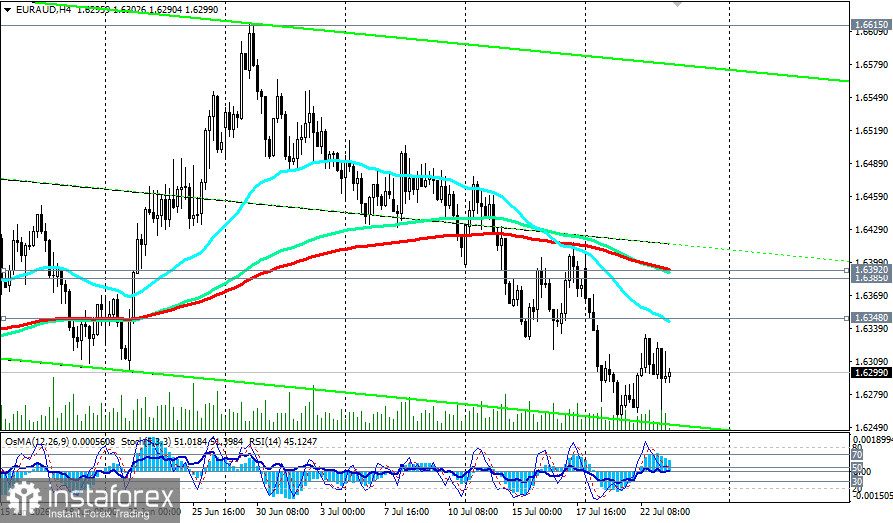
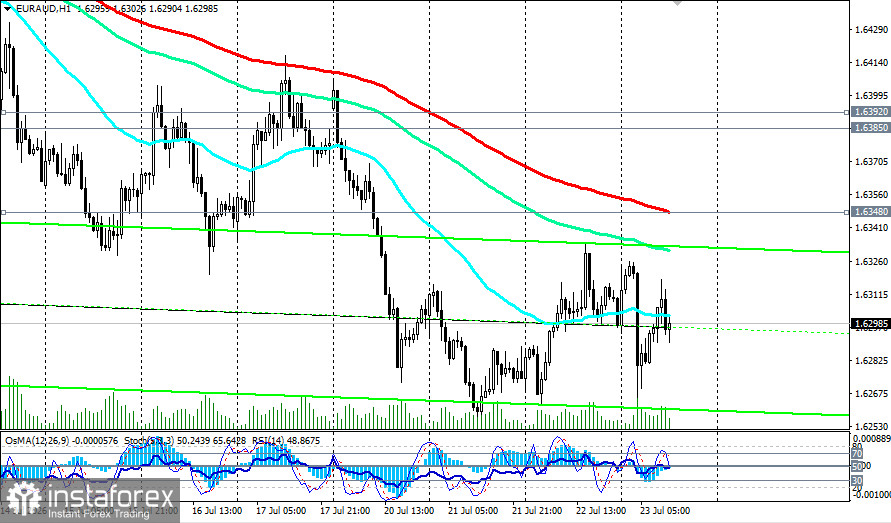
EUR/AUD is trading in a bearish zone, showing uncertain dynamics after a bounce from support at 1.6260. The pair remains under pressure from short- and medium-term downtrends, while price is below the 50-, 144-, and 200-period EMAs on charts from hourly to weekly, which act as dynamic resistance.
Technically, EUR/AUD retains a bearish bias, but short-term indicators on the 1- and 4-hour charts point to possible consolidation or a rebound.
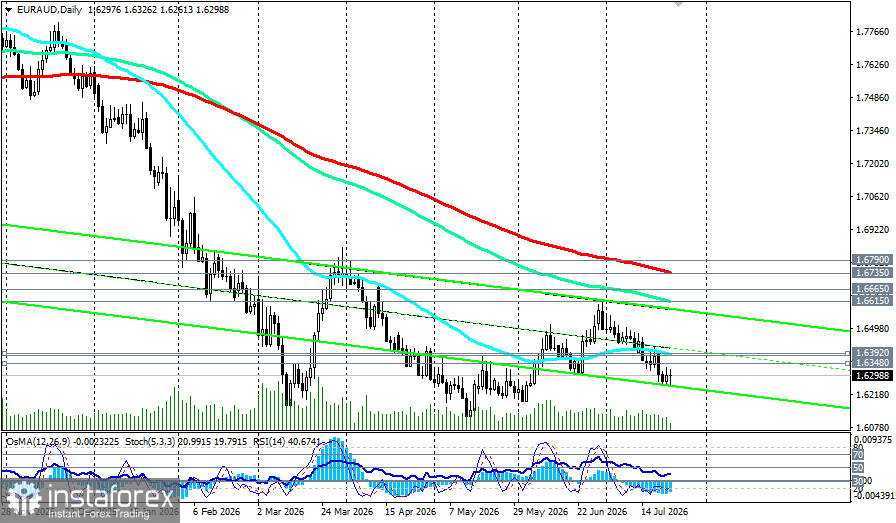
Immediate resistance is at 1.6330 and 1.6348 (the 144- and 200-hour EMAs). Next resistance levels are 1.6385 (50-day EMA) and 1.6392 (200-day EMA on the 4-hour chart).
Immediate support is at 1.6260 (local support and the daily descending channel's lower line). Further support lies at 1.6200 (round level) and 1.6180 (local).
Key events to watch
- July 23 — ECB meeting. Forecast: policy rate expected to be left at 2.25%. Possible impact: hawkish signal = EUR up; dovish = EUR down.
- July 23 — Christine Lagarde press conference. Possible impact: key driver for the euro.
- July 24 — PMI business activity releases for the euro area and Australia. Possible impact: affects growth expectations.
- July 23 — US weekly initial jobless claims. Possible impact: indirect via dollar dynamics.
- August 11 — RBA meeting. Forecast: policy rate expected to be left at 4.35%. Possible impact: hawkish = support for AUD; dovish = pressure.
- July 29 — Australia Q2 CPI. Forecast: 1.4% q/q. Possible impact: strong = support for AUD; weak = pressure.
Key events to monitor
- ECB meeting (July 23). This is the main event for the pair. The rate decision and Lagarde's press conference will set the euro's near-term trajectory.
- Australia inflation (Q2 CPI). Publication next week will be a key indicator for the RBA. Strong prints could boost tightening expectations and support the AUD.
- Geopolitics. Escalation in the Middle East and higher oil prices create risks for global growth and can influence policy expectations.
- Technical zone 1.6348–1.6392. A confirmed break of this zone would likely change the short-term trend.
- Monetary policy divergence. The divergence in ECB and RBA rate expectations remains the key fundamental driver. Any signals of a policy shift from either central bank could trigger a sharp move in the pair.
Conclusion and recommendations for investors
EUR/AUD is in a decisive phase where a bullish impulse from expectations of a hawkish ECB collides with bearish pressure from strong Australian labor market data and RBA tightening expectations. The key level, 1.6348, remains the main watershed for short-term dynamics. This week market attention will focus on the ECB meeting, geopolitical developments, and Australian economic data, which could provide fresh signals for the pair's direction.
For short-term traders: long trades are possible amid a break above 1.6348 with targets at 1.6385–1.6410. Consider shorts only on a break below 1.6250 confirmed by fundamentals.
For medium-term investors: adopt a wait-and-see stance until geopolitics and the ECB meeting clarify the outlook. A correction to 1.6210–1.6190 could be used to enter longs if the ECB's hawkish tilt endures and AUD weakness continues.
Risk management: remain cautious given heightened volatility from central-bank decisions and geopolitical events. Use strict stop-loss discipline and monitor developments in the Middle East and comments from ECB and RBA officials.
See also our recent articles:
- EUR/GBP: pound under pressure after mixed inflation data
- Crypto market (SOL): on verge of breakout amid optimism around CLARITY
¡Los informes analíticos de InstaForex lo mantendrá bien informado de las tendencias del mercado! Al ser un cliente de InstaForex, se le proporciona una gran cantidad de servicios gratuitos para una operación eficiente.


