 Permanecer

Condiciones de negociación
Products
Herramientas


The price test at 159.15 occurred when the MACD indicator had moved significantly above the zero mark, limiting the pair's upward potential.
Despite the dollar coming under pressure from a weak retail report last Friday, there were no significant changes in the USD/JPY pair. The Japanese yen remains at the center of discussions regarding the Bank of Japan's policy, prompted by statements from former Finance Ministry official Takehiko Nakao. In his opinion, the central bank should raise the base rate at every meeting to narrow the interest rate gap with the U.S. and alleviate pressure on the national currency. The logic here is straightforward, as the wide gap in yields between Japan and the U.S. has long been the main reason for the yen's weakness, and its narrowing could restore support for the currency. Nakao emphasized that real interest rates in Japan remain negative, whereas in other major economies they are positive, and that achieving a policy rate of 2.25% or even 2.5% would not be unusual. In other words, the BOJ has significant room for policy normalization, and he sees gradual tightening through rate hikes as the main tool for preventing further yen weakening, which is much more sustainable than one-off measures. It is evident that as long as there is a gap in interest rates, pressure on the yen will persist.
As for the intraday strategy, I will rely more on implementing scenarios No. 1 and No. 2.
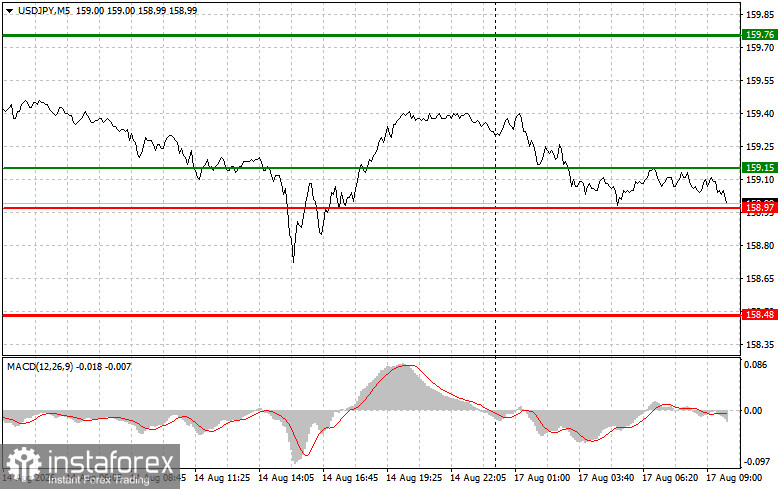
Scenario No. 1: I plan to buy USD/JPY today when the entry point reaches around 159.15 (green line on the chart) with the target of growth to the level of 159.76 (thicker green line on the chart). Around 159.76, I intend to exit my long positions and open short positions in the opposite direction (expecting a 30-35-pip move in the opposite direction from the level). It is best to return to buying the pair during corrections and major pullbacks in USD/JPY. Important! Before buying, make sure that the MACD indicator is above the zero mark and is just starting its rise from it.
Scenario No. 2: I also plan to buy USD/JPY today in the event of two consecutive tests of 158.97, when the MACD indicator is in the oversold area. This will limit the pair's downward potential and lead to an upward market reversal. Growth can be expected towards the opposite levels of 159.15 and 159.76.
Scenario No. 1: I plan to sell USD/JPY today only after the 158.97 level is updated (red line on the chart), which will lead to a rapid decline in the pair. The key target for sellers will be 158.48, where I plan to exit my shorts and immediately open longs in the opposite direction (expecting a move of 20-25 pips in the opposite direction from the level). Sellers could return at any moment, given just a hint from the central bank. Important! Before selling, ensure that the MACD indicator is below the zero mark and is just starting its decline from it.
Scenario No. 2: I also plan to sell USD/JPY today in the event of two consecutive tests of 159.15, when the MACD indicator is in the overbought area. This will limit the pair's upward potential and lead to a downward market reversal. A decline towards the opposite levels of 158.97 and 158.48 can be expected.
Important: Beginner forex traders need to make entry decisions very cautiously. Before key fundamental reports are released, it is best to stay out of the market to avoid sharp price fluctuations. If you decide to trade during news releases, always set stop orders to minimize losses. Without placing stop orders, you can quickly lose your entire deposit, especially if you do not practice money management and trade large volumes.
And remember, successful trading requires a clear trading plan, as outlined above. Making spontaneous trading decisions based on the current market situation is inherently a losing strategy for intraday traders.
¡Los informes analíticos de InstaForex lo mantendrá bien informado de las tendencias del mercado! Al ser un cliente de InstaForex, se le proporciona una gran cantidad de servicios gratuitos para una operación eficiente.


