 Permanecer
Condiciones de negociación
Products
Herramientas



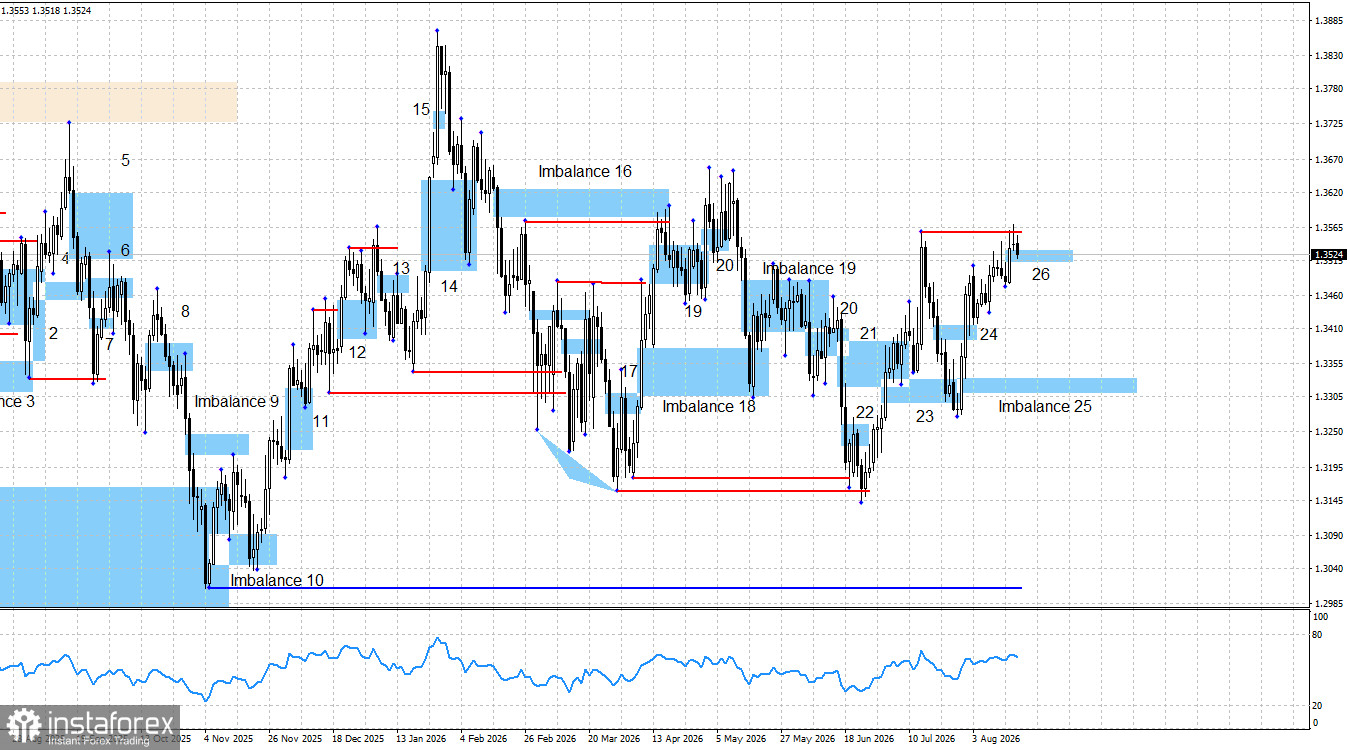
The GBP/USD pair continues to rise, which I consider entirely justified. Reports on the US economy, labor market, and inflation have largely settled the debate over whether the FOMC will raise interest rates in September. Nonfarm Payrolls declined for the fourth consecutive month and fell below zero. The US economy is slowing. Inflation is declining. The situation may change following the August data, but at present, the FOMC is much closer to maintaining a wait-and-see stance than to making hawkish decisions.
In recent weeks, there has been widespread speculation in the market that high inflation would force the Fed to raise rates. Kevin Warsh has also spoken about excessively high inflation that needs to be brought back to the target level. However, as I expected, inflation is not the only factor that matters to the regulator. The labor market is no less important to the FOMC, and its current condition cannot be ignored. Overall, the situation for the Fed in August has become almost a stalemate. Tightening monetary policy could cause the economy and labor market to cool even further. At the same time, simply waiting is also problematic, as inflation could begin accelerating again as early as August. Donald Trump is unwilling to make concessions to Iran, while Iran sees no reason to negotiate with Trump. The conflict continues, the blockade of the Strait of Hormuz remains in place, and oil prices are rising again, which could lead to higher inflation.
As I have already noted, geopolitical developments are no longer having a favorable impact on the dollar, as negotiations between the United States and Iran have reached a complete deadlock. Officially, Tehran is negotiating only with Oman. It remains unclear what these negotiations will lead to in terms of ending the conflict and reopening the Strait of Hormuz. Iran may be able to agree with Oman on terms for controlling the Strait of Hormuz, but how would that resolve the conflict with the United States and end the US blockade of the strait?
At the beginning of the new week, oil prices rose to $93 per barrel and, in my view, could return above $100 in the near term if the Strait of Hormuz remains closed. In that case, inflation in the United States and the United Kingdom could begin accelerating again. If the conflict can be resolved, however, oil prices could return to the $60–70 per barrel range. In that case, further Fed tightening may not be necessary, while the Bank of England is not currently facing the same problem of elevated inflation. At present, however, the Fed is the one unable to make a hawkish move, while the Bank of England, on the contrary, is prepared to tighten monetary policy if inflation begins to accelerate, although there are currently no signs of this. Therefore, in my view, the pound sterling even has a certain advantage.
The chart analysis shows a new bullish advance. Traders currently have three bullish imbalances (24, 25, and 26), within which buy opportunities can be considered. Imbalance 24 has already generated a bullish signal that traders could have acted on. Imbalance 25 remains unmitigated. Imbalance 26 may generate a buy signal as early as today or tomorrow. There are currently no bearish patterns. Therefore, traders currently only need to keep their long positions open and wait for the reaction to imbalance 26 to confirm the continuation of the current bullish trend. The liquidity sweep of the July 15 high may prove to be a false signal. I suggest considering it only if imbalance 26 is invalidated.
The economic backdrop on Tuesday created some problems for the pound, as the unemployment report came in worse than traders expected. However, the pound's fate will be decided tomorrow. If the inflation report comes in below expectations, the bears may launch an attack, invalidate imbalance 26, and the liquidity sweep for a short position would then become actionable. Otherwise, a new bullish advance will begin from imbalance 26.
The overall fundamental backdrop remains such that, in the long term, I cannot expect anything other than a decline in the US currency. The war between Iran and the United States has not changed this outlook either. Nor has the possibility of a Fed rate hike in 2026. Geopolitical developments prompted the market to recall the dollar's safe-haven status for several months, but the conflict has already passed its active phase. Expectations of FOMC monetary policy tightening have declined substantially in recent weeks, putting pressure on the US currency. Therefore, in my view, any dollar appreciation is temporary and driven by short-term factors. I see no reason for a new bearish advance.
The economic calendar for August 19 contains two events, of which I consider only the UK inflation report important. The impact of the economic backdrop on market sentiment on Wednesday could be significant.
The long-term outlook for the pound remains bullish. Following liquidity sweeps of the two most recent swings and the formation of a series of buy signals, the bulls began an advance that is still underway. I currently see no basis for a bearish attack, as there are no bearish patterns or signals. The bulls received a buy signal from imbalance 24, which remains valid. A new buy signal may form within imbalance 26. The target for further growth in the pound is the May 1 high at 1.3656, which is approximately 100 points away. I suggest considering the liquidity sweep of 1.3557 only if imbalance 26 is invalidated.
¡Los informes analíticos de InstaForex lo mantendrá bien informado de las tendencias del mercado! Al ser un cliente de InstaForex, se le proporciona una gran cantidad de servicios gratuitos para una operación eficiente.


