 Permanecer

Condiciones de negociación
Products
Herramientas


The morning was marked by mixed dollar dynamics: EUR/USD managed to recover some of its losses, while the pound continued to weaken. However, the overall background remains unchanged — the market is waiting for tomorrow's Fed decision and is reacting to any economic data much more strongly than usual.
Let's start with Germany. The September ZEW Economic Expectations Index was released — it is a survey of financial analysts on how they expect the German economy to perform over the next six months. The indicator barely changed, rising by just 0.5 points to 34.7, while the assessment of the current situation increased much more significantly, by 14 points to -47.1. Institute President Achim Wambach attributes the resilience of expectations to fiscal stimulus and export momentum, but warns that risks remain significant due to high energy prices, the war in Iran, and the threat of hybrid attacks. Interestingly, the picture varied considerably across sectors: insurers and banks, which benefit from high interest rates, are performing noticeably better, while the automotive and steel industries remain deeply negative. Across the euro area as a whole, expectations, by contrast, fell by almost 6 points, although the assessment of the current situation also improved.
This creates an interesting divergence: Germany is holding up more firmly, while the euro area as a whole is more concerned, and this appears to be a logical consequence of the ECB's restrictive policy. On September 10, the ECB raised its rate for the second time since the start of the war in Iran, bringing the deposit rate to 2.50%. For the euro, the signal is mixed: on the one hand, the economy is clearly adapting to higher interest rates better than feared; on the other hand, the decline in euro-area expectations suggests that the market is pricing in the risk of slower growth ahead. This means that support from monetary policy is not as unconditional as it may appear immediately after the rate hike decision.
The pound came under pressure this morning due to UK labor-market data. The number of unemployment benefit claims rose sharply by 27,800 in August, reversing the 11,800 decline recorded a month earlier. This indicator is considered an early signal of weakening employment because an increase in benefit claims usually occurs before conditions deteriorate across the labor market as a whole. However, the decline in the pair was limited by the fact that the unemployment rate remained unchanged at 4.9%, although the market had expected an increase. Unemployment is a much more reliable indicator than volatile weekly claims, and in my view, its stability prevented GBP/USD from falling more sharply. As a result, the pound's reaction was mixed, and I would not rule out the possibility that the pair may recover part of its morning decline over the next few hours if no new negative budget-related news emerges.
In the second half of the day, attention will shift to ADP employment data and the New York Fed's Empire State Manufacturing Index. The market expects a significant deterioration in the latter, to 14.1 points from 20.6 a month earlier. If the figure comes in above expectations, the dollar will have an additional reason to strengthen ahead of the Fed meeting itself: strong employment and manufacturing data would only provide further arguments in favor of a more restrictive policy. For the euro and the pound, such a scenario would mean continued pressure from both directions. For EUR/USD, strong ADP data could outweigh the effect of today's ZEW report and restore a downward bias, while GBP/USD, already weakened by budget-related concerns, would have little support in the absence of strong domestic signals. I believe the reaction of both pairs to the US data will be fairly synchronized — the overall dollar environment currently outweighs the local factors affecting each currency individually.
Momentum
For the euro, the key level on the upside is 1.1544, and a break above it could take the pair to 1.1563 and then 1.1579. However, such a move would require a significant catalyst, while today's data are more likely to weigh on the single currency, so I consider this a secondary scenario. A downside break of 1.1525 looks much more actionable, opening the way toward 1.1507 and 1.1486. In my view, the combination of today's news, from the divergence in ZEW data to expectations of a strong ADP report, points toward these levels.
For the pound, the upside level is 1.3502, above which the pair could reach 1.3531 and 1.3565. However, without unexpected support from domestic data, the pound simply lacks a catalyst for further growth. A downside break of 1.3464 looks much more realistic, with targets at 1.3435 and 1.3401, especially since this morning's sharp increase in benefit claims has already indicated the direction in which the market is leaning.
Mean Reversion
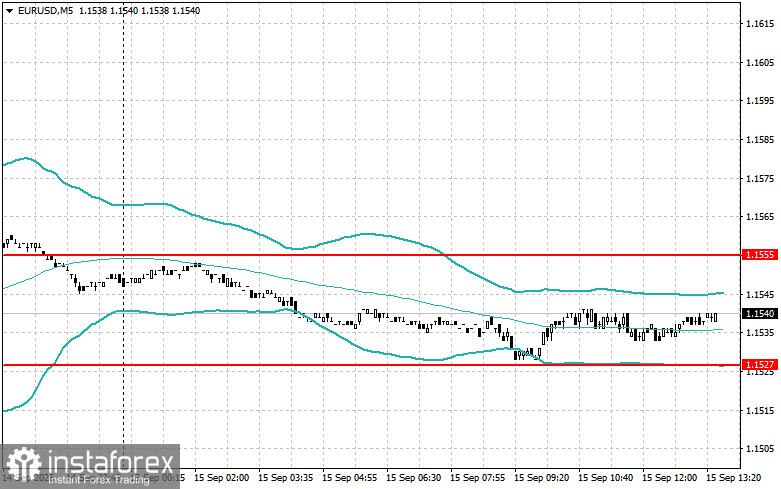
For the euro, I am watching 1.1555 on the upside. The logic is as follows: the pair attempts to move above this level, but there are not enough buyers to sustain the move, and the price then returns below the level, creating a sell signal. This scenario looks quite reasonable today because the overall background is already weighing on the euro, meaning that any attempt at an upward move may remain merely a technical rebound. The downside level is 1.1527, where the approach is reversed — I would look for buying opportunities after an unsuccessful attempt to push the market below this boundary. However, buying against the prevailing market sentiment is always riskier than selling in the direction of the trend, so it is reasonable to keep the target for such a rebound modest, within 15–20 points, rather than expecting a reversal of the entire market picture.
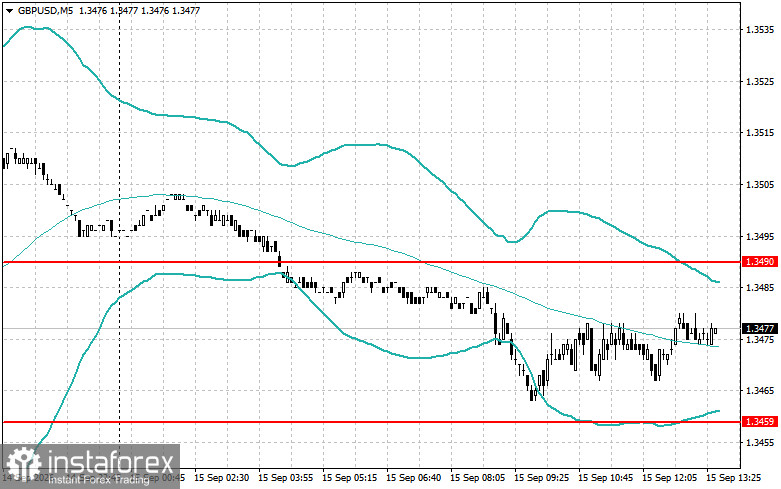
For the pound, the upper boundary is 1.3490. The same approach applies here: if the pair moves above the level and quickly loses momentum, a return below the level provides a basis for a sell trade. Given the pound's weakness following today's labor-market data, this outcome appears likely. The lower level of 1.3459 suggests buying on a rebound after a false break below the level, but this area should be approached with caution. The current background for the pound is so unfavorable that even a successful technical rebound could be very short-lived before the pair turns lower again.
¡Los informes analíticos de InstaForex lo mantendrá bien informado de las tendencias del mercado! Al ser un cliente de InstaForex, se le proporciona una gran cantidad de servicios gratuitos para una operación eficiente.


