 Rimani
Condizioni di trading
Strumenti



The price test at 154.94 occurred when the MACD indicator had risen significantly from the zero mark, which limited the dollar's upward potential. The second test at 154.94 coincided with the MACD being in the overbought area, prompting the implementation of sell scenario #2 for the dollar, but the pair did not decline.
The Japanese yen continued its depreciation against the US dollar, showing sensitivity to US labor market data. The reports released, including the unemployment claims report, were better than forecasts, strengthening the US currency and putting additional pressure on the yen. This fact exacerbated the trend of the Japanese currency's weakening observed this week. Investors, guided by strong US economic data, moved capital into US assets, which typically increases the dollar's value against the yen. Such movement reflects differences in monetary policy and economic prospects between the two countries.
Today's data showing a decrease in Japan's consumer price index to 1.5% has strengthened the case for a more cautious approach by the Bank of Japan to interest rate hikes, further pressuring the yen. This unexpected deflationary impulse, deviating from analysts' forecasts, highlights the complexity of the economic situation in the country and poses a difficult task for the central bank—to find a balance between controlling inflation and supporting fragile economic growth.
The drop in inflation to 1.5%, significantly below the Bank of Japan's target of 2%, raises concerns about the sustainability of Japan's economic recovery. As long as inflationary pressure remains weak, any aggressive tightening of monetary policy could hinder consumption and investment, jeopardizing recent gains. This, in turn, increases negative pressure on the yen, as lower interest rates make the Japanese currency less attractive to foreign investors compared to assets in higher-yielding countries.
As for the intraday strategy, I will rely more on implementing scenarios #1 and #2.
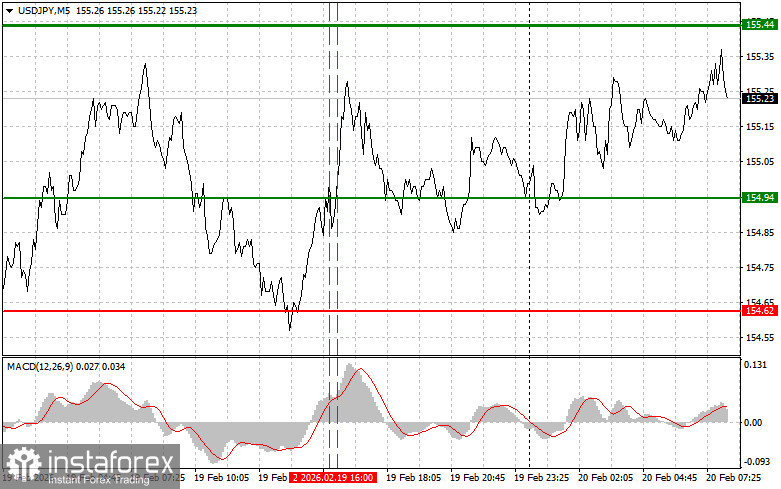
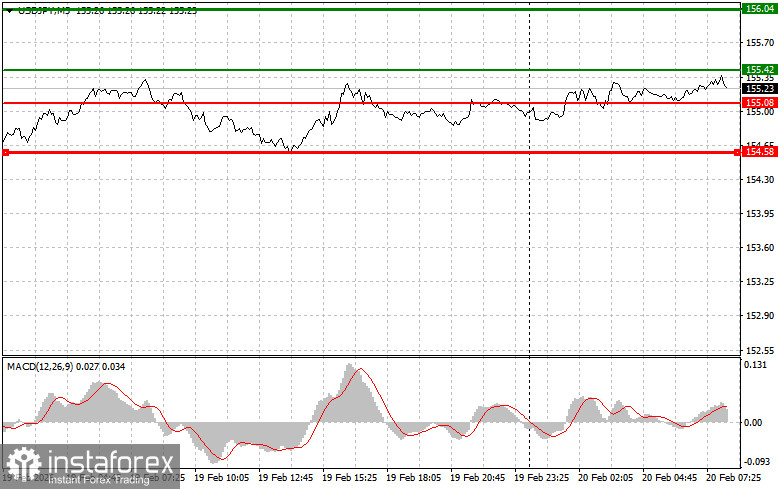
The thin green line represents the entry price at which one can buy the trading instrument;
The thick green line represents the approximate price where one can set Take Profit or secure profits, as further growth above this level is unlikely;
The thin red line represents the entry price at which one can sell the trading instrument;
The thick red line represents the approximate price where one can set Take Profit or secure profits, as further decline below this level is unlikely;
The MACD indicator: when entering the market, it is important to consider overbought and oversold zones.
Important: Beginner traders in the Forex market should be very careful when making entry decisions. It is best to stay out of the market before important fundamental reports are released to avoid getting caught in sharp price fluctuations. If you decide to trade during news releases, always set stop orders to minimize losses. Without setting stop orders, you can quickly lose your entire deposit, especially if you do not use money management and trade large volumes.
And remember, for successful trading, it is essential to have a clear trading plan, as outlined above. Making spontaneous trading decisions based on the current market situation is inherently a losing strategy for an intraday trader.
Le recensioni analitiche di InstaForex ti renderanno pienamente consapevole delle tendenze del mercato! Essendo un cliente InstaForex, ti viene fornito un gran numero di servizi gratuiti per il trading efficiente.


