 Rimani

Condizioni di trading
Strumenti


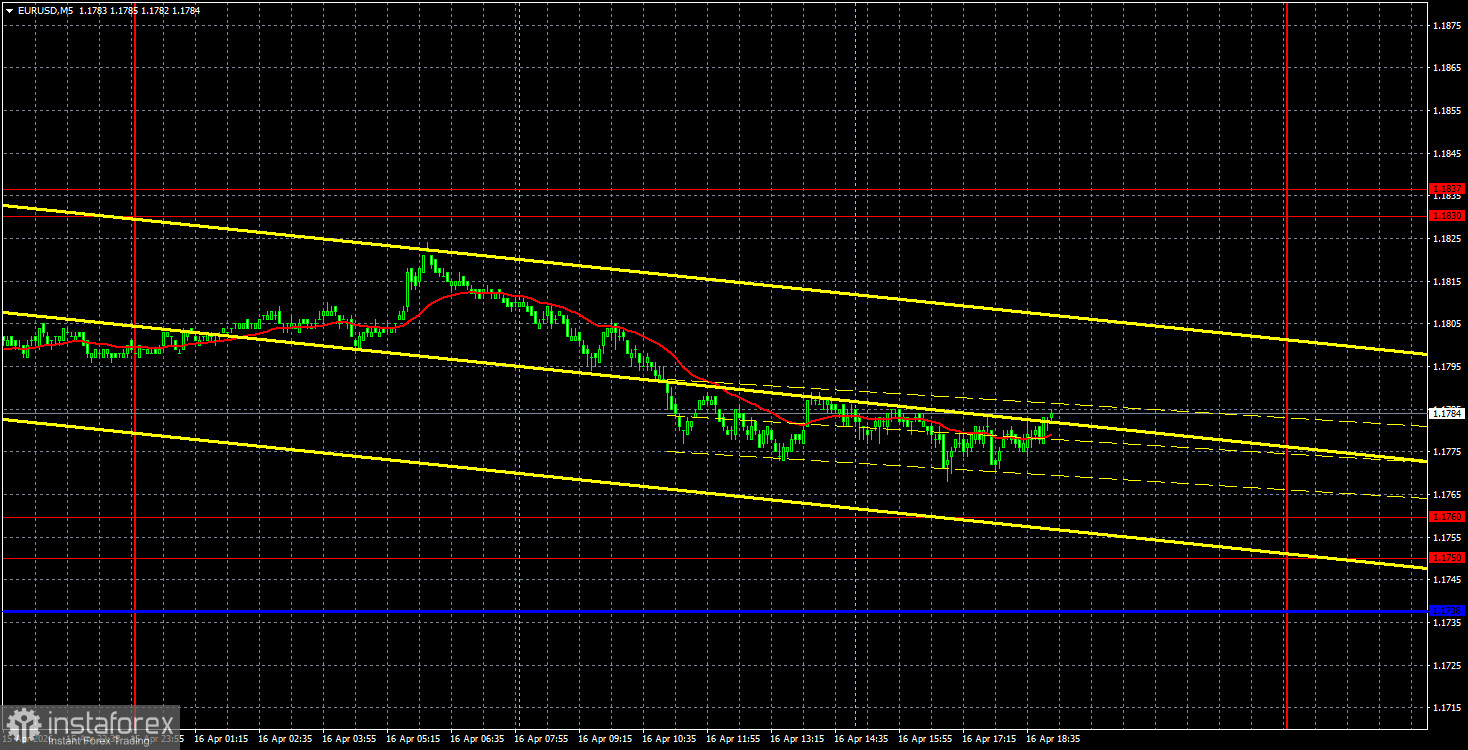
The EUR/USD currency pair continued its predominantly low-volatility movement on Thursday, showing a slight downward bias. Important macroeconomic events were again absent, and the market is no longer paying attention to secondary geopolitical news. The Eurozone published its second March inflation estimate. In fact, the inflation level came in slightly above forecasts; however, just a day earlier, Christine Lagarde urged the markets not to rush to conclusions and cautioned against the premature formation of a new rate trajectory. In other words, the March inflation rise did not alarm the European Central Bank, so in April, the central bank may decide to avoid tightening monetary policy.
At the same time, Donald Trump announced that negotiations between Lebanon and Israel would take place today, the first in 34 years. Simultaneously, the U.S. president stated that he has ended his 10th war, even though neither the Iran/U.S. war nor the Israel/Lebanon war is actually over, and it's unclear where Trump counted eight more wars.
On the hourly timeframe, the pair continues to exhibit an upward trend, as indicated by the trend line. Overall, unless a new geopolitical shock occurs soon, the European currency can steadily continue to rise towards this year's highs. Of course, not immediately, but 2026 has just begun. This is far from the euro's ceiling, as Trump's policies will continue to have a destructive impact on the national currency, the economy, trade relations, and the U.S. reputation.
On the 5-minute timeframe, no trading signals were formed yesterday. The last buy signal was generated on Tuesday from a rebound in the 1.1750-1.1760 area, and throughout Thursday, the price traded within 5 pips of the target area.
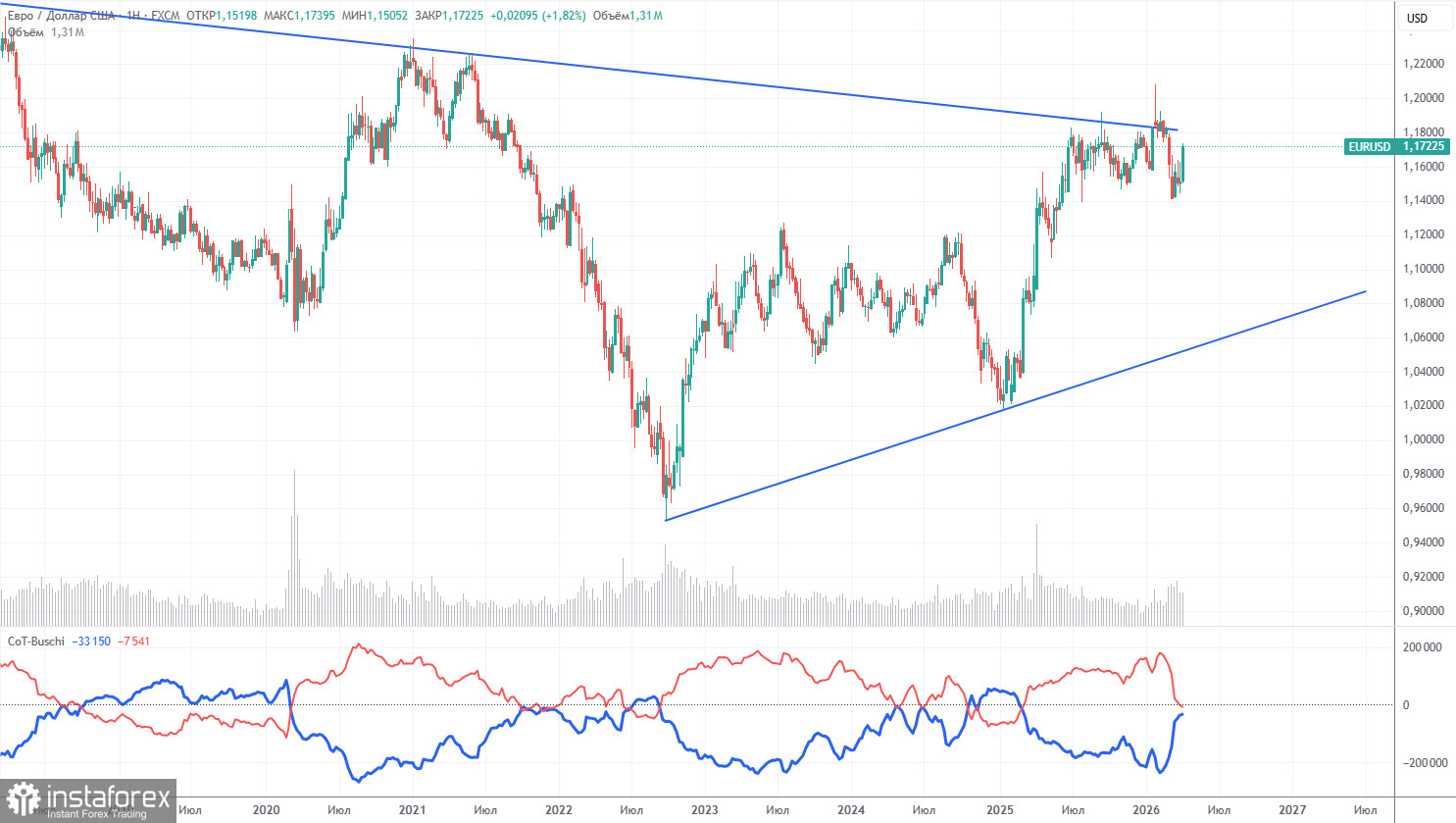
The latest COT report is dated April 7. The illustration for the weekly timeframe clearly shows that the net position of non-commercial traders remains "bullish," but is rapidly declining amid geopolitical events. Traders are massively shedding the euro in favor of the U.S. dollar. Donald Trump's policy has not changed, but the dollar now serves as a "reserve currency," ensuring strong demand for it.
We see no fundamental factors that would strengthen the euro; however, there are plenty that would weaken the dollar. The war in the Middle East temporarily made the dollar super-attractive, but once this factor's "shelf life" expires, everything will return to normal. In the long term, the euro may fall to 1.06 (the trendline), but the upward trend will remain intact. Currently, the pair has not deviated significantly from the descending trend line, which has been breached several times.
The position of the red and blue lines of the indicator indicates parity between bulls and bears. Over the last reporting week, the number of longs among the "Non-commercial" group increased by 800, while the number of shorts increased by 8,800. Accordingly, the net position decreased by another 8,000 contracts over the week.
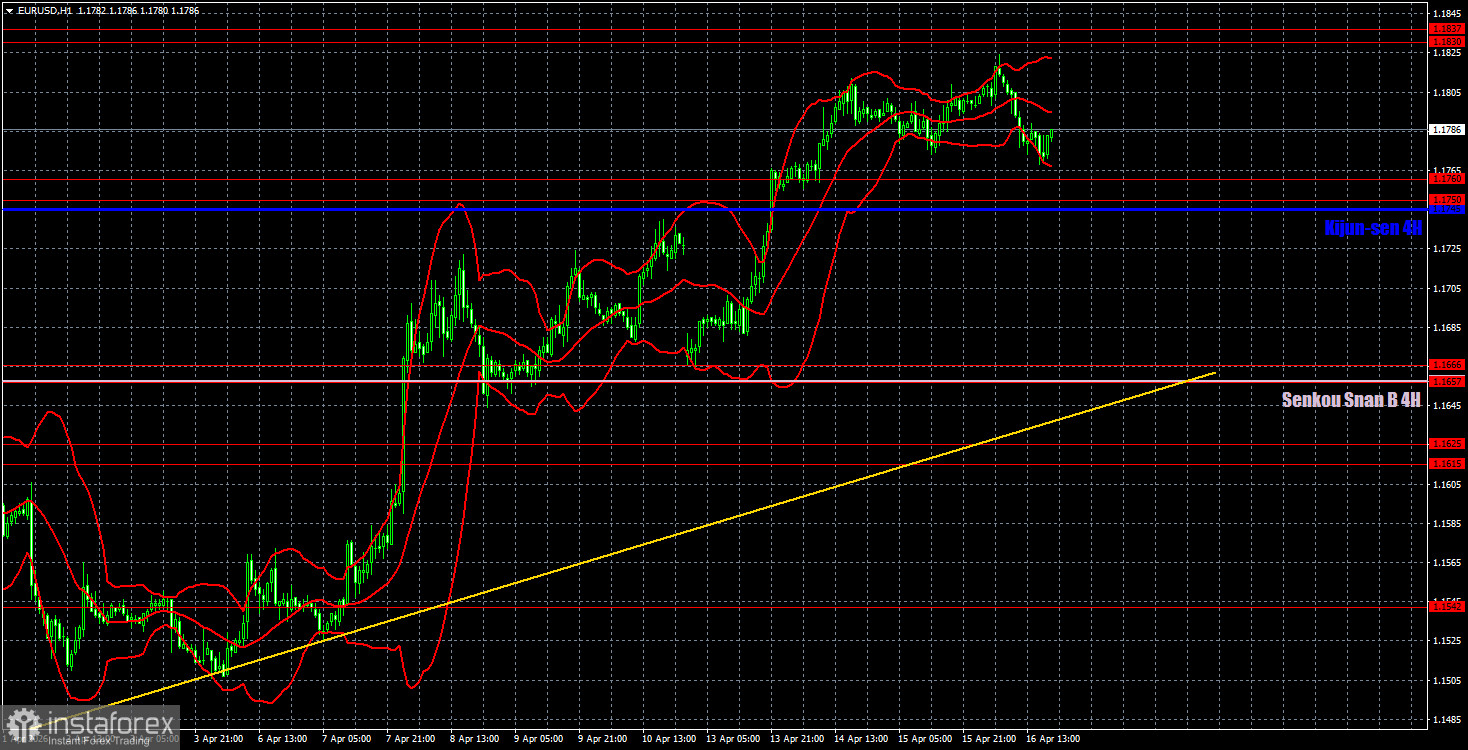
On the hourly timeframe, the EUR/USD pair continues its upward trend. A new escalation in the Middle East could again change traders' priorities, so any growth should be approached with caution. At the same time, the situation in the Middle East remains tense but is not worsening, so there are few strong reasons to further strengthen the U.S. dollar. There are currently no technical grounds to expect a decline.
For April 17, we highlight the following trading levels — 1.1362, 1.1426, 1.1542, 1.1615-1.1625, 1.1657-1.1666, 1.1750-1.1760, 1.1830-1.1837, 1.1907-1.1922, as well as the Senkou Span B line (1.1658) and Kijun-sen line (1.1745). The Ichimoku indicator lines may shift throughout the day, which should be taken into account when determining trading signals. Don't forget to set the Stop Loss order to breakeven after the price has moved in the right direction by 15 pips. This will protect against potential losses if the signal turns out to be false.
On Friday, no significant reports or events are scheduled in the Eurozone or the U.S. However, a new round of negotiations may take place between Iran and the U.S. There are also negotiations expected between Lebanon and Israel. Therefore, today will be a "Day of Geopolitics."
On Friday, traders may consider short positions if the price consolidates below the 1.1750-1.1760 area, targeting 1.1657-1.1666. Long positions can be opened on a rebound from the area of 1.1750-1.1760 with a target of 1.1830-1.1837.
Support and resistance price levels are thick red lines around which the movement may end. They are not sources of trading signals.
The Kijun-sen and Senkou Span B lines are lines of the Ichimoku indicator, transferred to the hourly timeframe from the 4-hour timeframe. They are strong lines.
Extreme levels are thin red lines from which the price previously rebounded. They are sources of trading signals.
Yellow lines are trend lines, trend channels, and any other technical patterns.
Indicator 1 on the COT charts shows the size of the net position of each category of traders.
Le recensioni analitiche di InstaForex ti renderanno pienamente consapevole delle tendenze del mercato! Essendo un cliente InstaForex, ti viene fornito un gran numero di servizi gratuiti per il trading efficiente.


