 Rimani
Condizioni di trading
Strumenti



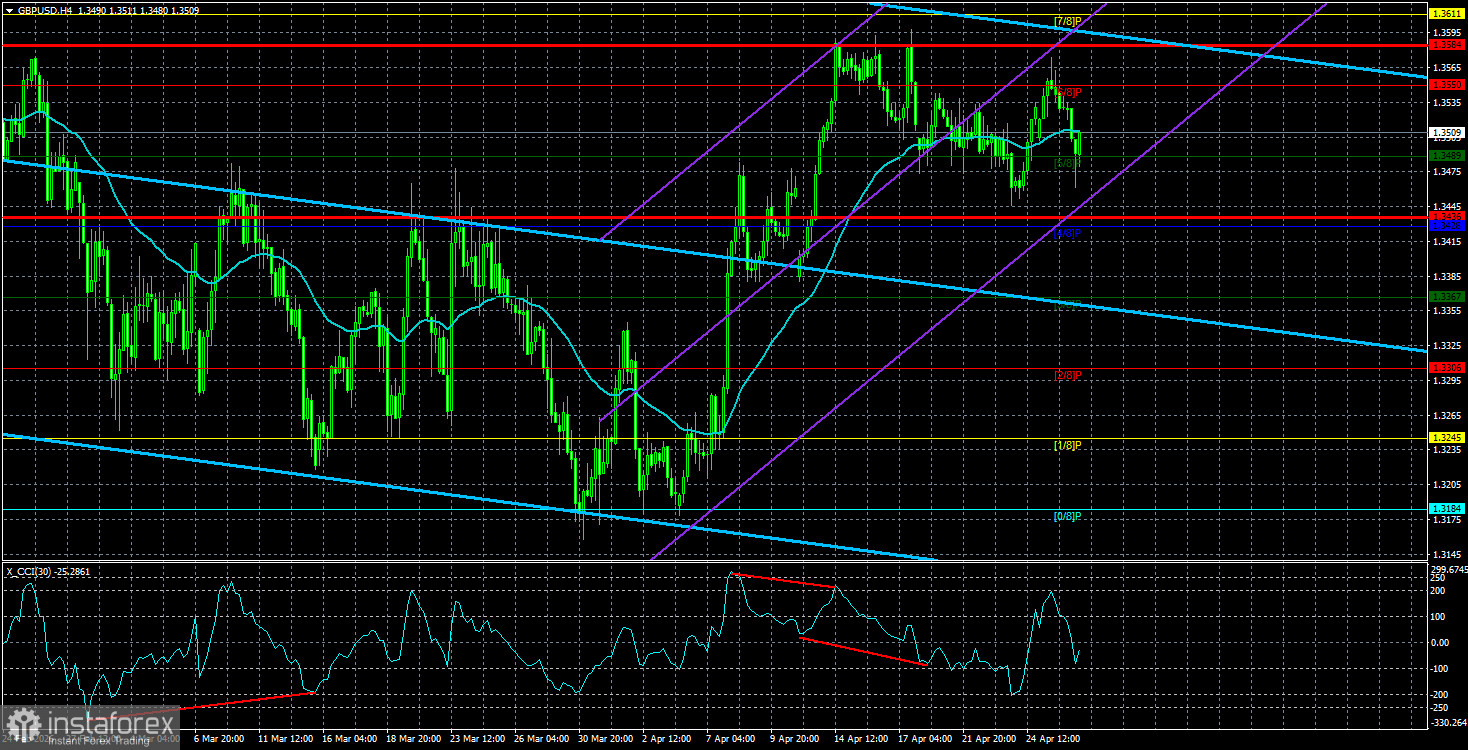
The GBP/USD currency pair showed a fairly confident rise during the day on Tuesday, and the most important question for traders now is, "Why did the dollar strengthen a day before the FOMC meeting?" In our view, the answer lies within the question itself. The market anticipates that the FOMC may tweak its monetary policy stance towards a more "hawkish" position. We believe there is no basis for this assumption, and we will detail why in this article. However, it can already be said with a high degree of certainty that we are unlikely to hear any "hawkish" rhetoric, as the market has already priced in this scenario. As a result, the U.S. dollar may appreciate further within the current correction that began on April 17, but it likely won't have enough strength for more than that.
In general, discussing the Federal Reserve's monetary policy realization, it should be understood that it currently depends on two factors: inflation and the labor market. This is neither news nor a secret, as the Federal Reserve has been balancing between these two points for several years. However, the situation was somewhat different earlier. Last year, the American central bank implemented three policy easings to support the labor market. While we cannot say the U.S. labor market has fully recovered, at the last Monetary Committee meeting, Jerome Powell made it clear that inflation is now the top priority.
Seemingly, the Fed should be the most eager to raise the key rate, especially since the consumer price index jumped by 0.9% year-on-year in March alone. However, this is not the case. Jerome Powell clearly outlined the Fed's main goal, but that does not mean the Fed is ready to neglect its other objectives. Let's refer to the Nonfarm Payrolls reports: in January, 160,000 jobs were created; in February, -133,000; and in March, 178,000. On average, about 69,000 jobs are created in the American economy each month in 2026. This is an exceptionally low figure. It is worth noting that a normal figure is 150,000-200,000 jobs per month, and during Joe Biden's term, at least 120,000-150,000 jobs were created each year.
Thus, it is still too early to speak of a recovery in the U.S. labor market, and celebrating this recovery would be premature. The Fed understands this well, and tightening monetary policy will lead to a contraction in the labor market and an economic slowdown. Interestingly, the U.S. economy grew only by 0.5% in the fourth quarter of last year, and no one yet knows what the figure will be for the first quarter of this year. The economy under Trump is growing more slowly than under Joe Biden. Therefore, for the Fed, raising rates would be almost tantamount to self-sabotage, especially given that this will be Jerome Powell's last meeting and his successor, Kevin Warsh, will likely push the Monetary Committee to lower the key rate. Thus, we do not expect a tightening of the Fed's rhetoric, which could support the U.S. currency.
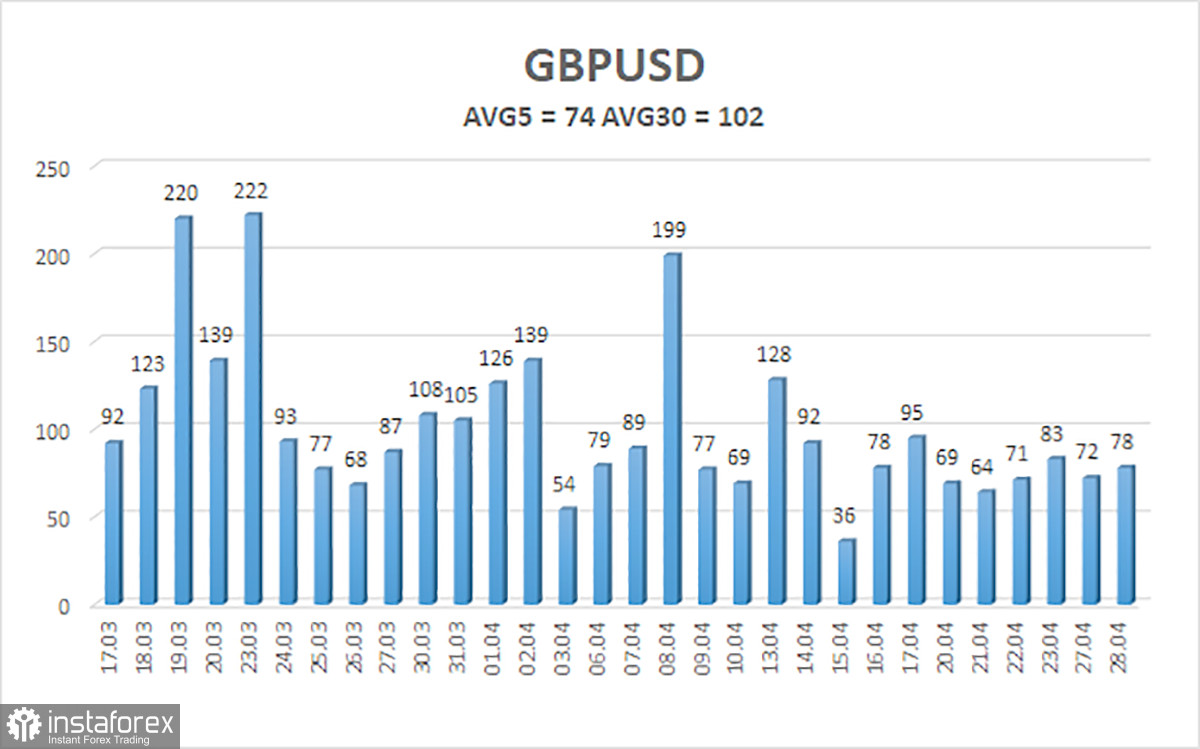
The average volatility of the GBP/USD pair over the last five trading days is 74 pips, which is considered "average." On April 29, we expect movement within the range defined by 1.3436 and 1.3584. The upper linear regression channel is pointing downward, indicating a shift to a downward trend. The CCI indicator has entered the overbought area and formed a "bearish" divergence, which has warned of a downward pullback in advance.
S1 – 1.3489
S2 – 1.3428
S3 – 1.3367
R1 – 1.3550
R2 – 1.3611
R3 – 1.3672
The GBP/USD currency pair continues to recover after two "months of geopolitics." Donald Trump's policies will continue to pressure the U.S. economy, so we do not expect the U.S. currency to grow in 2026. Therefore, long positions with a target of 1.3916 and above remain relevant when the price is above the moving average. If the price is below the moving average, short positions can be considered with targets of 1.3436 and 1.3428 on technical grounds. In recent weeks, the British currency has recovered, and the influence of geopolitical factors on the market is diminishing.
Linear regression channels help to define the current trend. If both are directed in the same way, it means the trend is currently strong;
The moving average line (settings 20,0, smoothed) determines the short-term trend and the direction in which trading should currently be conducted;
Murray levels are target levels for movements and corrections;
Volatility levels (red lines) indicate the probable price channel in which the pair will operate over the next day, based on current volatility readings;
The CCI indicator – its entrance into the oversold area (below -250) or the overbought area (above +250) indicates that a trend reversal in the opposite direction may be approaching.
Le recensioni analitiche di InstaForex ti renderanno pienamente consapevole delle tendenze del mercato! Essendo un cliente InstaForex, ti viene fornito un gran numero di servizi gratuiti per il trading efficiente.


