 Zůstat

Obchodní podmínky
Nástroje


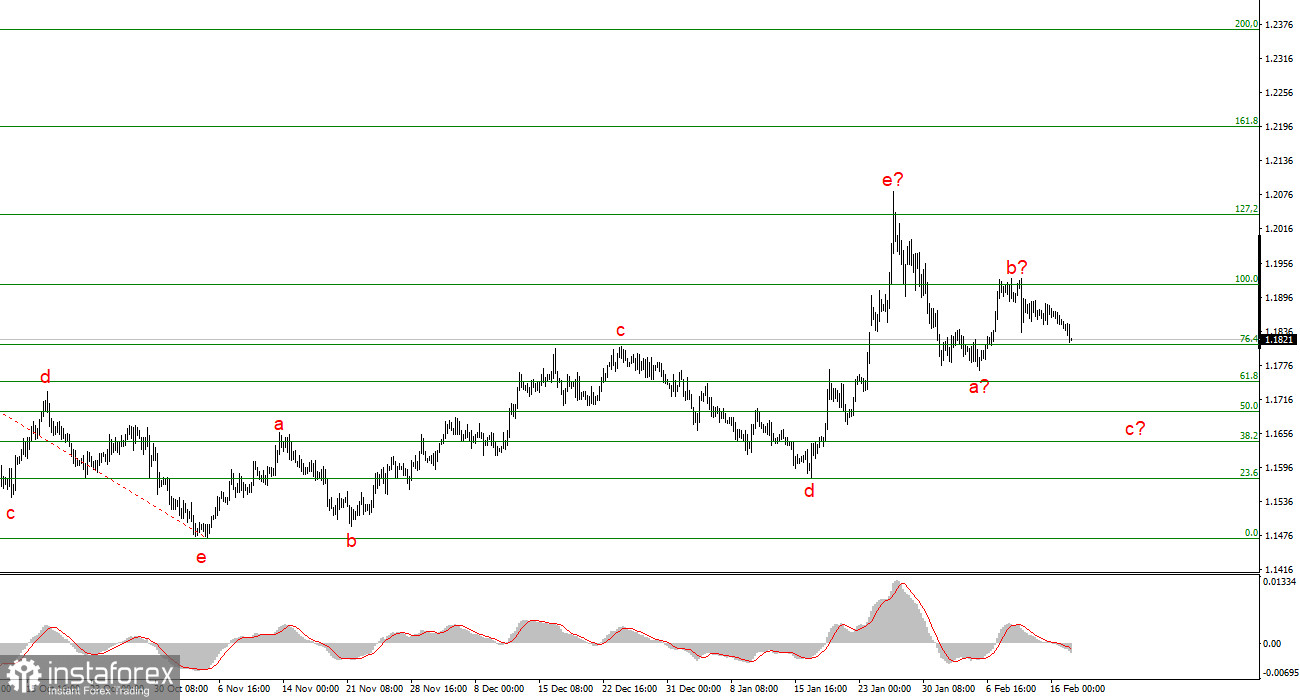
The wave count on the 4-hour chart for EUR/USD is not ideal but raises no major questions. There is still no talk of canceling the upward trend that began in January of last year; only the internal wave structure is occasionally adjusted. In my view, the pair has completed the formation of the global wave 4 (lower chart). If this assumption is correct, wave 5 has now begun and is continuing to form. Wave 5 may be quite extended, with targets ranging up to the 25th level.
The internal wave structure of the expected wave 5 is not entirely clear (upper chart). The upward sequence of waves cannot be considered impulsive due to relatively strong corrective waves. At the moment, it is interpreted as a-b-c-d-e. However, if wave 5 becomes extended, its internal structure will also be quite complex. If this is the case, the wave count may be adjusted again. In any case, I expect further increases in EUR/USD, though in the coming days the market may focus on forming a corrective a-b-c structure.
On Tuesday, EUR/USD again showed the same amplitude and movement pattern as the previous five days. Out of the last seven trading days, the market was almost inactive on six of them. For example, today's movement amplitude did not exceed 25 points; yesterday it was 20 points. The only difference on Tuesday was a decline in the instrument rather than sideways movement. What caused the decline in demand for the euro?
There are two reasons. First, the market began to anticipate new "dovish" measures from the ECB. The last Eurozone inflation report showed a slowdown to 1.7%. I noted then that the likelihood of a new round of rate cuts had significantly increased, which could pressure the euro. However, the very next day Christine Lagarde stated that she did not see any problem with inflation slowing to 1.7%, as the main focus is its long-term average, not a single report. The market, however, seemed skeptical, and demand for the euro continued to decline.
Second, the economic sentiment indices from the ZEW institute released this morning came in below market expectations. These are not the most important data, and the market reaction was not strong. Thus, market participants appear ready to form a full corrective a-b-c structure. If this assumption is correct, the euro's decline could continue toward the 17th level.
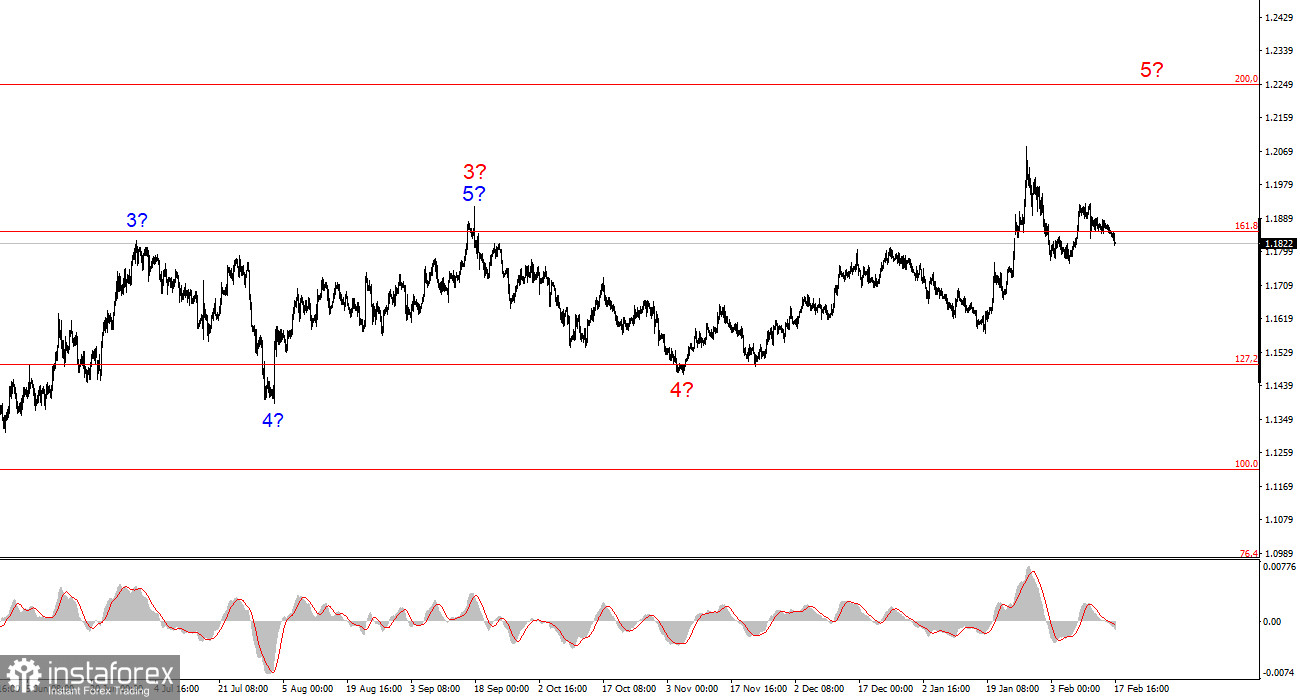
Based on the EUR/USD analysis, I conclude that the pair continues to form the upward portion of the trend. Donald Trump's policies and the Fed's monetary policy remain key factors supporting long-term weakness in the US dollar. Targets for the current trend section may extend up to the 25 level. At present, I consider the instrument to remain within global wave 5, so I expect further increases in the first half of 2026. However, the pair may form another downward wave within a correction in the near term. I consider it appropriate to now focus on identifying areas and levels for new purchases, with targets around 1.2195 and 1.2367, corresponding to 161.8% and 200.0% Fibonacci levels.
At a smaller scale, the entire upward portion of the trend is visible. The wave count is nonstandard, as corrective waves vary in size. For example, the larger wave 2 is smaller than the internal wave 2 within wave 3. Such situations occur. I remind that it is better to identify clear structures on charts rather than strictly follow every wave. The current upward wave structure is clear.
Key Principles of My Analysis:
Díky analytickým přehledům společnosti InstaForex získáte plné povědomi o tržních trendech! Jako zákazníkovi společnosti InstaForex je Vám k dispozici velký počet bezplatných služeb umožňujících efektivní obchodování.


