 Zůstat

Obchodní podmínky
Nástroje


The market atmosphere remains extremely unstable. Currently, traders are closely watching the U.S. administration's actions to stabilize energy prices, especially amid heightened rhetoric from President Donald Trump and the emergence of a new Supreme Leader in Iran.

Recently, the U.S. announced the issuance of a second temporary permit for the import of Russian oil. This new directive, which applies to crude oil, is broader in scope than the previous order, which only allowed India to stimulate its purchases. Concurrently, the price of Brent crude oil is approaching the psychologically significant $ 100-per-barrel mark. According to the International Energy Agency (IEA), there is currently an unprecedented supply disruption, the largest in the history of the global oil market.
These events unfold against the backdrop of geopolitical tension in the Middle East, which will undoubtedly continue to put pressure on the market. The risks associated with potentially heavier bombardments of energy infrastructure on both sides, heightened rhetoric, and the mere existence of new uncertainty factors compel investors to exercise caution. High volatility signals the uncertainty among market participants regarding future pricing directions and the sustainability of supply.
Interestingly, despite the U.S. intentions to regulate prices, Brent oil is demonstrating an upward trend. This may indicate the limited impact of the administration's individual measures on the global market, where fundamental factors such as production volumes, consumption, and geopolitics play a dominant role. Temporary permits to purchase Russian oil may be a positive signal, but they cannot compensate for the large-scale supply disruptions reported by the IEA.
Moreover, the Trump administration plans to repeal a century-old maritime law requiring the use of U.S. vessels to transport goods between U.S. ports. This initiative, aimed at reducing transportation costs and stimulating domestic trade, has received mixed reactions. Supporters of the repeal argue that the law is outdated and restricts competition, leading to inflated shipping prices within the country. They believe that removing this restriction would attract more international carriers, thereby easing pressure on oil prices by reducing logistics costs and, consequently, making goods cheaper for end consumers.
However, opponents of this step express serious concerns about its consequences for the American shipbuilding industry and security. They believe that repealing the century-old law could undermine the positions of domestic carriers, who currently compete with larger and more economically powerful foreign companies.
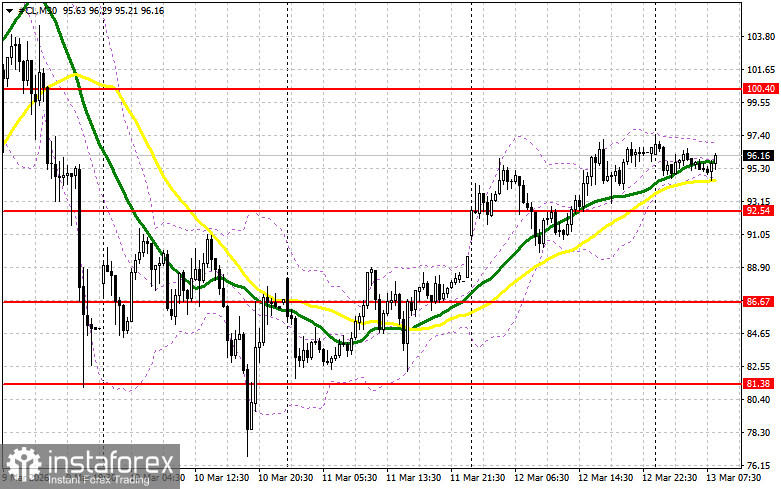
From a technical standpoint, buyers need to break through the nearest resistance at $100.40. This will allow for targeting $106.83, above which it will be quite challenging to break through. The furthest target will be around $113.36. In the event of a decline in oil prices, bears will attempt to take control over $92.54. If they succeed, breaking this range will deliver a serious blow to the bulls' positions and push oil down to a low of $86.67 with the prospect of reaching $81.38.
Díky analytickým přehledům společnosti InstaForex získáte plné povědomi o tržních trendech! Jako zákazníkovi společnosti InstaForex je Vám k dispozici velký počet bezplatných služeb umožňujících efektivní obchodování.


