 Zůstat

Obchodní podmínky
Nástroje


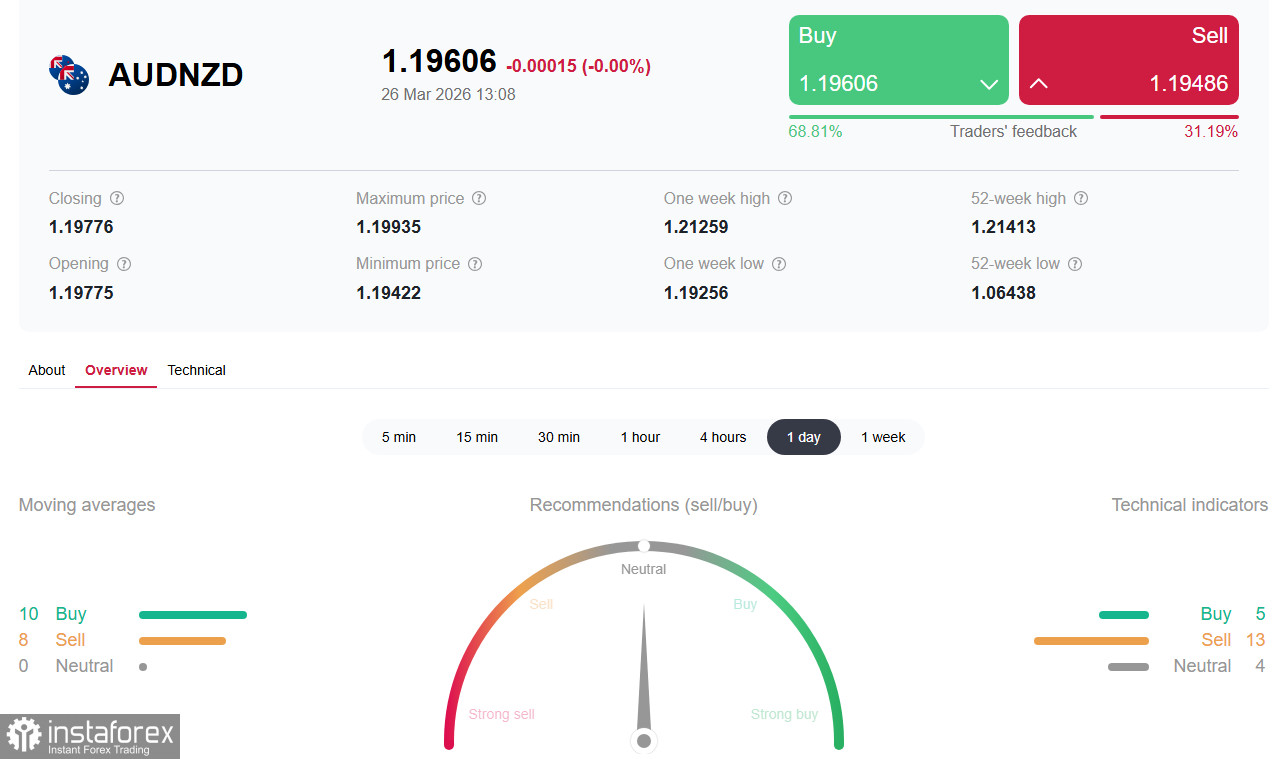
See also: InstaForex trading indicators for AUD/NZD
Despite a two-week pullback, the AUD/NZD pair finishes March 2026 with confident gains, consolidating around 1.1940–1.1950 in the early hours of the US trading session on Thursday after reaching last week's 13-year high of 1.2140. The Australian dollar continues to dominate the New Zealand dollar amid a dramatic divergence in monetary policy between the two central banks, amplified by geopolitical turbulence and the energy crisis.
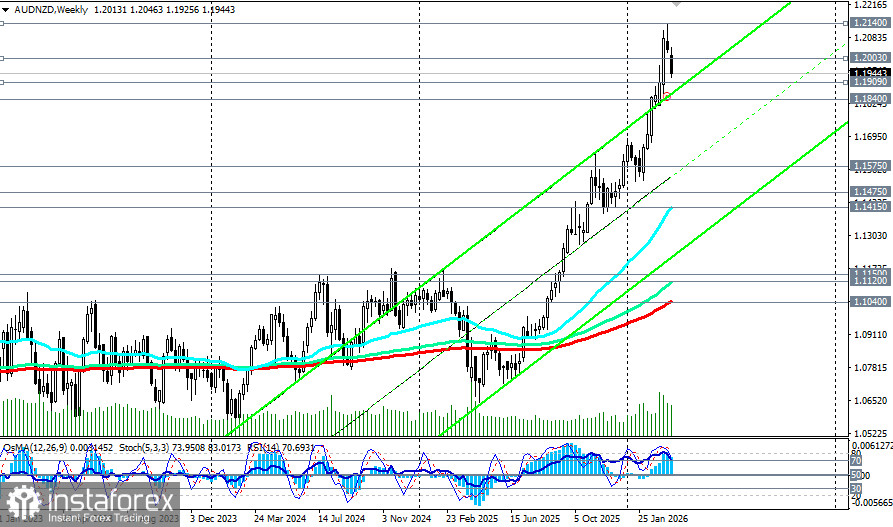
Key factor: monetary policy divergence
The Reserve Bank of Australia remains the only G10 central bank continuing a rate hike cycle. In February, the RBA raised the official cash rate (OCR) by 25 basis points to 3.85%, leaving the door open for further tightening. Last week, unlike other central banks, the RBA raised the rate again, underscoring its commitment to fighting inflation.
Deputy Governor Christopher Kent warned on Thursday that the war in Iran is tightening financial conditions and increasing the risks of an inflation spiral. Policymakers will have to rein in inflation against the backdrop of rising energy prices.
Markets reacted immediately: the probability of a May rate hike rose to 65%, and by year-end, the policy rate is expected to reach 4.75%. Some economists forecast that inflation in Australia could hit 5% in the second quarter.
By contrast with the hawkish RBA, the Reserve Bank of New Zealand is taking a more restrained stance. Although markets price in rate hikes in the second half of 2026, the futures trajectory remains significantly flatter than Australia's. New Zealand growth forecasts have been revised down, and the anticipated inflation path is returning to target levels more quickly.
RBNZ Governor Anna Breman emphasized global uncertainty, saying she does not rule out either a rate hike or a rate cut. Economists warn that NZD should not be treated as a simple alternative to AUD — the upside potential for the New Zealand currency is limited.
Geopolitical factor: energy crisis
The Middle East conflict, now in its fourth week, continues to dominate market sentiment. The Strait of Hormuz remains effectively blocked, and Iran rejected the US 15-point peace plan, setting its own demands, including control over the strait and the closure of US bases in the region. WTI crude has again risen above $92 per barrel.
A key distinction between the two economies — Australia and New Zealand — is their position in the energy balance. Australia, as a major exporter of liquefied natural gas (LNG) and coal, benefits directly from rising energy prices. Australia's status as a net energy exporter shields its terms of trade during the current crisis. This provides fundamental support for AUD.
New Zealand, by contrast, remains dependent on imported petroleum products. Rising fuel costs hit consumers and businesses directly, increasing stagflation risks.
Conclusion
Thus, New Zealand's structural vulnerability and a more cautious RBNZ will constrain NZD appreciation. At the same time, as noted above, Australian inflation could reach 5% in Q2, strengthening the case for further RBA tightening. This creates additional momentum for AUD appreciation.
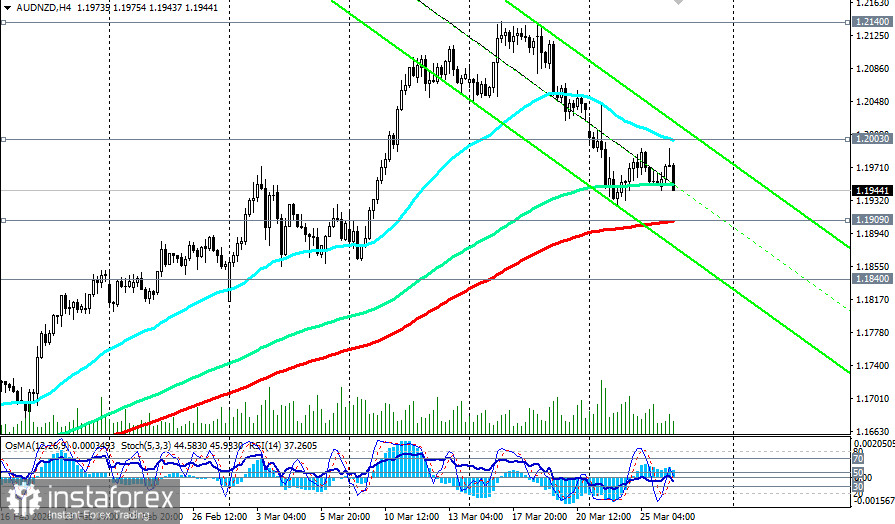
AUD/NZD finds itself at the epicenter of a rare fundamental divergence in the FX market. The RBA continues its tightening cycle, while the RBNZ stays on the sidelines. The energy crisis caused by the Strait of Hormuz blockade favors Australia as a net exporter, while weakening import-dependent New Zealand.
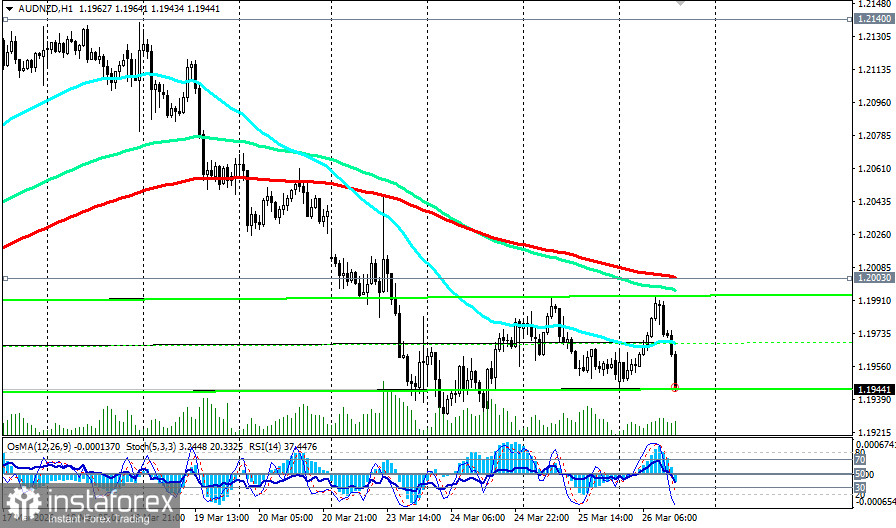
The key zone 1.1909 (EMA200 on the 4-hour chart)–1.2003 (EMA200 on the 1-hour chart) may become the scene of a decisive battle for the remainder of the week. Holding above 1.2010 and breaking the 13-year high of 1.2140 would open the way to 1.2180–1.2200. A break below 1.1890 could trigger a correction to 1.1840 (EMA50 on the daily chart)–1.1800, but the overall structure remains bullish.
Under any scenario, volatility will stay high. Investors should closely monitor the development of diplomatic contacts around the Strait of Hormuz, and, most importantly, RBA rhetoric on the outlook for rates. Success will favor those who can assess the resilience of the structural divergence amid persistent geopolitical uncertainty.
Díky analytickým přehledům společnosti InstaForex získáte plné povědomi o tržních trendech! Jako zákazníkovi společnosti InstaForex je Vám k dispozici velký počet bezplatných služeb umožňujících efektivní obchodování.


