 Zůstat

Obchodní podmínky
Nástroje


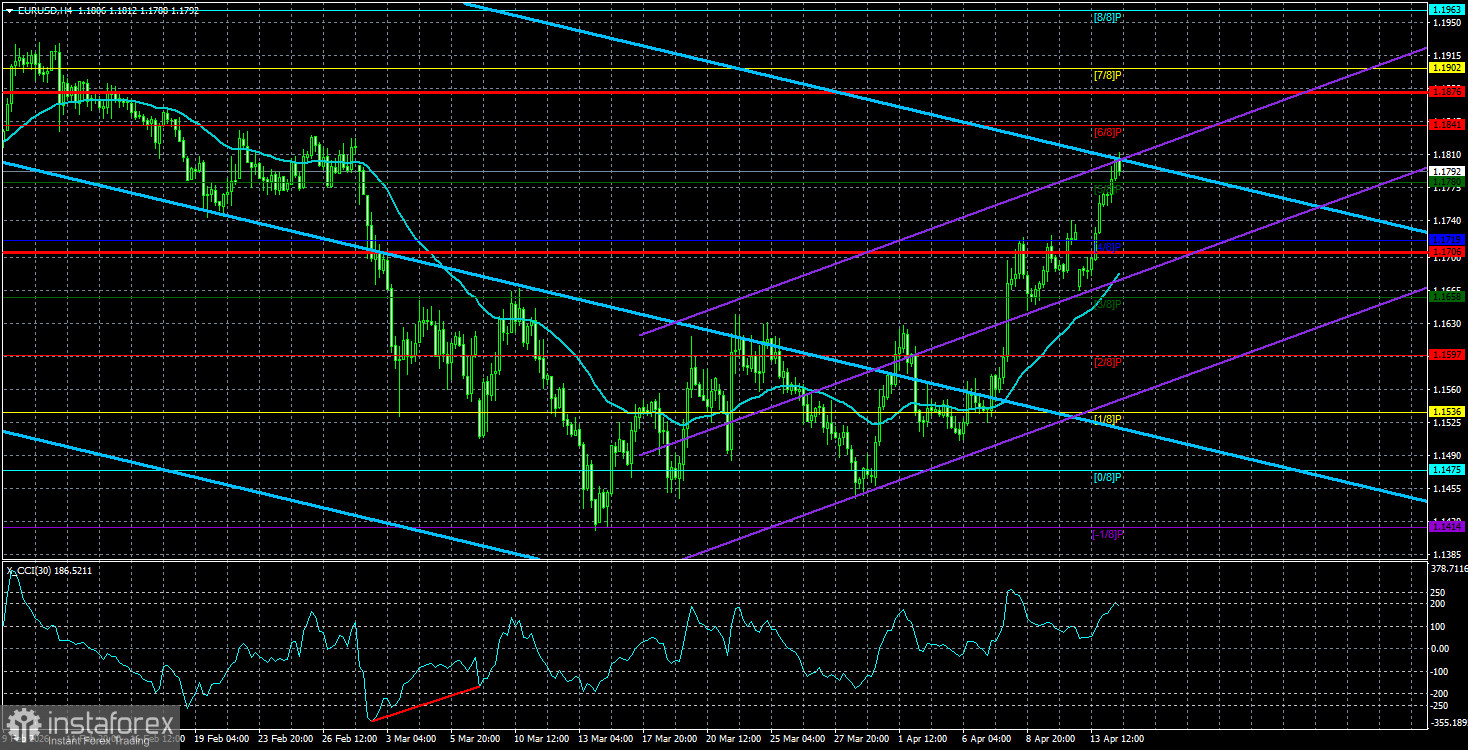
The EUR/USD currency pair continued its upward movement on Tuesday, building on the momentum that began last week. Recall that last week was significant for the market. And we are not talking about the two-week ceasefire between Iran and the U.S., the U.S. GDP or inflation reports, or the negotiations in Islamabad. We are talking about a global shift in sentiment among traders. It is worth noting that any movement of any instrument in any market can be explained if one wishes to do so, even if the explanation does not correspond to the truth. And the vast majority of experts usually do just that—they explain movements ex post. What is the point?
For the past two months, we have continuously stated that the dollar's growth was purely driven by geopolitical factors, and even that factor would not save it from a long-term decline. Geopolitical factors cannot support the U.S. currency indefinitely, and the market cannot continuously ignore all factors except geopolitics. And now, over the last week and a half, the EUR/USD pair has risen by 300 points and is near the 18-level. The 18-level is just 250 points away from the euro's highest level in the last four years. As soon as the market became saturated with the safe-haven dollar, the geopolitical factor caused the dollar to revert to its traditional downward trend under Donald Trump. The EUR/USD pair is once again very close to its highs. Just two weeks ago, it seemed that the U.S. dollar would rise for most of 2026.
If the market traded purely on geopolitical factors in the last two months, it is now trading against them. Consider this: last week, only on Wednesday did the market have grounds to buy euros or pounds, as that day a ceasefire in the Middle East was established. A ceasefire that was violated on the very same Wednesday. Over the weekend, it became known that Iran and the U.S. once again failed to reach an agreement on nuclear energy (what a surprise!), and on Monday, Donald Trump ordered his navy to blockade the Strait of Hormuz for Iranian tankers and any other tankers willing to pay Iran for using the strait. Thus, if the market had continued to trade on geopolitics, we would not have seen such a strong rise in the euro last week, and this week we would have seen a collapse in the euro. However, the euro is rising and may soon return to where it started its decline at the end of January this year. The upward trend, as we have said many times, remains intact, as clearly seen on the daily and weekly timeframes.
Now we await further growth of the euro for one simple reason—Donald Trump. In 2026, Trump's "achievements" included igniting a full-scale war in the Middle East, which has already sparked an energy crisis around the globe. Trump continues to stubbornly pursue not a "golden age" for the U.S., but a "stone age."
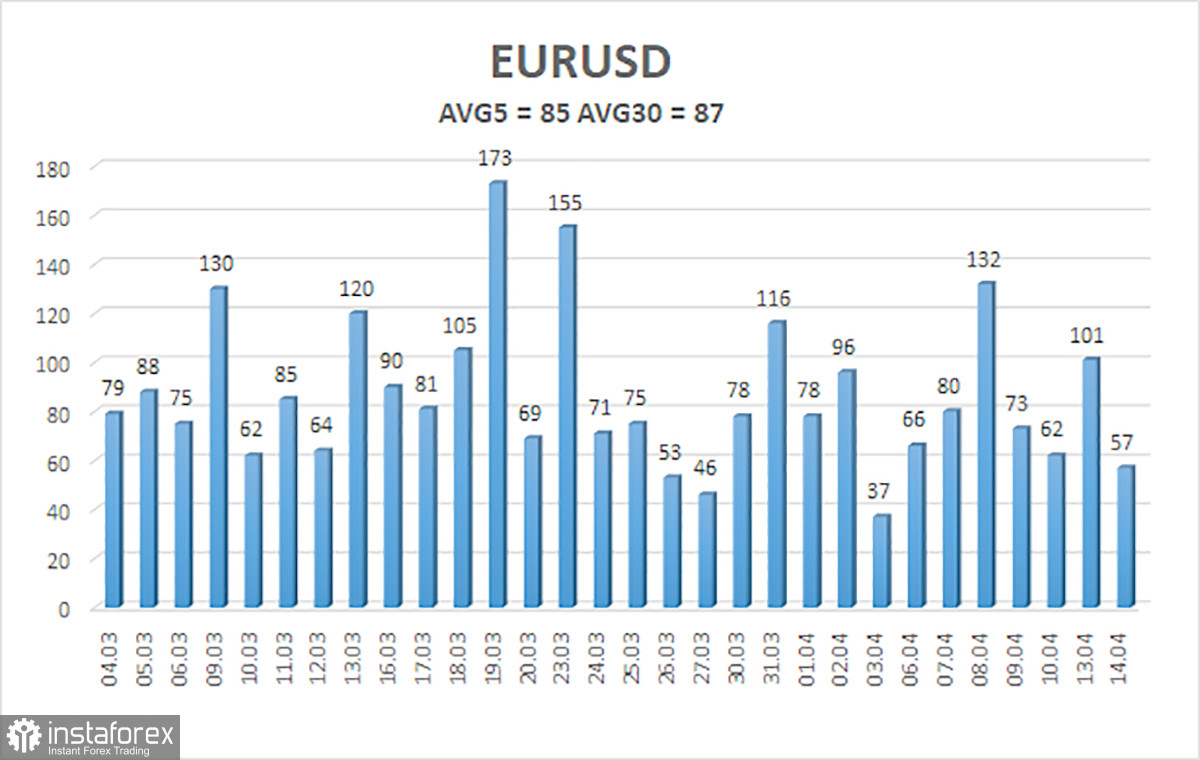
The average volatility of the EUR/USD currency pair over the last 5 trading days as of April 15 is 85 pips, which is considered "average." We expect the pair to trade between 1.1706 and 1.1876 on Wednesday. The upper channel of the linear regression has turned downwards, indicating a change in trend to a downward one. However, an upward trend may resume at this time. The CCI indicator has entered the overbought area, warning of a possible downward pullback in the near future.
S1 – 1.1658
S2 – 1.1597
S3 – 1.1536
R1 – 1.1719
R2 – 1.1780
R3 – 1.1841
The EUR/USD pair has begun its upward movement, but its continuation will once again depend on geopolitical factors. The global fundamental backdrop for the dollar remains extremely negative; however, over the past two months, the market has focused solely on geopolitics, rendering all other factors practically irrelevant. If the price is below the moving average, short positions can be considered with targets at 1.1597 and 1.1536. Above the moving average line, long positions are relevant with targets of 1.1841 and 1.1876. The market is gradually distancing itself from the geopolitical factor, and familiar economic factors may come to the forefront in the near future.
Regression channels help determine the current trend. If both are directed in the same way, it indicates a strong trend.
The moving average line (settings 20.0, smoothed) defines the short-term trend and direction in which trading should proceed.
Murray levels serve as target levels for movements and corrections.
Volatility levels (red lines) indicate the probable price channel in which the pair is likely to trade over the next day, based on current volatility readings.
The CCI indicator's entry into the oversold area (below -250) or the overbought area (above +250) indicates that a trend reversal in the opposite direction is approaching.
Díky analytickým přehledům společnosti InstaForex získáte plné povědomi o tržních trendech! Jako zákazníkovi společnosti InstaForex je Vám k dispozici velký počet bezplatných služeb umožňujících efektivní obchodování.


