 Zůstat
Obchodní podmínky
Nástroje



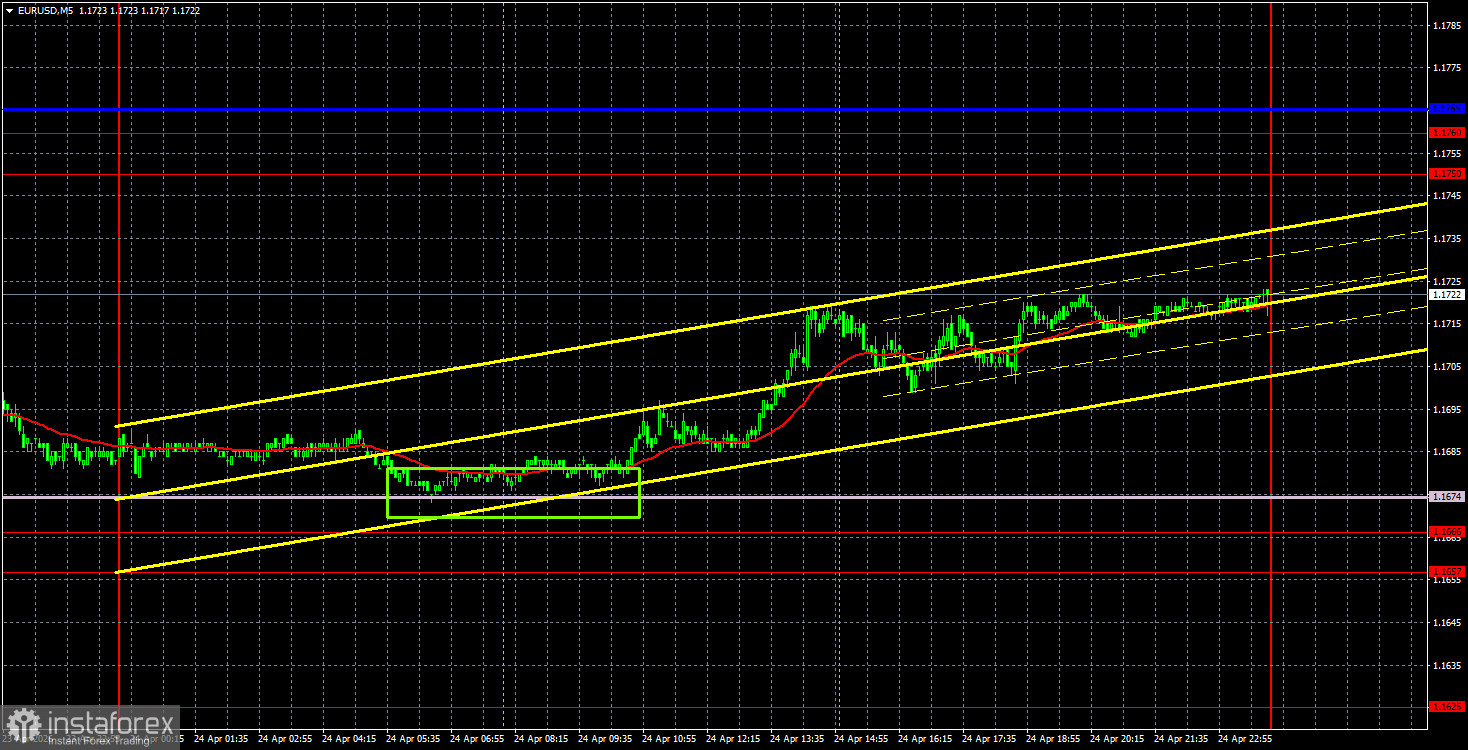
On Friday, the EUR/USD currency pair would have continued its downward movement if it hadn't encountered a strong support line from the Ichimoku indicator—Senkou Span B. Essentially, the entire day turned out to be technical. There were no significant macroeconomic reports in the Eurozone, and the University of Michigan consumer sentiment index in the US was published only in the evening. The final value for April is 49.8 points, which is above forecasts but below the previous value. Thus, it is hard to definitively say whether this report was positive. However, it doesn't matter much since the market continues to ignore almost the entire macroeconomic backdrop. The illustration above shows that there was no reaction to this report. There was also a report that Iranian Foreign Minister Abbas Araqchi was heading to Pakistan, but this event did not provide significant support for the euro either. Therefore, we believe about 80% of the euro's rise on Friday was driven by a bounce off the Senkou Span B line.
From a technical standpoint, on the hourly timeframe, the pair failed to consolidate below the Senkou Span B line, so the upward trend remains intact despite breaking the trend line. If the Kijun-sen line is breached on Monday or Tuesday, the upward movement may continue. Let's recall that we expect only growth for the euro in the medium term, but there will be quite a few important macroeconomic and fundamental events this week, so movements could be varied.
On the 5-minute timeframe, only one trading signal was formed on Friday. During the European trading session, the price bounced off the Senkou Span B line, allowing traders to open long positions. By the end of the day, the pair was rising, and the trade could be closed with a profit of about 30 pips.
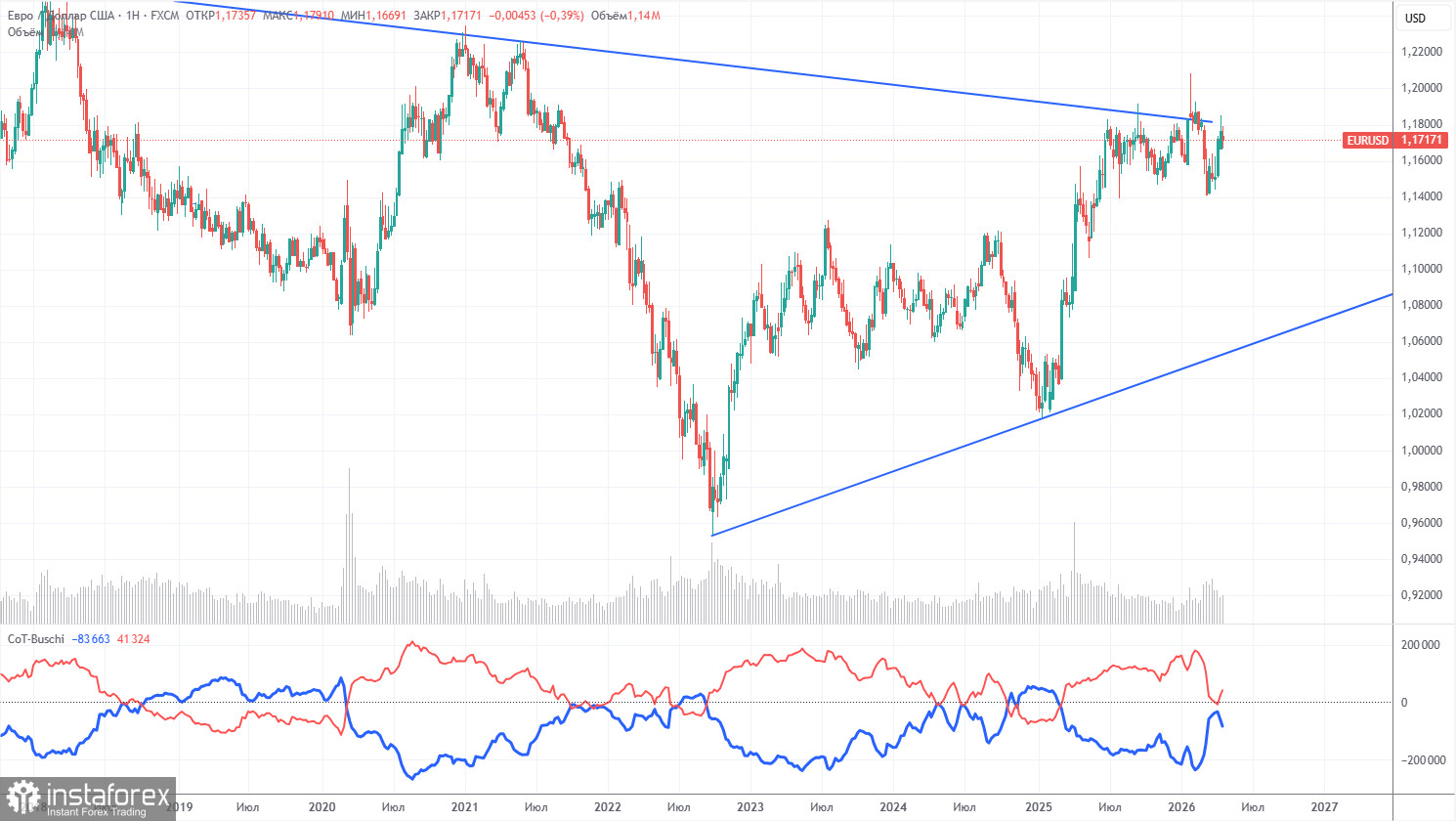
The latest COT report is dated April 21. The illustration of the weekly timeframe clearly shows that the net position of non-commercial traders remains "bullish," but is rapidly decreasing due to geopolitical events. Traders have been shedding the European currency in favor of the U.S. dollar in recent months. Trump's policy remains unchanged, but for some time now, the dollar has served as a "reserve currency." However, this process may already be behind us.
We still do not see any fundamental factors supporting the strengthening of the euro, while there are plenty of factors for the decline of the U.S. dollar. The war in the Middle East has made the dollar temporarily super attractive, but once this factor reaches its "expiration date," everything will revert to the way it was. This expiration may have already occurred. In the long term, the euro could fall as low as 1.06 (the trendline), but the upward trend will still remain relevant. Currently, the pair has not strayed far from the descending trendline, which has been breached several times.
The positioning of the red and blue lines of the indicator indicates parity between bulls and bears. In the last reporting week, the number of longs in the "Non-commercial" group increased by 2,700, while the number of shorts decreased by 12,500. Consequently, the net position increased by 15,200 contracts over the week.
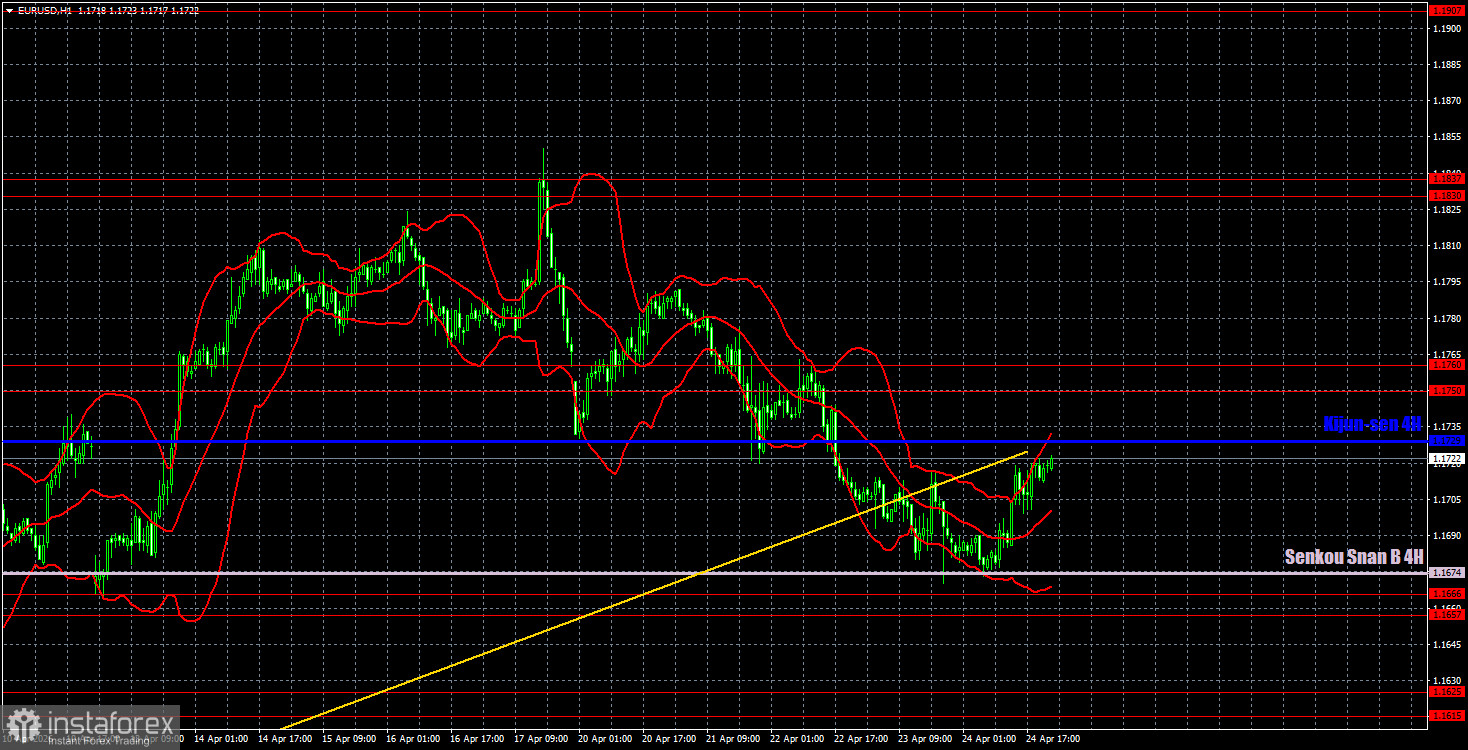
On the hourly timeframe, the EUR/USD pair continues to form an upward trend, but it has only corrected over the past week. The correction may already be complete. The situation in the Middle East remains tense but has not worsened, so there are currently few strong reasons for the U.S. dollar to strengthen. There will be many important events this week, so we can expect the trend to continue and for volatility to remain high.
For April 27, we highlight the following levels for trading: 1.1362, 1.1426, 1.1542, 1.1615-1.1625, 1.1657-1.1666, 1.1750-1.1760, 1.1830-1.1837, 1.1907-1.1922, as well as the Senkou Span B line (1.1674) and the Kijun-sen line (1.1729). The Ichimoku indicator lines may shift during the day, which should be considered when determining trading signals. Don't forget to set a Stop Loss order to breakeven if the price moves 15 pips in the correct direction. This will protect against potential losses if the signal turns out to be false.
On Monday, Germany will publish the consumer confidence index, and that is all the events planned for the day. Therefore, strong movements in the EUR/USD pair are unlikely today.
On Monday, traders may consider opening short positions if the price bounces off the Kijun-sen line, targeting the Senkou Span B line. Long positions can be opened if the price consolidates above the Kijun-sen line, targeting 1.1750-1.1760 and 1.1830-1.1837.
Price levels of support and resistance – thick red lines, around which the movement may end. They are not sources of trading signals.
Kijun-sen and Senkou Span B lines – lines of the Ichimoku indicator that are carried over to the hourly timeframe from the 4-hour one. They are strong lines.
Extreme levels – thin red lines from which the price has previously bounced. They are sources of trading signals.
Yellow lines – trend lines, trend channels, and any other technical patterns.
Indicator 1 on COT charts – the size of the net position of each category of traders.
Díky analytickým přehledům společnosti InstaForex získáte plné povědomi o tržních trendech! Jako zákazníkovi společnosti InstaForex je Vám k dispozici velký počet bezplatných služeb umožňujících efektivní obchodování.


