 Zůstat
Obchodní podmínky
Nástroje



The wave pattern on the 4-hour chart for EUR/USD has undergone some modifications. There is still no reason to talk about the cancellation of the upward trend segment (shown in the lower chart), which began in January of last year. However, the trend structure has now taken on a corrective form. From a long-term perspective, wave C is expected to develop, with its low positioned below the low of wave A. At the current stage, it is difficult to believe in such a significant decline of the euro, but the first quarter of 2026 demonstrated that geopolitics can dramatically alter market sentiment and reverse established trends.
On the lower time frame, I can identify a classic five-wave bearish structure. Following the completion of this structure, the instrument may transition to an upward wave sequence, and at present, the structure appears complete. Therefore, a rise in the euro may be expected from the 1.1513 level, which corresponds to the 76.4% Fibonacci retracement level. However, without support from geopolitical developments, the euro is unlikely to receive strong market backing.
The EUR/USD pair was virtually unchanged on Wednesday, while traders continued to assess yesterday's inflation report. Opinions vary widely. Some economists believe that inflation data coming in line with forecasts allows the Federal Reserve to maintain its wait-and-see approach, as inflation did not show a significant acceleration in May. There is also a view that current inflation levels are acceptable to US President Donald Trump and that the pace of inflation growth has begun to slow. In my opinion, these interpretations are incorrect.
Inflation has been rising for three consecutive months and has nearly doubled over that period. If that is not a cause for concern, what is? Should policymakers wait until inflation approaches 6% before taking action? In my view, it is important to focus on the root of the problem. Inflation is rising, and there is no need to look for excuses, believe in a swift resolution of the Middle East conflict, or rely on unrealistic expectations. The current reality is harsh and uncompromising. Inflation continues to increase, and the slower pace of growth in May does not justify the conclusion that the upward inflation trend is reversing. Even if the Consumer Price Index eventually stops accelerating—which will happen sooner or later—that does not mean the Federal Reserve can relax and expect inflation to return to its 2% target on its own. The Federal Open Market Committee (FOMC) will eventually have to tighten monetary policy. The only question is when that process will begin.
Since yesterday, expectations in the futures market have become more hawkish. According to the CME FedWatch Tool, the probability of a Federal Reserve rate hike before the end of the year now exceeds 70%. The increase in hawkish expectations has been modest, but the next Federal Reserve meeting will take place as early as next week. At that point, market participants should be able to make more accurate forecasts for the remainder of 2026. In my opinion, most FOMC members—including Jerome Powell—will not be able to ignore rising inflation indefinitely, regardless of the views expressed by Stephen Miran and Kevin Warsh.
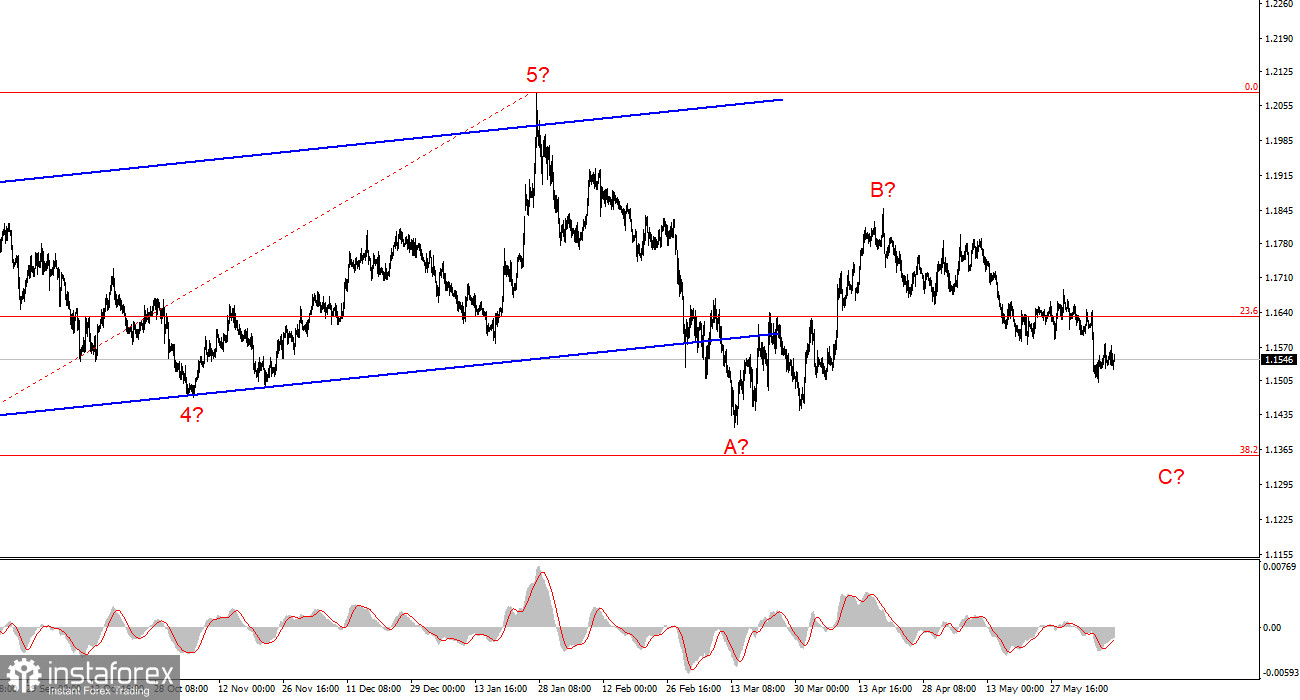
Based on my EUR/USD analysis, I conclude that the pair remains within the broader upward trend segment (shown in the lower chart), while in the shorter term it remains within a downward trend segment that may already be complete. In my opinion, this may be a reasonable time to consider building long positions. The unsuccessful attempt to break below the 1.1513 level, corresponding to the 76.4% Fibonacci retracement level, combined with the completed appearance of the bearish wave structure, suggests that the pair may transition into a new upward wave sequence with targets near the 1.1700 level and above.
On the higher time frame, an upward trend segment remains visible, followed by the development of a corrective wave structure. In the near term, wave C is expected to form with targets near 1.1352, which corresponds to the 38.2% Fibonacci retracement level. Once the A-B-C corrective structure is complete, a new long-term bullish trend may begin.
Key Principles of My Analysis
Díky analytickým přehledům společnosti InstaForex získáte plné povědomi o tržních trendech! Jako zákazníkovi společnosti InstaForex je Vám k dispozici velký počet bezplatných služeb umožňujících efektivní obchodování.


