 Zůstat

Obchodní podmínky
Nástroje


The EUR/USD pair tested the intermediate resistance level at 1.1450 today (the middle Bollinger Bands line on the H4 chart) before reversing sharply lower toward the base of the 1.14 level in response to the latest escalation in the Middle East.
Notably, traders showed remarkable resilience last week by largely ignoring developments in the region. Instead, market participants focused on the macroeconomic agenda, which proved unfavorable for the U.S. dollar. The main catalysts were the U.S. CPI and PPI reports, with almost all key components coming in weaker than expected. Geopolitical developments provided only underlying support for the greenback—as the U.S. dollar continues to serve as a safe-haven asset—preventing EUR/USD buyers from securing a foothold above the 1.1470 resistance level.
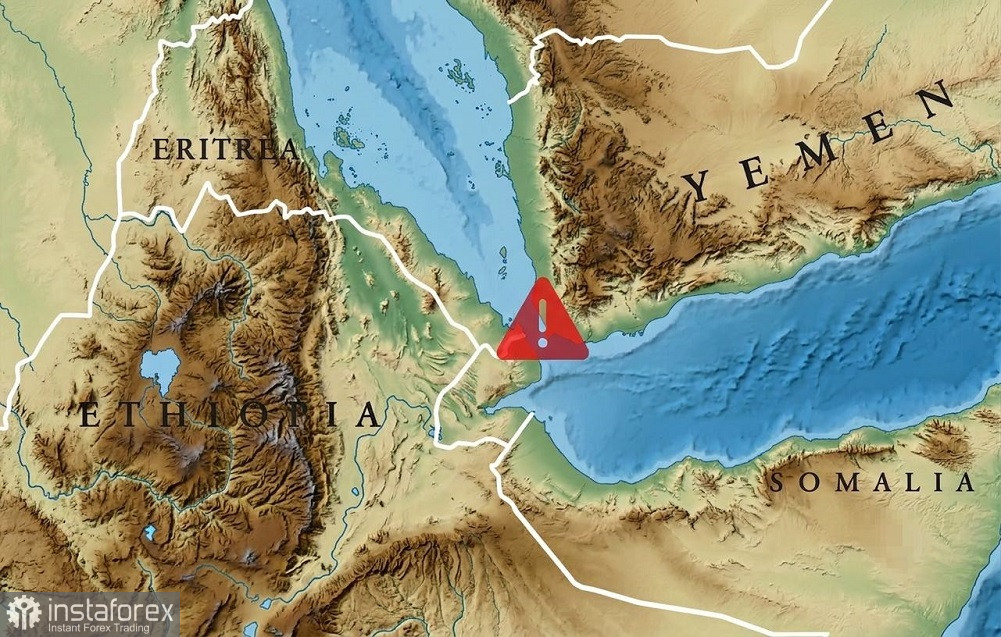
This week, the market faces another test. The latest escalation stems from Yemen's Houthis, who have announced a maritime blockade of Saudi Arabia. In essence, this represents another phase of the Middle East conflict. While traders were willing to push geopolitical risks into the background last week, they must now determine whether this new crisis can overshadow macroeconomic factors. Will the market maintain its resilience, or will geopolitics finally take center stage?
To begin with, today's announcement by the Houthis imposing a "maritime blockade" on Saudi Arabia and banning vessels sailing under the Saudi flag triggered increased volatility in both the oil market and U.S. dollar currency pairs. It remains unclear how the Houthis intend to enforce the announced blockade in practice. However, the statement itself has heightened market anxiety because the group controls a significant portion of Yemen's coastline along the Bab el-Mandeb Strait, one of the world's most important maritime chokepoints.
The market is now trying to determine whether the current situation can reasonably be compared with the crisis surrounding the Strait of Hormuz and whether a similar scenario could unfold.
According to a number of analysts and political observers, the likelihood of a full-scale blockade of the Bab el-Mandeb Strait remains relatively low despite the Houthis' aggressive rhetoric.
First, the Bab el-Mandeb Strait differs significantly from the Strait of Hormuz. While Iran possesses a fully developed navy, coastal missile systems, submarines, military aircraft, and an extensive anti-ship defense network, the Houthis' capabilities are far more limited. They are capable of creating localized risks for shipping but lack the resources necessary to establish lasting control over the entire waterway. In other words, they can carry out isolated attacks against specific targets, but they do not possess the naval forces required to physically control the strait, inspect vessels, or deploy extensive minefields capable of halting all maritime traffic.
Second, a complete closure of the strait would also block deliveries of food, medicine, and fuel to Yemen's own ports, including Hodeidah. Such a blockade would therefore inflict severe economic and humanitarian damage on Yemen itself.
Third, there is the China factor. China is one of the largest importers of Saudi oil. In addition, any closure of the Bab el-Mandeb Strait would directly disrupt shipments of Chinese goods to Europe. As is well known, Beijing exercises both direct and indirect influence over Iran and the Houthis, giving China a clear interest in preventing prolonged disruption to maritime trade in the region.
Fourth, closing the Bab el-Mandeb Strait would almost certainly trigger an immediate international military response. The Houthis would face not only sporadic retaliatory strikes but potentially a much broader military operation. Naval forces from the United States, the United Kingdom, several EU member states, and regional countries are already deployed in the area and have previously carried out strikes against Houthi military infrastructure in response to attacks on commercial shipping. A full blockade would likely provide justification for a significantly larger operation.
Finally, many observers believe that the Houthis themselves have little interest in crossing such a critical red line. As before, they appear to be using the threat of closing the strait primarily as an instrument of targeted military and political pressure rather than as an objective in itself. Today's announcement should therefore be viewed in that context—as an attempt to increase pressure on Saudi Arabia. Most likely, the Houthis will seek to target Saudi oil tankers, but they are unlikely to be able to completely block the Bab el-Mandeb Strait, either from a technical or a strategic standpoint.
Judging by market behavior, traders have reached a similar conclusion. Despite the initial sharp reaction, EUR/USD remains within the 1.14 level, where it has traded for the past four weeks. If sellers fail to secure a consolidation below the 1.1410 support level (the lower Bollinger Bands line on the H4 chart) in the near term, long positions may be considered. At the same time, traders should keep in mind that persistent geopolitical uncertainty continues to cap the pair's upside near 1.1470 (the upper Bollinger Bands line on the daily chart), where taking profits would be advisable.
Díky analytickým přehledům společnosti InstaForex získáte plné povědomi o tržních trendech! Jako zákazníkovi společnosti InstaForex je Vám k dispozici velký počet bezplatných služeb umožňujících efektivní obchodování.


