 Zůstat

Obchodní podmínky
Nástroje


In the headline of this review, which is harmless and generally truthful, there lies a hefty portion of sarcasm and irony. On Tuesday, Axios shared another insider report that intermediaries in the negotiations between the U.S. and Iran are once again proposing a ceasefire to the parties. This time—for ten days. What happens next after this ceasefire is also broken? A new ceasefire for 3 days, 12 hours, or 45 minutes? Axios reported that the ceasefire would allow the opening of the Strait of Hormuz and a return to negotiations. I have only one question: has Tehran seen this proposal?
Eighty percent of the information coming from American media or directly from the President has been refuted by Tehran within an hour. Who said Iran wants another ceasefire and is ready to unblock the Strait of Hormuz? Let's assume that's true. What concessions would the U.S. need to make for Iran to agree to open the Strait of Hormuz? Interestingly, no official information has come from either Iran or the U.S. According to some journalists, Donald Trump currently has two options regarding Iran: either increase pressure and start an expanded campaign to force the country to capitulate, or sit down at the negotiating table again. Perhaps I reveal a secret to some, but these two options have always been on Trump's desk. Whether it was a month ago, two months ago, or three. There's always a choice between escalation and peace.
The problem is that Trump initiated this war, yet the leader of the White House cannot finish it. Washington cannot achieve the destruction of Iran's nuclear arsenal by military means and certainly cannot unblock and control the Strait of Hormuz. What other tools does Trump have to achieve his goals? None. Sanctions against Iran are ineffective, the war yields no results, and negotiations fall through time after time. The situation is entirely deadlocked—for the American president.
He cannot choose retreat because in that case, the whole world will understand that America lost the war, and with a bang. Choosing escalation is possible, but only out of desperation. Therefore, we are most likely facing a new escalation in the Middle East, which will also yield no results. In a month, the parties may return to the negotiating table; in a month and a half, they may resume hostilities. And so on, indefinitely. I still believe that the war in the Middle East is a long-term affair.
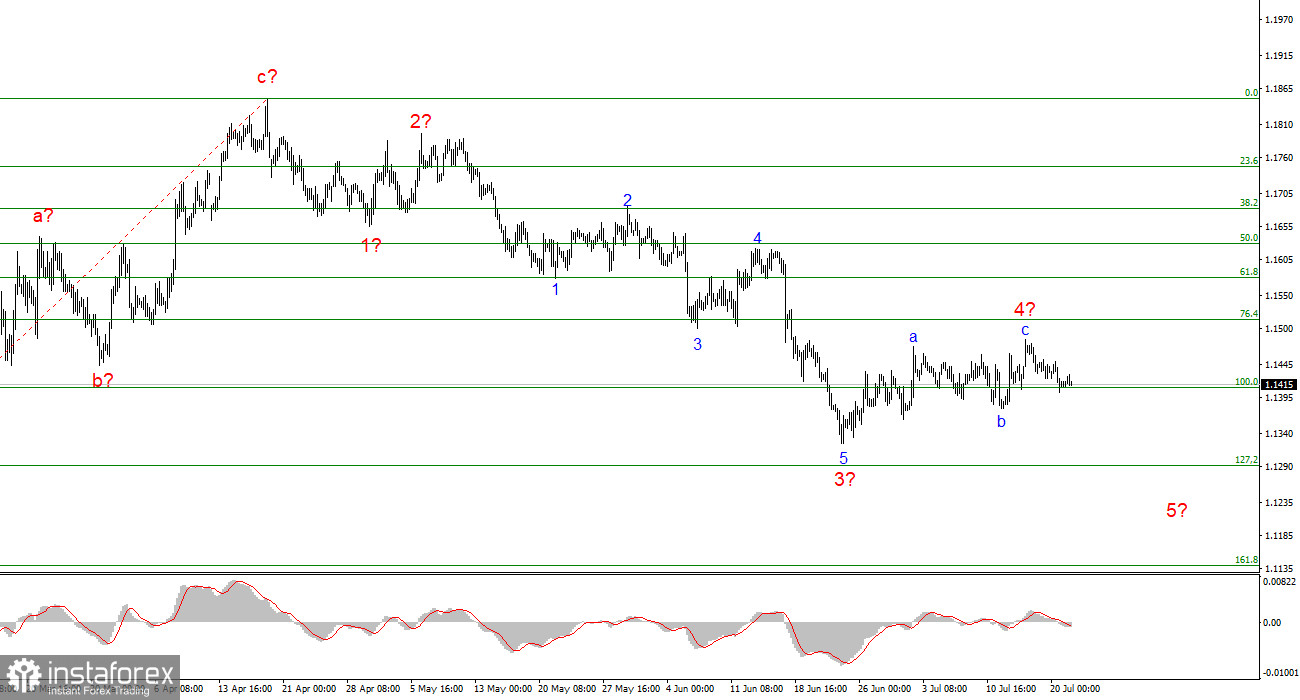
Based on the analysis of EUR/USD, I conclude that the instrument remains within an upward segment of the trend, while in the short term, it is within a downward segment of the trend. In my opinion, now is a good time to try forming long positions, but the instrument may still dip down to the 13th figure within wave 5 in C. Wave analysis often presents surprises, so I would start to adjust towards buying now.
The wave structure of the GBP/USD instrument has become quite complex. Currently, the instrument has constructed three waves down, while EUR/USD could have built 5 waves. Consequently, the British pound may form another wave down, just like the euro, but this wave could be the second within a new upward segment of the trend. Thus, the divergence in wave counts between the euro and pound will exist, but it will be insignificant. Based on this, I expect a pullback downward in the near term, followed by the formation of a new upward section of the trend with initial targets around the 37-38 figures.
Díky analytickým přehledům společnosti InstaForex získáte plné povědomi o tržních trendech! Jako zákazníkovi společnosti InstaForex je Vám k dispozici velký počet bezplatných služeb umožňujících efektivní obchodování.


