 Zůstat
Obchodní podmínky
Nástroje



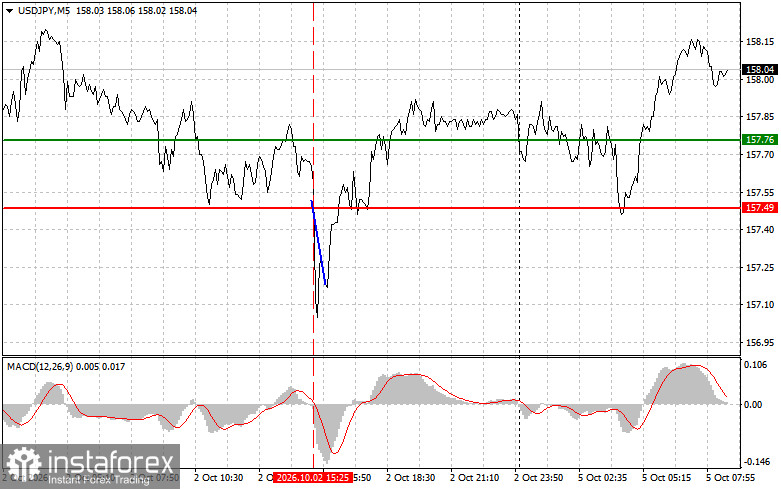
The test of 157.49 occurred as the MACD indicator began moving down from the zero line, confirming a good entry point to sell the dollar. As a result, the pair fell by more than 40 pips.
For the yen Friday's US labor data primarily meant a revision of expectations about the policy divergence between the two central banks. US September employment came in noticeably below average, revisions to July and August worsened the summer picture, and wage growth slowed. If the Federal Reserve builds a case for a pause while the Bank of Japan moves toward tightening, the policy gap starts to compress.
Ueda has repeatedly said that price-rise risks deserve more attention than before, and Takata, the committee's main hawk, believes Japan is no longer an exception among developed economies. Against that backdrop the US economic slowdown looks especially significant because it reduces pressure on Tokyo from rate differentials. Scott Bessent previously met with Ueda and publicly pushed the Bank of Japan toward more decisive steps, so the political element also works in the yen's favor. Energy remains a separate factor: Japan depends on fuel imports, and expensive oil continues to weigh on the trade balance.
Today's Japanese data were mixed and tempered optimism around the yen. The services-sector PMI for September fell to 51.3 from 51.6 in August, while analysts had expected the previous level to hold. The composite PMI also missed forecasts, dropping to 52.3 from 52.5. Both readings remain above 50, so the economy is still expanding, but the pace is clearly slowing, and services—the main driver of domestic demand—weakened. For the BOJ this is not a reason to abandon normalization, but it reduces arguments for haste and makes it easier for committee members favoring a more cautious pace to defend their position.
Consumer-confidence data slightly softened the picture. The indicator came in at 35.4 versus a forecast of 35.3 and 35.5 a month earlier — essentially unchanged and a touch above expectations. The level itself remains low, indicating households remain sensitive to higher energy and everyday goods prices. For the yen, this result is neutral.
For intraday strategy, I will mainly rely on implementing Scenario 1 and Scenario 2.
Scenario 1: Buy USD/JPY today if price reaches the entry area around 158.13 (green line) with a target of 158.56 (thicker green line). Around 158.56 plan to exit long positions and consider opening short positions for a counter-move (expecting 30–35 pips). Prefer to return to longs on corrections and significant pullbacks. Important: before buying, ensure MACD is above zero and only beginning to rise from it.
Scenario 2: Also buy USD/JPY if there are two consecutive tests of 157.93 while MACD is in the oversold area. This would limit downside potential and trigger a reversal upward. Expect moves toward 158.13 and 158.56.
Scenario 1: Sell USD/JPY only after the 157.93 level is broken (red line); this should lead to a rapid decline. Sellers' key target is 157.50, where I plan to exit shorts and immediately open longs for a counter-move (expecting 20–25 pips). Sellers can return at any moment — any hint from the central bank is enough. Important: before selling, ensure MACD is below zero and only beginning to fall.
Scenario 2: Also sell if there are two consecutive tests of 158.13 while MACD is in the overbought area. This would cap upside and trigger a downward reversal. Expect declines to 157.93 and 157.50.
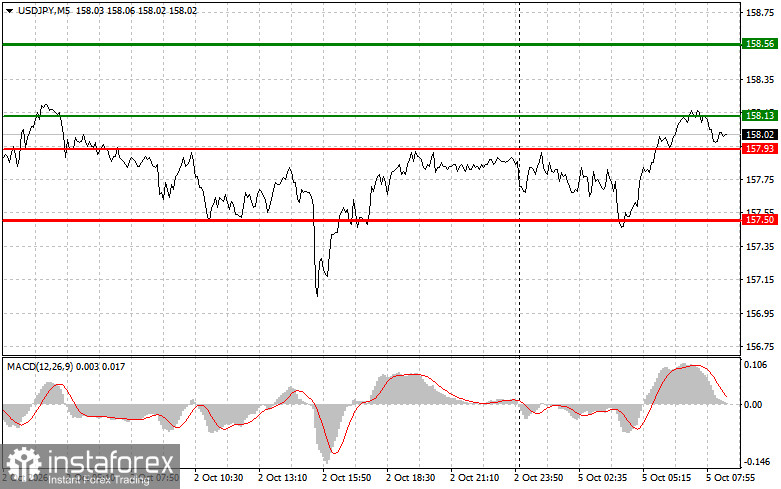
Thin green line – entry price at which you can buy the trading instrument.
Thick green line – approximate price where you can place Take Profit or manually lock in profits, since further upside above this level is unlikely.
Thin red line – entry price at which you can sell the trading instrument.
Thick red line – approximate price where you can place Take Profit or manually lock in profits, since further downside below this level is unlikely.
MACD indicator. When entering the market, it is important to follow the overbought and oversold zones.
Important. Beginner traders in the Forex market must be very cautious when making entry decisions. It is best to stay out of the market before the release of important fundamental reports to avoid getting caught in sharp price swings. If you decide to trade during news releases, always place stop orders to minimize losses. Without stop orders,, you can quickly lose your entire deposit, especially if you don't use money management and trade large volumes.
Remember that successful trading requires a clear trading plan, like the example above. Spontaneous trading decisions based on the current market situation are inherently a losing strategy for an intraday trader.
Díky analytickým přehledům společnosti InstaForex získáte plné povědomi o tržních trendech! Jako zákazníkovi společnosti InstaForex je Vám k dispozici velký počet bezplatných služeb umožňujících efektivní obchodování.


