 Zůstat


Obchodní podmínky
Nástroje


The price test at 1.1209 came when the MACD indicator had moved far below the zero mark, limiting the pair's downside potential—especially after the large decline seen earlier. For that reason, I did not sell the euro.
Clearly, the euro is now squeezed by three factors, none directly related to Europe—first, oil. After attacks in Saudi Arabia, Brent resumed strong gains, and the region — which imports energy — takes a double hit as production and living costs rise. Second, France, where authorities are preparing for new protests on Saturday, is boosting police and deploying the military to avoid a repeat of last weekend's unrest. For the market, this signals that political risk remains. The third factor is the dollar, which strengthened noticeably against most currencies yesterday. U.S. data were unlikely to be the main cause, but they shouldn't be dismissed. Initial jobless claims came in better than expected, and the September leading indicators index was 0.0% versus a -0.1% forecast. Continuing claims slightly exceeded forecasts, so the labor market looks resilient but not overheated.
European data today are unlikely to move markets. Preliminary October PMIs for manufacturing, services and the composite euro area index will be released in the first half of the day, but analysts' expectations barely differ from recent values. Manufacturing is forecast at 52.7 versus 52.9 previously, and services at 52.6 versus 53.0. The composite was 53.1 and has no published forecast.
This picture suggests the euro-area economy continues to expand, albeit a bit more slowly. Readings above 50 indicate expansion, and in services — the main contributor to European growth — expansion persists for now. If PMIs print very weak, pressure on the euro will intensify at the end of the week, and EUR/USD will have little chance to avoid further declines. I believe that with expected figures, the pair will remain in its current range, and the decisive factors will again be the dollar, oil, and news from France.
For the intraday strategy, I will rely more on Scenarios No. 1 and No. 2.
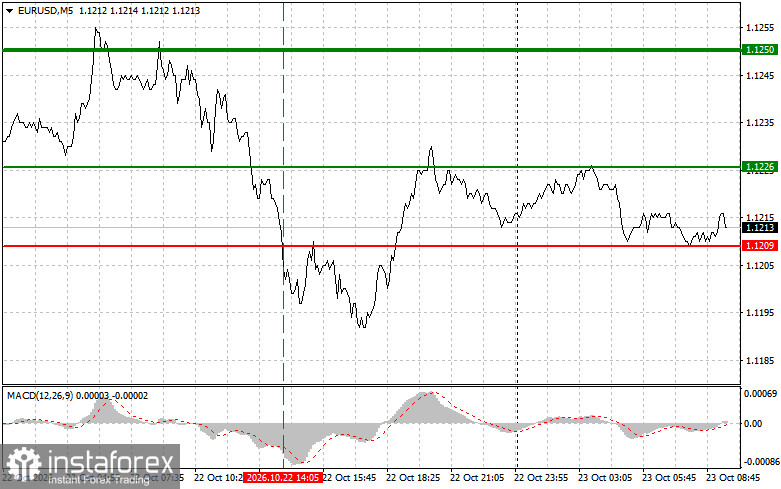
Scenario No. 1: Today, it is possible to buy the euro when it reaches around 1.1221 (green line on the chart), targeting a rise to 1.1250. At 1.1250, I plan to exit the market and also sell the euro in the opposite direction, expecting a 30–35 pip move from the entry point. One can count on the euro rising today only after good euro-area data. Important! Before buying, make sure the MACD indicator is above the zero mark and is only beginning to rise from it.
Scenario No. 2: I also intend to buy the euro today in the event of two consecutive tests of the price 1.1207 at a time when the MACD indicator is in the oversold area. This will limit the pair's downward potential and lead to an upward reversal. One can expect a rise to the opposite levels of 1.1221 and 1.1250.
Scenario No. 1: I plan to sell the euro after it reaches the 1.1207 level (red line on the chart). The target is 1.1175, where I intend to exit the market and immediately buy in the opposite direction (expecting a 20–25 pip move away from the level). Strong pressure on the pair can return at any moment today. Important! Before selling, make sure the MACD indicator is below the zero mark and is only beginning to decline from it.
Scenario No. 2: I also intend to sell the euro today in the event of two consecutive tests of the price 1.1221 at a time when the MACD indicator is in the overbought area. This will limit the pair's upside potential and lead to a downward reversal. One can expect a decline to the opposite levels of 1.1207 and 1.1175.
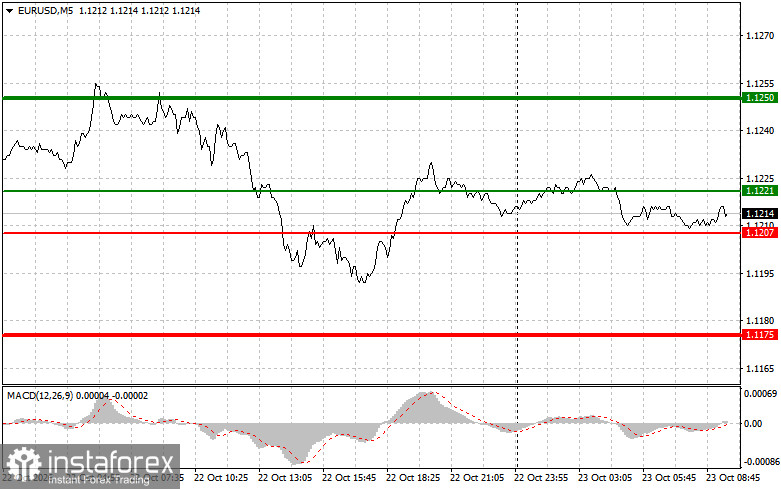
Thin green line — entry price where you can buy the instrument.
Thick green line — approximate price where you can place Take Profit or manually lock in profits, because further upside above this level is unlikely.
Thin red line — entry price where you can sell the instrument.
Thick red line — approximate price where you can place Take Profit or manually lock in profits, because further downside below this level is unlikely.
MACD indicator. When entering the market, it's important to consider overbought and oversold zones.
Important. Novice Forex traders must be very cautious when deciding to enter the market. It is best to stay out before major fundamental reports to avoid getting caught in sharp price swings. If you decide to trade during news releases, always place stop orders to minimize losses. Without stop orders, you can quickly lose your entire deposit, especially if you don't use money management and trade large volumes.
Remember: successful trading requires a clear trading plan, like the example above. Spontaneous trade decisions based solely on the immediate market situation are, by definition, a losing strategy for an intraday trader.
Díky analytickým přehledům společnosti InstaForex získáte plné povědomi o tržních trendech! Jako zákazníkovi společnosti InstaForex je Vám k dispozici velký počet bezplatných služeb umožňujících efektivní obchodování.


