 Anuluj

Warunki handlowe
Narzędzia


n mid-July 2026, a real market drama unfolded around the aerospace giant SpaceX (SPCX). For the first time since its historic June IPO, the company's shares fell below the offering price of $135, temporarily hitting a low of $132.15 before closing at $135.27. This represents a 33% drop from the peak values recorded immediately after listing. SpaceX's market capitalization declined from a record $2.1 trillion to $1.8 trillion.
Although SpaceX's IPO was the largest in US history, raising $75 billion, less than 5% of its shares were listed on the exchange. This artificial scarcity initially drove stock prices up, but investors are now facing a harsh reality: August is just around the corner, potentially bringing a massive wave of sell-offs as the lockup period expires. Meanwhile, leading investment banks remain highly optimistic—Evercore ISI set a price target of $230, Needham raised its forecast to $250, and Raymond James is projecting $800.
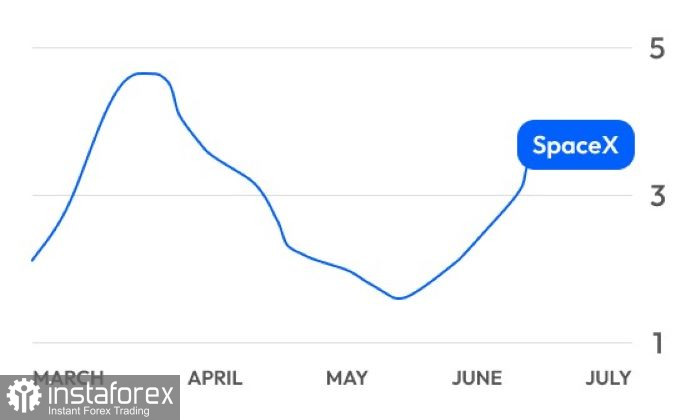
The current decline in share prices is the result of fundamental factors that will continue to pressure SpaceX stock in the medium term:
Massive lockup expiration in August. The main threat is the expiration of lockup restrictions for employees and early investors on the second trading day after the release of the first quarterly report (expected in early August). Approximately 911.5 million shares, worth a total of $123 billion, will hit the market. For comparison, the entire current volume of SpaceX shares traded on Nasdaq is $86 billion. The supply of shares will more than double, creating a massive supply overhang. An additional 455.8 million shares could have unlocked at a price above $175.50, but this is currently irrelevant. By December, the company's free float is expected to grow to 40% of its total capital.
Extremely high valuation. Even after losing a third of its value, SpaceX trades at 49 times expected annual revenue. For comparison, Tesla is valued at 15 times revenue. Furthermore, SpaceX ended last year with a net loss of around $5 billion, making its current valuation highly speculative and vulnerable.
Historical performance of market debutants. Data from 50 major US IPOs since 2010 shows that companies whose shares fell below their offering price within the first two months consistently underperformed the market in the future. Their median growth was 61%, compared to 112% for those that maintained their starting positions.
Technological challenges and capital expenditure. SpaceX has received FAA clearance for new Starship tests, but its commercial efficiency has yet to be proven. The $17 billion acquisition of EchoStar's spectrum for Starlink mobile internet requires massive capital expenditures (CapEx), delaying the achievement of stable net profitability.
Our outlook on the situation is significantly more cautious than the hyper-optimistic expectations of most Wall Street analysts.
Over the next two months (August–September 2026), SpaceX will face a severe resilience test. The massive volume of shares released from lockup will create colossal selling pressure that the market will not be able to absorb quickly. During this period, we project a further decline in SPCX share prices, testing local support in the $110–$115 range (a drop of another 15–20% from current levels). Speculative concepts like a SpaceX-Tesla merger into a single holding company ("Elon Corp") or news about Starship launches will offer only short-term rebounds, which will likely be stifled by insider sell-offs.
Price stabilization and a return to growth above the IPO level of $135 are unlikely to happen before late 2026 or early 2027. This recovery will depend entirely on Starlink demonstrating solid operating profit growth and Starship tests proving that cargo deployment can be both regular and cost-effective. Investors are advised to take a wait-and-see approach and avoid rushing to buy until the August lockup storm settles.
Dzięki analizom InstaForex zawsze będziesz na bieżące z trendami rynkowymi! Zarejestruj się w InstaForex i uzyskaj dostęp do jeszcze większej liczby bezpłatnych usług dla zyskownego handlu.


