 Anuluj
Warunki handlowe
Narzędzia



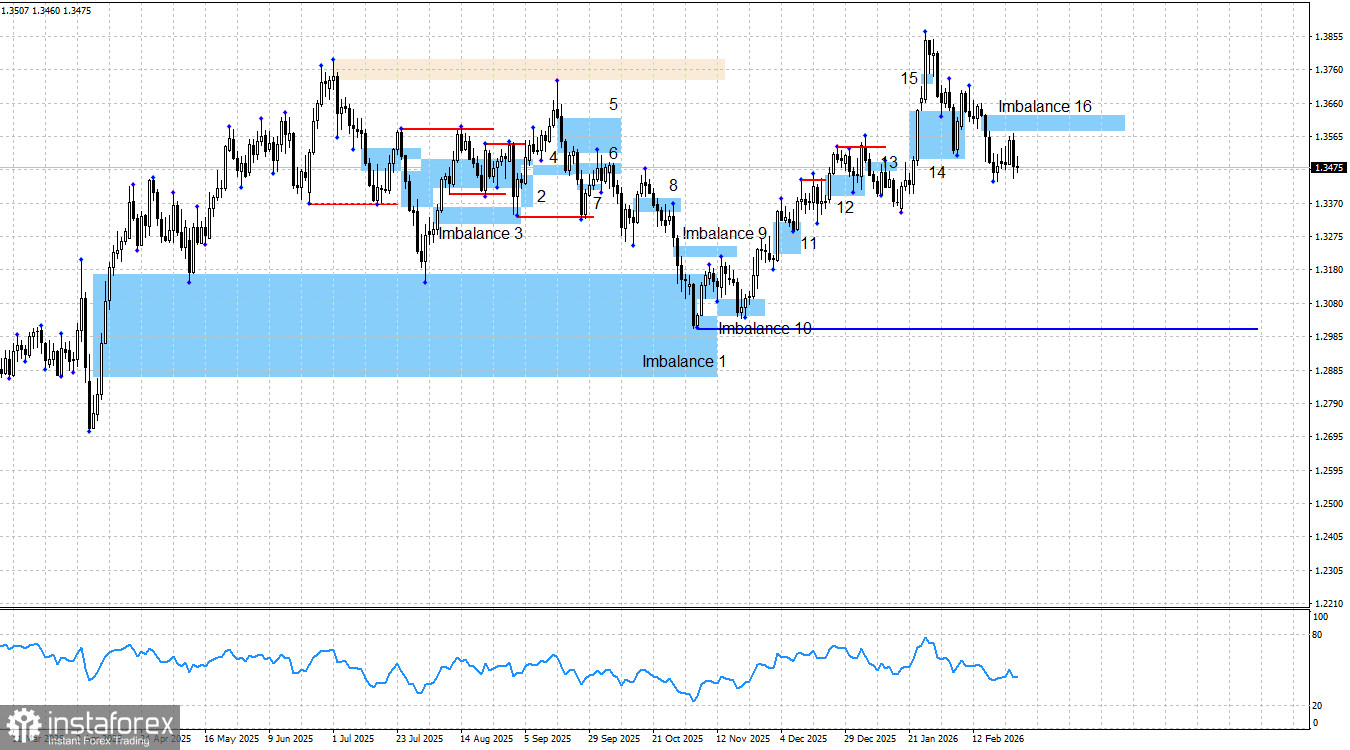
The GBP/USD pair continues to decline within a broader bullish trend. The only active pattern that may currently be useful for traders remains the bearish imbalance 16. This pattern could have been triggered during yesterday's upward move, but the pound missed it by just 6–7 points. As a result, no sell signal was formed, and traders had no reason to open short positions. It should also be remembered that the bullish trend is still intact. The pair could fall even to the 1.3100 level, and the bullish trend would still remain relevant. In any case, I question the advisability of selling.
There has been very little news today. I have already mentioned the failure of the negotiations in Geneva. This was likely the main reason for the renewed strengthening of the U.S. dollar—but only against the pound. The euro, as a reminder, has been trading sideways for a week, maintaining not only a bullish trend but also the current bullish impulse. Thus, it is the pound that is suffering most from developments in the East. Not even from the events themselves, but from rumors and expectations related to a possible war between the United States and Iran. Overnight, Afghanistan and Pakistan exchanged strikes, signaling the start or resumption of another military conflict. There were also reports that Afghanistan struck a Pakistani nuclear facility. Hundreds were killed and injured. In my view, the dollar can currently rely only on geopolitical instability worldwide.
The bullish trend in the pound remains intact. Therefore, as long as it holds (above the 1.3012 level), I would focus more on bullish signals. The pound's decline may be significant, but it could also end at any moment. In any case, the only currently active imbalance 16 has not produced any signal. There are no grounds for new trades at this time.
On Friday, there was no news from the United Kingdom, while in the United States the Producer Price Index was released, exceeding forecasts for the second consecutive month. This suggests that producers are raising prices at a faster pace, which may negatively affect inflation in the future. U.S. inflation has slowed to 2.4%, but many traders and the Federal Open Market Committee fear that this slowdown is temporary and that inflation may accelerate again in 2026. In that case, further monetary easing by the Fed would be delayed, providing the dollar with additional support.
In the United States, the overall news backdrop remains such that, in the long term, it is difficult to expect anything other than dollar weakness. The situation in the U.S. remains complex. U.S. labor market data continues to disappoint more often than it surprises positively. Three of the last four meetings of the Federal Open Market Committee resulted in dovish decisions. Military actions and threats by Donald Trump toward Denmark, Mexico, Cuba, Colombia, Iran, EU countries, Canada, and South Korea, the initiation of criminal proceedings against Jerome Powell, another government shutdown, and the scandal involving U.S. elites in the Epstein case all contribute to the picture of a political and structural crisis in the country. In my view, bulls have everything they need to continue advancing throughout 2026.
A bearish trend would require a strong and stable positive news backdrop for the dollar, which is difficult to expect under Donald Trump. Moreover, a strong dollar is not in the U.S. president's interest, as it would maintain a trade deficit. Therefore, I still do not believe in a bearish trend for the pound. Too many risk factors continue to weigh heavily on the dollar. Short positions may be considered from bearish patterns, but I personally would not recommend this to traders. I consider the recent decline of the pair to be, to some extent, a coincidence of circumstances.
News calendar for the U.S. and the United Kingdom:
United States – ISM Manufacturing PMI (15:00 UTC).
On February 27, the economic calendar contains one fairly important event. The impact of the news backdrop on market sentiment on Monday is likely to appear in the second half of the day.
GBP/USD Forecast and Trading Advice:
For the pound, the overall picture remains bullish, although the short-term outlook has turned bearish. There are currently no relevant bullish patterns. There is only the bearish imbalance, to which the price must first return and show a reaction before traders can consider potential short positions.
It is worth noting that the pound's decline in recent weeks has been strong enough to distort the previously bullish picture due to an unfortunate combination of circumstances. If Donald Trump had not repeatedly threatened to attack Iran and sent military ships to the Persian Gulf, we likely would not have seen such a sharp drop in the pound. I believe this decline may end just as unexpectedly as it began. In my opinion, the trend has not shifted to bearish in recent weeks.
Dzięki analizom InstaForex zawsze będziesz na bieżące z trendami rynkowymi! Zarejestruj się w InstaForex i uzyskaj dostęp do jeszcze większej liczby bezpłatnych usług dla zyskownego handlu.


