 Anuluj
Warunki handlowe
Narzędzia



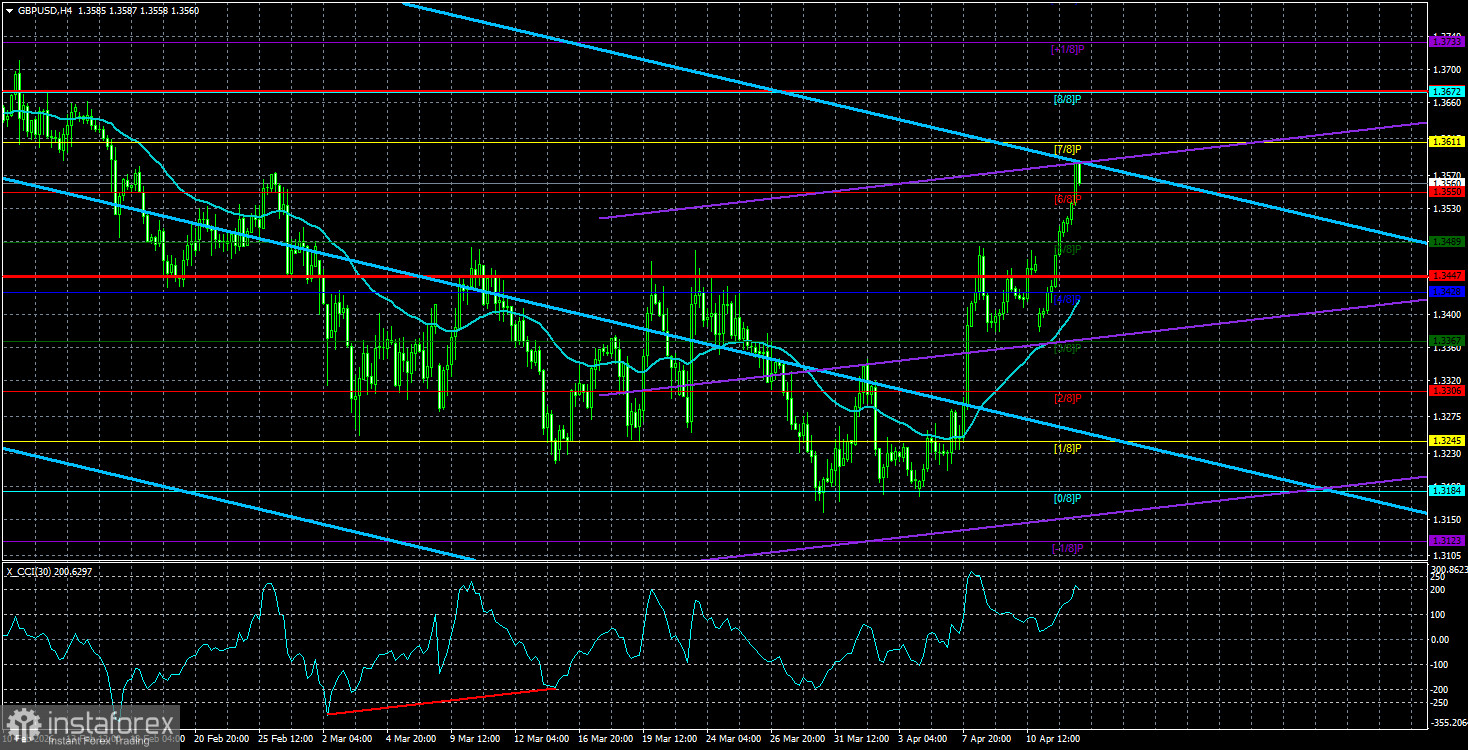
The GBP/USD currency pair continued to trade upward on Tuesday, marking the seventh consecutive day of gains. Everything we discussed in the EUR/USD article is also relevant for GBP/USD. Last week, the market finally remembered that there is more to the world than just geopolitics, the Middle East, oil, gas, and the dollar. As soon as the market recalled this, it also recalled all the events of the last two months that it had diligently ignored.
Let's remind ourselves of all the factors unrelated to geopolitics. The year began with the U.S. Supreme Court ruling that all of Donald Trump's trade tariffs were illegal. The White House refused to return the tariffs to their owners, so many Americans realized a simple fact—they had been robbed of at least $150 billion by their own government. Trump, not batting an eye, immediately imposed additional tariffs under different laws, fully confirming our expectations. Now, the court could cancel any tariffs and declare them illegal, but that wouldn't change anything. Trump will not return the collected money, and new tariffs could be introduced, even based on the "Pedestrian Crossing Bill" or the "Pet Walking Law." Then all of America could sue Trump, the court would take at least a year to consider the case, and ultimately would simply recognize the tariffs as illegitimate, and that would be it.
Next, the macroeconomic data on the U.S. labor market and unemployment (for February) failed dramatically. It became clear that the U.S. labor market is not just not recovering; it could fall even lower in 2026. The growth rate of the American economy during its "golden age" dropped to 0.5% in the fourth quarter, while rising fuel, oil, and gas prices accelerated inflation.
This brings us smoothly to the monetary policy of central banks. Since inflation, thanks to Trump, will rise in many countries, it would be reasonable to assume that all central banks will tighten monetary policy in 2026, putting many currencies on an equal footing. But, in practice, it will not work out that way. The European Central Bank and the Bank of England indicated in their last meeting that they are ready to tighten policy by April. However, the Federal Reserve, led by Jerome Powell, has not sent any signals to the market about a potential rate hike. On the contrary, the FOMC committee remains "dovish" and expects one rate cut this year. Therefore, the tightening of monetary views in the U.S. is limited to a smaller number of rate cuts.
Why is that? Because the Fed has to consider not only inflation but also economic growth and the U.S. labor market. If the key rate starts to rise, Trump may have a heart attack; the economy will slow further, and the Non-Farm Payrolls report will "delight" with negative figures each month. Let's recall that, on average, last year, America created only 14,000 jobs per month. Thus, the BoE and the ECB will be tightening their policies this year, but not the Fed. This is again favorable for the euro and the pound.
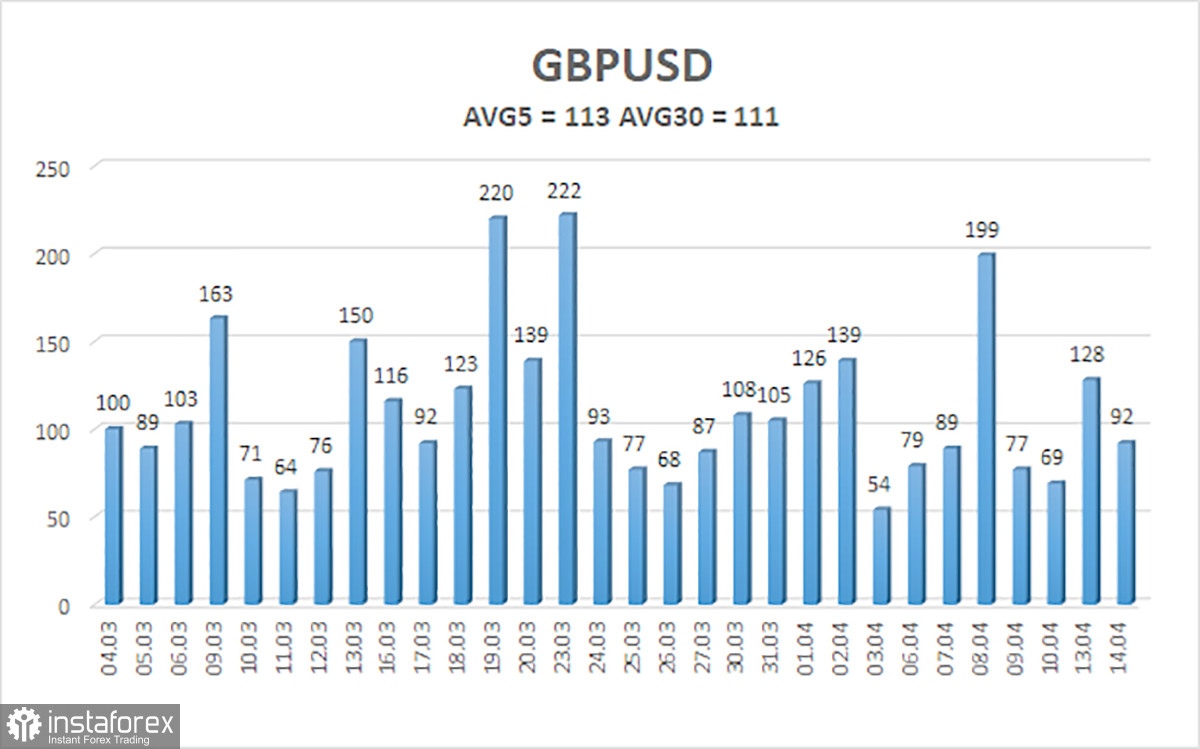
The average volatility of the GBP/USD pair over the last 5 trading days as of April 15 is 113 pips. For the pound/dollar pair, this value is "high." Thus, we expect movements within the range bounded by 1.3447 and 1.3673 on Wednesday. The upper channel of the linear regression has turned downward, indicating a trend change. The CCI indicator has moved into the overbought territory, signaling a potential downward pullback. However, market movements are still primarily influenced by geopolitics rather than technical analysis.
S1 – 1.3550
S2 – 1.3489
S3 – 1.3428
R1 – 1.3611
R2 – 1.3672
R3 – 1.3733
The GBP/USD currency pair continues its recovery after two months dominated by geopolitics. Trump's policies will continue to weigh on the U.S. economy, so we do not expect the dollar to grow in 2026. Therefore, long positions with targets of 1.3916 and above remain relevant as long as the price is above the moving average. If the price is below the moving average line, short positions with targets of 1.3367 and 1.3306 can be considered on geopolitical grounds. In recent months, almost all news and events have been negative for the British pound, contributing to a prolonged downward trend. Geopolitics remains a key factor, but its influence is beginning to weaken.
Regression channels help determine the current trend. If both are directed in the same way, it indicates a strong trend.
The moving average line (settings 20.0, smoothed) defines the short-term trend and direction in which trading should proceed.
Murray levels serve as target levels for movements and corrections.
Volatility levels (red lines) indicate the probable price channel in which the pair is likely to trade over the next day, based on current volatility readings.
The CCI indicator's entry into the oversold area (below -250) or the overbought area (above +250) indicates that a trend reversal in the opposite direction is approaching.
Dzięki analizom InstaForex zawsze będziesz na bieżące z trendami rynkowymi! Zarejestruj się w InstaForex i uzyskaj dostęp do jeszcze większej liczby bezpłatnych usług dla zyskownego handlu.


