 Anuluj
Warunki handlowe
Narzędzia



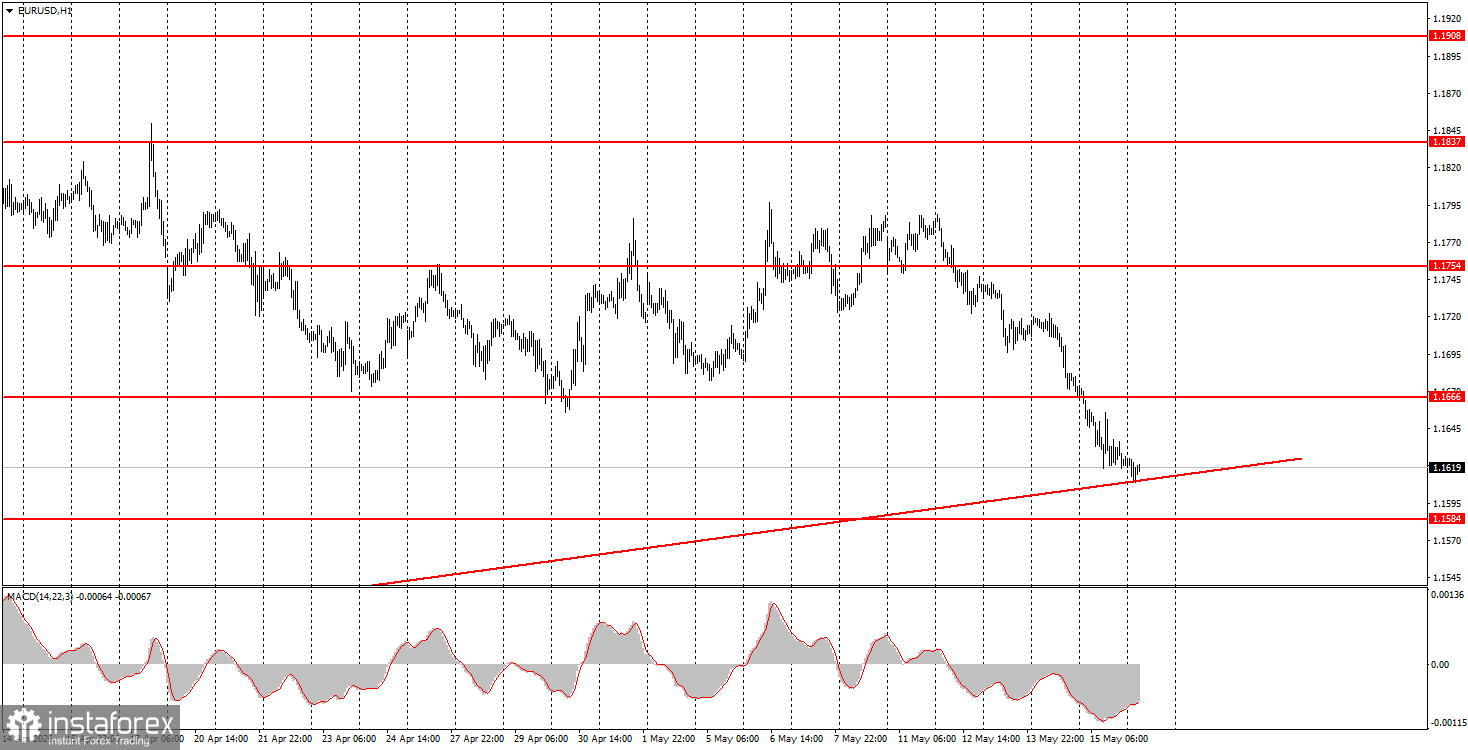
The EUR/USD currency pair continued its downward movement on Friday, marking the fourth consecutive day of decline. Last week, the euro moved in only one direction—downward. In our fundamental articles, we analyzed all the events that could have provoked such a movement and concluded that the main culprit remains geopolitics. The market had been selling the dollar for about a month amid optimism over an agreement between Iran and the US, but after a month, it has come to realize that no deals are in sight and that Tehran and Washington seem to be drifting further apart. Thus, optimism has evaporated, and the market has once again turned its interest to safe-haven assets and currencies, anticipating a resumption of war in the Middle East. That is how we see the situation. Of course, it should not be denied that the probability of at least one tightening of the Federal Reserve's monetary policy is also increasing, providing additional support for the US dollar. Technically, there is still an upward trend with a trend line, but if the market does not receive a new "ray of hope" soon, we could see a stronger decline in the pair.
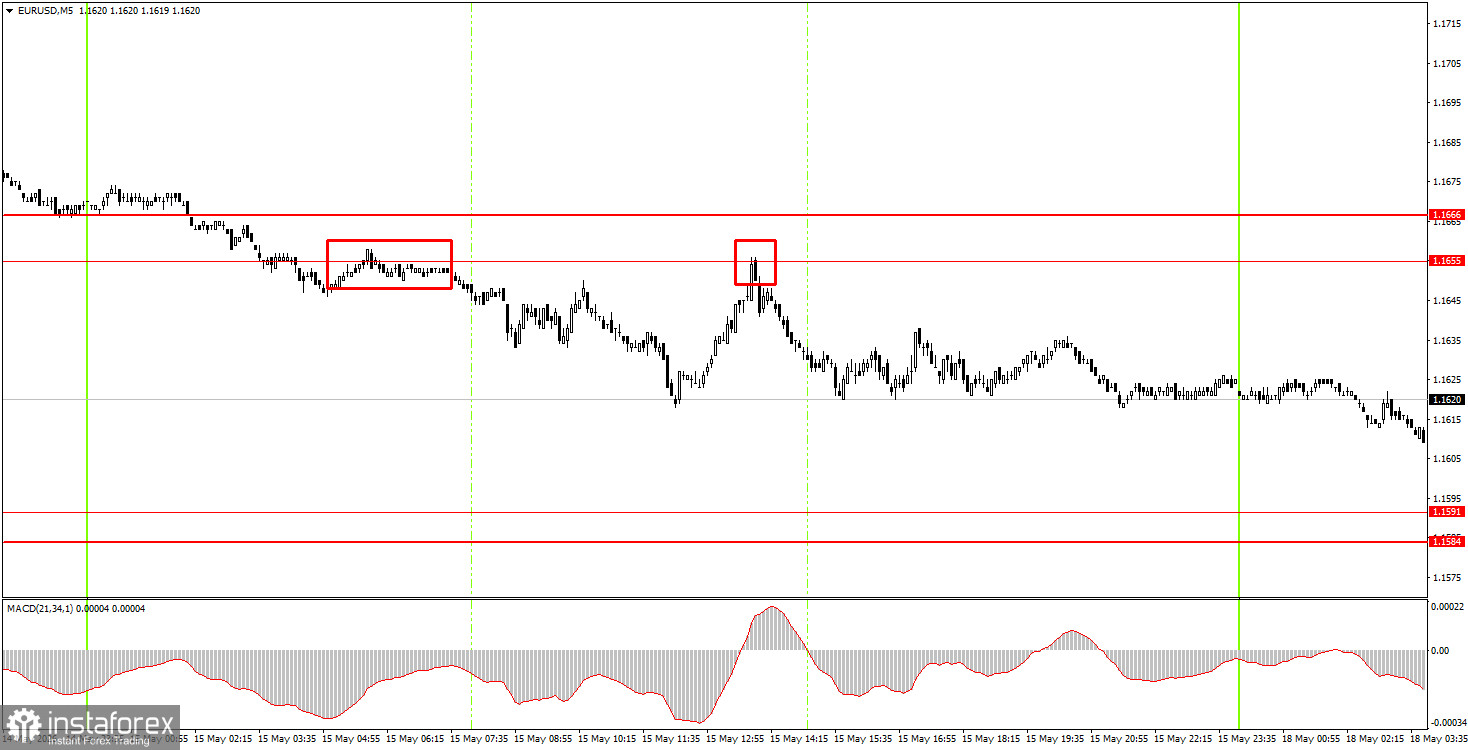
On the 5-minute timeframe, two very decent trading signals were formed on Friday. At the opening of the European trading session, the pair broke through the area of 1.1655-1.1666 and reversed from this area just before the start of the American session. Thus, novice traders could have opened two sell trades, one of which yielded approximately 20 pips in profit.
On the hourly timeframe, the upward trend is still intact, but the euro has been correcting for several weeks now. The US currency has resumed its rise, as the conflict in the Middle East is on the verge of escalation; however, we do not expect significant long-term growth for the US dollar. The market continues to largely ignore fundamentals and macroeconomics.
On Monday, novice traders may open short positions targeting 1.1584-1.1591 if the price bounces again from the 1.1655-1.1666 area. Long positions may be considered upon a price bounce from the area of 1.1584-1.1591 with a target of 1.1655-1.1666.
On the 5-minute timeframe, the following levels should be considered: 1.1354-1.1363, 1.1413, 1.1455-1.1474, 1.1527-1.1531, 1.1584-1.1591, 1.1655-1.1666, 1.1745-1.1754, 1.1830-1.1837, 1.1899-1.1908. On Monday, the event calendars for both the Eurozone and the US are completely empty, and no geopolitical news has emerged over the weekend. As a result, we are likely to face a "boring Monday."
Price levels (areas) of support and resistance – levels that are targets when opening purchases or sales, or sources of signals.
Red lines – channels or trend lines that display the current trend and indicate which direction is preferable to trade now.
MACD indicator (14, 22, 3) – histogram and signal line – a supporting indicator that can also be used as a source of signals.
Important speeches and reports (contained in the news calendar) can significantly influence the movement of the currency pair. Therefore, during their release, trading should be done as cautiously as possible, or one should exit the market to avoid a sharp price reversal against the preceding movement.
Beginners trading in the Forex market should remember that not every trade can be profitable. Developing a clear strategy and effective money management are key to long-term trading success.
Dzięki analizom InstaForex zawsze będziesz na bieżące z trendami rynkowymi! Zarejestruj się w InstaForex i uzyskaj dostęp do jeszcze większej liczby bezpłatnych usług dla zyskownego handlu.


